CARACAS, Venezuela — Oswaldo Pinto is accustomed to disappointments during shopping excursions to buy food for his family. But he was especially demoralized the other day after scouring for bargains at the sprawling Coche Market, which serves a mostly working-class clientele on the southern fringes of this chaotic capital.
“This month I could only buy half of what I needed,” said Pinto, 41, a taxi driver and father of two, including a new baby at home. “Everything has just become too expensive. The prices are rising very quickly. Only meat is a bit cheaper now — but I can’t afford that either.”
His meager purchases in hand, Pinto left the market. Across the street from the exit, a mural blares a message of defiance:
A military boot with a red star stomps the head of a cartoonish Donald Trump, who bears a Hitler mustache and whose golden crown lies on the ground. “No more Kings,” is emblazoned in English, next to an oil barrel with a Spanish-language demand: “No More War for Petroleum.”
The scene captures some of the contradictions in Caracas almost one month after Trump dispatched troops to snatch President Nicolás Maduro and his wife, Cilia Flores, and fly them to New York to face drug-trafficking and weapons charges — which the couple denounce as a frame-up.
In Caracas, most people seem too preoccupied with daily survival to pay attention to the political posters or the latest pronouncements of the ruling United Socialist Party, which now, in an improbable turnaround, appears to be bowing to the U.S. president’s demands.
Widespread hopes for a sweeping revival after Maduro’s ouster have crashed in the face of a sobering reality: Deposing a strongman can be a lot easier than transforming a nation.
Most of Venezuela’s 28 million people face the same challenges and sense of apprehension that they have endured for a dozen or so years. Cratering oil prices, a bungling government and punishing U.S. sanctions combined to collapse the economy of what was once Latin America’s richest nation, leading to hyperinflation, shortages of food and medicines and mass emigration.
Despite Trump’s vows of a new prosperity, many say things have gotten worse since Maduro’s removal. Uncertainty abounds, fueling inflation that, according to the International Monetary Fund, may soar to almost 700% this year.
“We really don’t quite know where all this is going to lead us,” said Nelida Castellanos, 40, a mother of two who was shopping in a middle-class area of east Caracas. “There is a little less anxiety now,” she added, recalling the nerve-racking days after Maduro’s forced exit. “Prices have come down a bit. But everything is still very expensive.”
She and her husband recently completed a grocery run. The bill: About $180 for beef, pork, chicken, sugar, rice, vegetables, coffee and “a little of everything,” Castellanos said. “That hardly lasts 15 days.”
Despite more than a quarter-century of socialist rule, economists say, Venezuela remains a deeply unequal nation. A 1% elite resides in mansions, tools about in luxury vehicles and flies off to ritzy foreign vacations. But the country’s once-robust middle class has been decimated, barely managing on salaries equivalent to about $50 to $120 a month. Then there is the ubiquitous underclass.
As many as 8 in 10 are mired in poverty, according to various surveys, in a country that sits atop the world’s largest proven petroleum reserves.
Even if Trump achieves his stated goal of revitalizing the run-down oil industry — a project that will probably take years — Venezuelans desperate for immediate change will probably be disappointed, experts say.
“Things should get better, but it will take time,” said Luis Oliveros, economist at the Metropolitan University here. “The key is the opening of the oil sector.”
Because of Venezuelans’ eroded spending power, markets are less busy than even a few months ago, according to merchants and customers.
“The price of fish is less than meat, so people do come to buy here,” said María González, 57, who runs a fish stand inside the Coche Market, a labyrinthine expanse of both wholesale and retail outlets that covers the space of about 20 U.S. football fields.
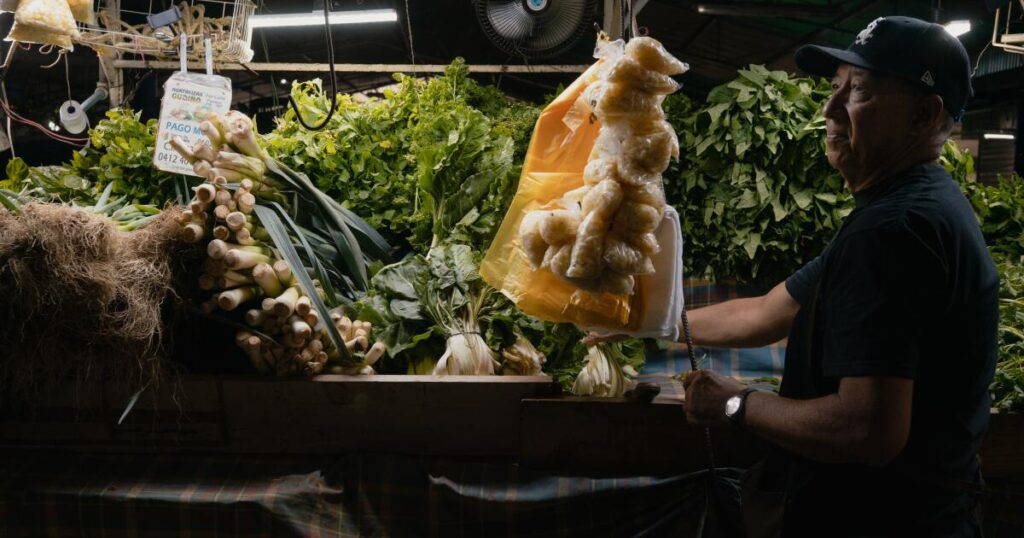
The abundance of food, at least for now, is a positive. Market stalls are brimming with produce. The problem: People don’t have the money to buy.
Fresh fish sells for $1 to $2.30 a pound, making it a popular alternative to beef, the cost of which soared to more than $11 a pound about the time of Maduro’s removal. Beef has since come down to about $6 a pound.
That’s still too pricey for most in a country where millions scrape by on sporadic income from street vending, domestic work, construction and other iterations of the informal economy. A mix of government pensions, food handouts and subsidized housing provides an ever-more tattered safety net. Remittances from loved ones abroad, part of the vast Venezuelan diaspora, have become lifelines for many families.
“One adapts,” said González, the fishmonger, as she cracked ice over the catch. “One lives day to day.”
One measure of resiliency is residents’ ability to adapt to ever-evolving methods of payment. Venezuela ceased being a largely cash-based economyduring the era of hyperinflation, in 2018-19, when people would lug around bags of bolívares — the national currency, named after Simón Bolívar, the 19th century independence leader known as El Libertador.
These days, most purchases are made through bank cards or via telephone apps linked to personal accounts. While the bolívar remains the official currency, the dollar serves as an alternative and benchmark, with both an official exchange rate and a “parallel,” free-market value. Even street vendors hawking sweets and trinkets follow the dollar’s rise and fall.
Early Thursday, the Central Bank of Venezuela exchange rate was 364 bolívares for $1. The parallel rate was 527 bolívares for a buck, about 45% more.
Alas, greenbacks are hardly available to people such as Tamara Mendoza, 65, who lives in the working-class Valle district. She spends weekends as a saleswoman in the Coche Market, offering her services at various food stands. On a good weekend, she said, she might earn the equivalent of $50, paid in bolívares.
During the week, she cares for her disabled nephew, Franco, 40. He contracted meningitis as a youth and still suffers from convulsions.
“Really, everything has been difficult for us,” Mendoza said. “But we keep on trying to survive.”
Not far away was the vegetable stand of Jorge Gudiño, 64. He has four children — two sons in Venezuela and two daughters who emigrated to Chile. His scattered family, like so many others, reflects the extraordinary exodus of almost 8 million Venezuelans — regarded as the largest-ever displacement of people in the Americas.
Like others interviewed, Gudiño declined to offer any political views, especially “after what happened” — the common euphemism for the U.S. attack.
He is worried about slumping sales, but remains hopeful of a bounce-back. Venezuelans are accustomed to wild fluctuations in just about everything — the cost of food, the value of the bolívar, the availability of gasoline and electricity, internet access and more.
“People do seem to have changed their habits,” said Gudiño, who was stacking onions, tomatoes, greens and other produce atop his stand. “It used to be that this market was packed at 6 a.m. Now clients come later, and they buy less. Prices keep going up and salaries remain the same.”
Change had better come soon, warned Maritza Colombo, a lawyer and mother of two, “because what is happening now is pure mockery.”
“I get it that everyone was nervous after what happened to Maduro,” added Colombo, 35, who was shopping Wednesday at supermarkets in east Caracas. “But, even now, it’s really impossible to purchase what one needs. “
She had drawn up a shopping list and had expected to spend about $250. She spent almost $400. “And I didn’t buy either meat or chicken.”
Special correspondent Mogollón reported from Caracas and Times staff writer McDonnell from Mexico City.
The post Trump’s promise of prosperity clashes with harsh reality in Caracas appeared first on Los Angeles Times.