Molly Phipps, a consultant in St. Paul, never considered herself much of a crier.
That was before Operation Metro Surge in the Twin Cities: before roving federal agents arrested thousands suspected of illegal immigration and killed two U.S. citizens, before the protests, the fear of going out in public, the Signal chats, the cellphone videos and the fweeeeet of the whistles.
“All of a sudden, a thought will come to my head or I’ll see a headline, and I’ll tear up,” said Ms. Phipps, the mother of two children. “Sometimes it’s just because regular people are doing amazing things. Or sometimes it’s because it’s so sad to walk into these once-thriving businesses and see them empty.”
Two months into the crackdown that the Trump administration has called the largest immigration enforcement effort in the agency’s history, residents of the Twin Cities say the constant strain of the operation has become overwhelming, compounded by a lingering uncertainty over when it will end.
This week has brought some hope to Minnesotans who oppose the operation. Those monitoring the news closely have seen small signals that the administration could be wavering in the face of intense public backlash. On Monday, officials said that Gregory Bovino, the Border Patrol leader who has directed aggressive operations in Los Angeles, Chicago and Minneapolis, was leaving Minnesota, along with some Border Patrol agents.
On Wednesday, a Department of Homeland Security official said that two of the agents involved in the shooting of Alex Pretti, a 37-year-old nurse who was killed after filming federal agents on Saturday, were on leave. Stephen Miller, a top aide to Mr. Trump who initially called Mr. Pretti an “assassin,” suggested on Wednesday that the agents who killed Mr. Pretti after he had been restrained and disarmed “may not have been following” protocol.
Still, with no firm signs of an end to the operation, anxiety in the Twin Cities is unceasing.
Many Latinos and Asian Americans, even those with legal immigration status, are afraid to step outside, keeping their children at home to attend school remotely on video calls. As they have for weeks, volunteers stand guard outside day cares and Mexican supermarkets, ready to alert everyone around if Immigration and Customs Enforcement agents are spotted. Bleary-eyed friends swap stories of their vivid nightmares about running, frightened, being chased by ICE agents.
Eduardo A. Colon, 72, a retired psychiatrist and a U.S. citizen, has lived in Minneapolis since 1979, when he moved from Puerto Rico to attend college. His family has been terrified for him to leave the house since the surge of agents started.
He said he feels drained by the hypervigilance of wondering what is going to happen next, and a feeling of rage over the entire crackdown.
“I have immediate fear in terms of safety, and violence we’re surrounded by,” he said, “and being disappointed with the legal pathways and options to try to make it all slow down and stop.”
Groups of residents that formed during the federal surge as “rapid response” networks, crowdsourcing where agents have been spotted, are as active as ever. Sarah Linnes-Robinson, the acting director of the Lyndale Neighborhood Association in Minneapolis, is a member of 14 separate Signal chats for rapid response groups, monitoring sightings of ICE agents making arrests and requests for help among neighbors.
There has been an outpouring of generosity from neighbors, but she worries that eventually the mutual aid will run dry. How much longer, she wonders, will people be willing to deliver groceries, donate money and volunteer their time to push back against a crackdown that they see as unjust?
“I feel honestly like I’m living in a video game,” Ms. Linnes-Robinson said. “I keep wondering what ICE agents are talking about when they go home at night. Are they talking about how they’ll level up and change the game, and what tactics they’re going to use?”
Even in the heavily Democratic cities of Minneapolis and St. Paul, some conservatives have blamed protesters and activists for raising tensions in the area by pushing back on ICE tactics and trying to stand in the way of federal agents.
But a sense of widespread disapproval of ICE’s tactics has reached across race, class and politics in the Twin Cities. At a walkout at the University of Minnesota this week, one nursing student, Mahmoud Toumeh, 33, described his political views as centrist. He said he had not voted in the last presidential election because he could not decide between Mr. Trump and Kamala Harris, the Democrat.
Mr. Toumeh, who said it had taken 13 years for him to go through the process of becoming a naturalized citizen, said he believed that people who are in the United States illegally and have committed crimes should be deported. But he said he opposed the sweeping tactics of this federal crackdown. Department of Homeland Security officials have described their efforts as targeted and lawful, but Mr. Toumeh said he was disturbed by reports that agents were now questioning people simply because they had accents that sounded foreign.
And he said he has heard from his high school friends from North Dakota, including many who now live in the Twin Cities, who have conservative views on immigration but are still opposed to the tactics of the crackdown.
“This is not really a political issue,” he said. “This is a humanitarian issue. And human decency, at its core.”
Sean vanNatta, a 55-year-old in West St. Paul who described himself as politically moderate, said he had been troubled by the methods the Trump administration was using. One of the players on his pickup soccer game on Saturday mornings has stopped coming, afraid of ICE even though he has legal status.
“I hope that they can stop what they’re doing and go about it in a more peaceful and legal manner,” he said of the administration’s approach.
And for Twin Cities residents who have lived through other traumas, including the murder of George Floyd in 2020 and the riots and protests that followed, the impact of the ICE operation has seemed to reach even broader.
“It’s affecting everyone — Black, white, Native, Hispanic — it doesn’t matter,” said Jonquil Broyles, 33, a home health care worker in Roseville, Minn. “In reality, it’s the whole state that’s being affected. It is very heavy.”
Many people in the Twin Cities spoke of a sense of isolation, a feeling that people elsewhere don’t understand the severity of the crisis.
Recently, Sue Morrison, 69, of St. Paul, was chatting on the phone with a friend from California, who asked how she was doing.
“I hope the craziness of Minneapolis isn’t bothering you,” Ms. Morrison recalled her friend as saying.
The question almost shocked her. “And I said, ‘Yes, it’s bothering me,’” she said. “I live here. How can it not bother me?’ If you think it’s somehow isolated to some tiny little pocket, you are badly mistaken, because it’s everywhere.”
By Thursday, Senate Democrats in Washington who had pushed back against the crackdown had struck a deal with President Trump and Republicans that would allow them to negotiate restrictions on the operation. And more Republicans were chiming in with criticism of the Department of Homeland Security and, in particular, Kristi Noem, who heads the department.
That backlash brought some hope to Sun Yung Shin, 51, a writer and teacher in Minneapolis. Her daily life is still fraught, she said, and she carries her passport and copies of immigration papers, just to be safe.
But she has been encouraged by the fact that a few Republicans have rebuked the administration over the operation and the deaths of Ms. Good and Mr. Pretti.
“If there’s a tipping point, we might be at it,” she said. “I’m hopeful there will be investigations.”
Around the Twin Cities, many people said they were seesawing between feeling angry and heartened, furious at the violence in their midst while moved by their neighbors’ response to it.
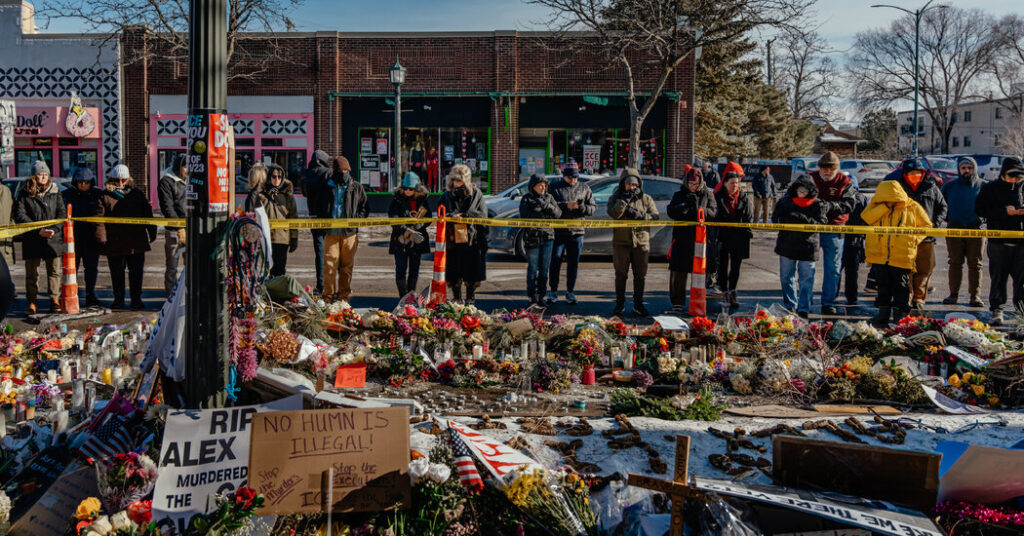
Eric Swanlund, a nurse anesthetist who lives in the suburb of Edina, had worked with Alex Pretti at the Veterans Affairs hospital.
Since Mr. Pretti was shot and killed on Saturday, Mr. Swanlund has been sick with anger, nauseated and grinding his teeth.
On Sunday evening, he and his neighbors held a small vigil at a park, where he felt a sense of solidarity. “A lot of people gave me hugs that have never given me hugs before,” he said. The next day, dozens more in Edina gathered for a weekly protest of ICE.
He held a sign taped to the end of a hockey stick. “Respect Existence or Expect Resistance,” it read.
Mr. Swanlund has imagined what it would be like if ICE were to end its operation in the Twin Cities, but there is little satisfaction to the thought.
“I would love for them to leave, but I feel like a lot of the damage is done,” he said. “And I don’t think the people of Minnesota are going to forget what they’ve done.”
Julie Bosman is the Chicago bureau chief for The Times, writing and reporting stories from around the Midwest.
The post Grief, Whistles and Bad Dreams: Minnesotans Describe 2 Months in an Immigration Crackdown appeared first on New York Times.