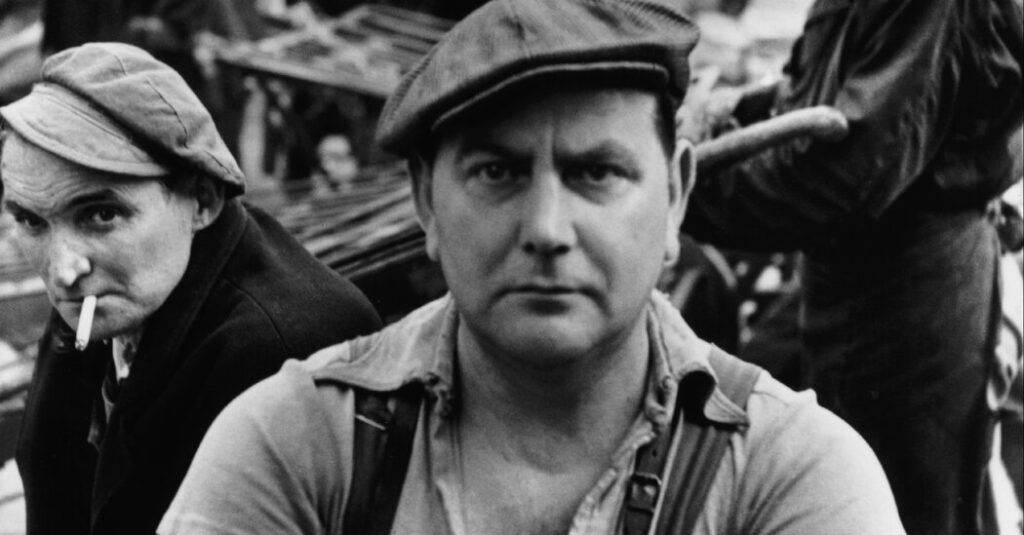
In September 1955, the French art publisher Verve brought out a large-format book with a joyously abstract red, blue and yellow cover by the Catalan artist Joan Miró. It contained 114 photographs taken across the European continent, from the craggy west coast of Ireland and the lakes of Switzerland to the steppes of Russia and Ukraine. The pictures were by Henri Cartier-Bresson. Its title was “The Europeans.”
A few respectful reviews aside, and despite a parallel American edition, the book didn’t have much immediate impact — far less than the work Cartier-Bresson had published three years earlier, “The Decisive Moment,” which made him the most famous photographer of his time and is still revered by art historians and photojournalists.
Now, over 70 years after it first appeared, “The Europeans” is being ushered out of the shadows, courtesy of the Paris foundation that the photographer set up with Martine Franck, his second wife. Escape the crowds of the city’s Marais district and head down to the basement gallery of the foundation, and there are the book’s vintage prints and contact sheets, alongside copies of an elegant new edition.
“‘The Europeans’ is just so important,” said the foundation’s director, Clément Chéroux, who curated the exhibition and put the new publication together. “Not just because of the pictures, which are of course super strong, but because of what the project represents.”
Cartier-Bresson spent the early 1950s in a whirlwind of travel, much of it on assignment from publications like Paris Match, Harper’s Bazaar, and Life and Holiday magazines.
In 1951, he went to rural Italy, then back to his native France, and then to Britain. The following year, he was in London to shoot blank-faced mourners crowded in Trafalgar Square for King George VI’s funeral, before heading to Dublin and rural Ireland. In 1953, he zipped across Greece, Austria and Germany — catching boozy, bleary partygoers at New Year’s celebrations in Hamburg as well as the stark streets of Cologne, where buildings shattered in World War II still loomed eerily over glossy new clothing outlets.
“He was living the life of a photo reporter,” Chéroux said. “There is barely a month without travel abroad.”
Europe was changing shape around him. NATO had come into being in 1949, the same year that the Council of Europe was founded. In 1950 — the year Cartier-Bresson began work on “The Europeans” — France’s foreign minister, Robert Schuman, announced a road map for what would eventually become the European Union. By the time Cartier-Bresson’s book hit the printers five years later, Germany was formally two separate nations, the Soviet Union had cemented the Warsaw Pact, and the chill of the Cold War had set in.
Whether or not he originally intended these trips to add up to a portrait of the continent, Cartier-Bresson was encouraged to produce one by his publisher, Stratis Eleftheriadis, who went by the name Tériade. In an interview for a Greek television documentary in 1990, Cartier-Bresson recalled presenting a suitcase “stuffed with photos” that he reviewed with Tériade. “We made the choice together, talked and talked, and even squabbled,” Cartier-Bresson said.
Though some of the images, especially those from France and Spain, look timeless, “The Europeans” also depicts Europe during a period of convulsive change. Punning on the title of their previous collaboration, one title that Tériade and Cartier-Bresson considered was “images of the old world in the decisive moment,” according to a letter in the foundation’s archive.
The very first photograph in the book, taken on the outskirts of Athens, wittily counterpoises Ancient Greek ruins with belching smokestacks. (Both are monuments of their time, the photographer hints.) Later in the sequence, pausing on a highway between Genoa, Italy, and Monte Carlo, Cartier-Bresson and his camera sneaked up to a gang of laborers and shot the complex latticework of scaffolding beneath a new bridge. As well as showing Italy’s frenetic postwar reconstruction, as that old world surrenders to the new order, the picture is a dynamic abstract study of rhythm and energy.
If you ignore the captions (printed at the end of the book, though prominently displayed on the gallery walls), it’s sometimes hard to tell which country you’re looking at. In itself, this is remarkable: A few years earlier, millions of people on the continent had been at war with one another. Now, Cartier-Bresson, who had served in the French army and spent nearly three years in a German prisoner-of-war camp, dared to suggest that what connected Europeans was greater than what divided them.
Chéroux suggested that there was a “tension” here — Cartier-Bresson was simultaneously trying to capture the specificity of each country he visited, “but at the same time show that there’s a kind of unity,” he said.
For the critic and curator David Campany, the creative director of the International Center of Photography in New York, “The Europeans” shows something “hanging in the balance,” both pictorially and politically.
“It’s difficult to know what the tone of the book is,” Campany said in a phone interview. “There’s a kind of open-endedness to it. You could put ‘The Europeans’ in front of 10 people and they’d all come away with a different response.”
Seven decades on, as Europe faces up to new geopolitical uncertainties, and when the postwar consensus looks shakier than ever, the pictures make for salutary viewing, Chéroux said. “They remind us that it was a dream to build a community of countries that had been at war for so many decades,” he said. “And we should be careful not to destroy this amazing entity we have created.”
The Europeans Through May 3 at the Fondation Henri Cartier-Bresson in Paris; henricartierbresson.org.
The post Cartier-Bresson’s Portrait of a Changing Europe, 70 Years On appeared first on New York Times.