Miles Yu is director of the China Center at Hudson Institute.
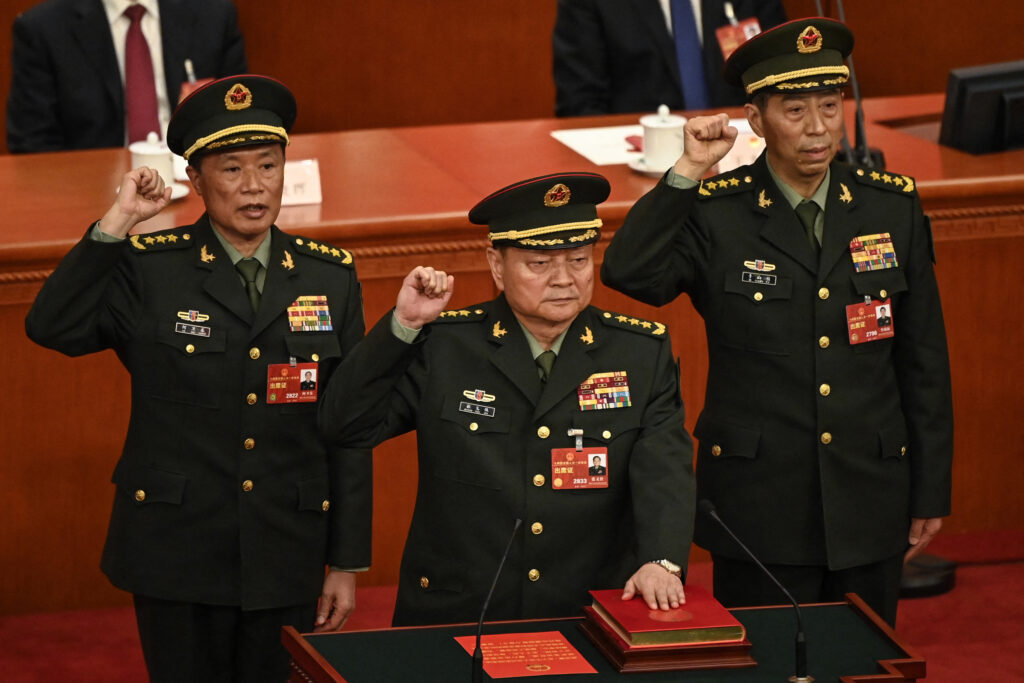
The dramatic purge of China’s highest-ranking uniformed officer, Gen. Zhang Youxia, last weekend is the latest evidence that communist dictatorships require absolute loyalty from their senior military leaders. And because absolute loyalty can never be absolutely verified, pursuing it inevitably breeds paranoia.
This is not an accident or a pathology unique to individual leaders. It is the structural logic of communist rule itself. From Joseph Stalin to Mao Zedong, from Kim Jong Un to Xi Jinping, concentrated power demands total obedience — and demanding total obedience produces endless purges.
At the core of every communist regime sits a single supreme leader who monopolizes authority over the party, the state, the military and the security apparatus. Such concentration of power leaves no room for genuine collective leadership. Yet the leader must still rely on human agents who wield enormous operational authority. This dependency creates a fatal contradiction: Those closest to power are simultaneously the most indispensable and the most dangerous.
The result is predictable. The supreme leader becomes obsessed with hidden dissent, double loyalty, and especially foreign collusion. Xenophobic paranoia becomes the most lethal weapon of regime survival. Accusations of conspiring with hostile external forces provide a perfect justification for eliminating rivals while preserving the moral mythology of the system. The leader is never wrong; traitors are simply everywhere.
Stalin perfected this logic. In 1937, Marshal Mikhail Tukhachevsky, the Red Army’s most brilliant commander, was accused of colluding with Nazi Germany to overthrow Stalin. The charge was fabricated, but that was beside the point. Tukhachevsky’s modernizing vision, prestige within the military and proximity to power made him intolerable. He was executed, along with much of the Red Army’s senior leadership.
During the Great Purge, Stalin fixated on “Trotskyites” — figures with international connections who could plausibly be portrayed as agents of foreign subversion. Of the Soviet Union’s five marshals, three were killed. Only Kliment Voroshilov and Semyon Budyonny survived, largely because they were militarily incompetent and politically harmless.
The People’s Republic of China has followed a similar script. Since 1949, military purges have come in waves, each reflecting the same underlying fear: The officers commanding the guns might one day turn them inward.
Under Mao, marshals were purged not for incompetence, but for insufficient ideological submission. Peng Dehuai was forced out in 1959 after criticizing the catastrophic Great Leap Forward, accused of colluding with the Soviet Union to undermine Mao. Lin Biao, Mao’s anointed successor, was later accused of plotting a coup with Soviet backing; his death in a mysterious plane crash in 1971 ended the last illusion of security at the top.
Mao’s paranoia was not irrational within his system. The 1964 “Malinovsky Incident” left a deep scar. After Soviet Defense Minister Rodion Malinovsky suggested to Marshal He Long in Moscow that China should remove Mao as the U.S.S.R. had removed Nikita Khrushchev, Mao became convinced that foreign-backed coups were not theoretical threats but living possibilities. He Long, who was also vice chairman of the Central Military Commission, was later purged and persecuted to death.
Even Mao’s closest collaborator, Liu Shaoqi — the regime’s chief enforcer and nominal head of state — was not spared. Mao labeled him a “renegade, traitor and scab” and Liu died after brutal torture. Absolute loyalty offered no immunity. Instead, proximity only increased danger.
The post-Mao era did not escape this logic. Zhao Ziyang, though not a military man, learned the same lesson. His fatal sin was telling Mikhail Gorbachev the truth — that China was ruled not by collective leadership but by “retired” Deng Xiaoping. Combined with Zhao’s reluctance to authorize mass killing during the Tiananmen Square protests, this honesty sealed his political demise.
Under Xi, purges have intensified. Since he took power in 2012, more than 110 senior People’s Liberation Army officers have been removed in what is the most extensive military cleansing since the Cultural Revolution. Initially framed as anti-corruption, the campaign has increasingly targeted the highest command, especially at the Central Military Commission.
The CMC vice chairmanship is arguably the most dangerous job in China. The vice chairs sit closest to the supreme leader and wield enormous control over the world’s largest armed force. Since 1949, nine vice chairmen have been purged — most accused, explicitly or implicitly, of colluding with hostile foreign forces.
Under Xi alone, Guo Boxiong and Xu Caihou were the first military leaders removed. Then , in 2023, an unprecedented purge began: Rocket Force commanders, procurement chiefs, theater commanders and finally Xi’s own loyalists. In 2025, He Weidong and Adm. Miao Hua were expelled.
Now, the purge of Zhang Youxia — Xi’s longtime ally and fellow princeling — is especially revealing. Having exhausted corruption charges and loyalist purges, Xi now appears poised to invoke the oldest communist accusation of all: treason through foreign collusion. Reports suggest Zhang may be accused of leaking nuclear secrets to the United States. How convenient! The purpose is clear. Xi must convince the system that this purge is not personal, not political, but righteous — an act of national salvation against an external enemy.
This is the paranoia-fueled logic of communist purges. The higher one rises, the more likely one is to be cast as a traitor. In such systems, survival depends not on competence, integrity or service — but on remaining invisible to the supreme leader’s fear.
The post China’s latest military purge is part of a long communist tradition appeared first on Washington Post.