Governors from six of the seven states that rely on the dwindling Colorado River are expected in Washington on Friday to try to break a two-year impasse over how to share its water.
They are scheduled to meet with Interior Secretary Doug Burgum two weeks ahead of a deadline that was set by the Bureau of Reclamation for the states to reach a compromise.
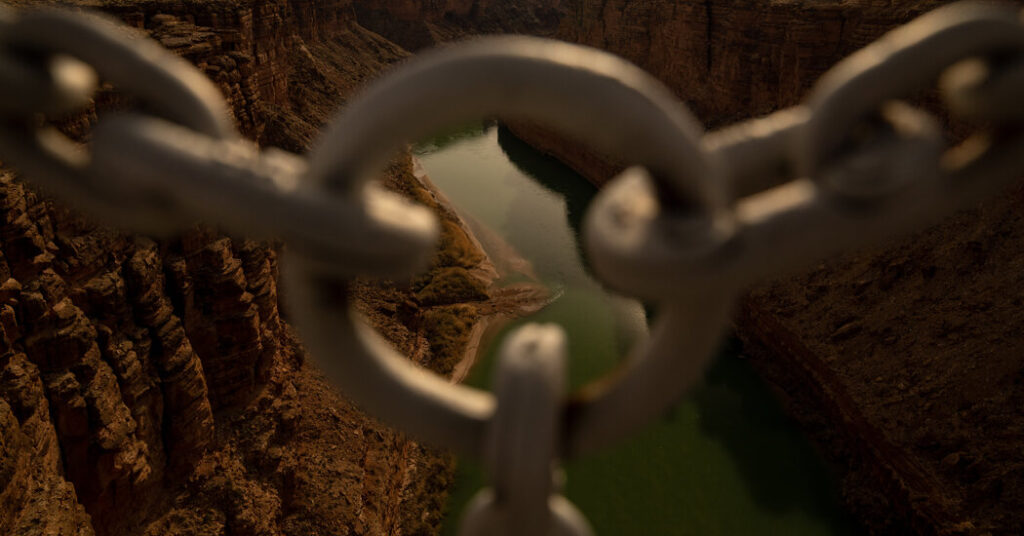
The states have struggled to agree upon rules for use of a rapidly shrinking water supply, as rising heat and changing precipitation patterns have drastically reduced the Colorado’s flow over the past two decades.
The unusual gathering of governors suggests both the extent to which the negotiations have become deadlocked, and their rising stakes. Drought this winter has increased the likelihood that reservoir levels may be critically low later this year. At the same time, some states are preparing for the likelihood that they may have to resolve the dispute over water supplies in court instead of at the negotiating table.
“What they’ve tried to date hasn’t worked,” said Michael Cohen, a senior fellow at the Pacific Institute, a water-focused research organization. “Getting some different people at the table really can only be an improvement at this point.”
Two governors from among the three states that draw the most water from the Colorado River — California, Colorado and Arizona — confirmed they would attend the meeting: Gov. Katie Hobbs, Democrat of Arizona, who pushed for the meeting, and Gov. Jared Polis, Democrat of Colorado.
Arizona has already voluntarily taken steep cuts in water use and faces more under a recently released plan that federal officials could enact if the states fail to reach a deal. Colorado, meanwhile, faces significant water shortages this year because its winter snowpack is on track to be among the smallest on record.
Gov. Gavin Newsom, Democrat of California, will not attend because of “a longstanding family commitment,” according to Anthony Martinez, a spokesman for Mr. Newsom.
The states have been working for the past two years on a plan to replace a river-sharing compact settled more than a century ago, and last updated in 2007. Under the 1922 agreement, Colorado River water is divided equally between the upper basin states — Colorado, Utah, Wyoming and New Mexico — and the lower basin, consisting of California, Arizona and Nevada. A smaller share is owed to Mexico, where the river historically flowed into the Gulf of California.
But in the nearly two decades since the most recent compact update, the river’s fortunes have turned increasingly dire as the climate changes and a megadrought persists. Now, much of the water each state is owed exists only on paper. They have been working to agree on who must make drastic water use cuts to safeguard a supply that is expected to continue to shrink.
Nearly two-thirds of the river basin was in drought as of Tuesday, with “severe” to “extreme” drought across Colorado mountains relied upon for spring and summer snowmelt, according to U.S. Drought Monitor data.
Negotiations have been frequent and intense in the months since the states missed a November deadline to come to an agreement. A plan must be in place by the end of September to guide water use in 2027 and beyond.
The lower basin states have offered new water cuts, but have pushed for upper basin states to commit to similar permanent reductions, said Tom Buschatzke, Arizona’s lead negotiator in the discussions. The lower basin’s water is stored in Lakes Powell and Mead, the nation’s largest reservoirs.
Mr. Buschatzke even suggested a willingness to explore temporarily waiving a central tenet of the 1922 compact — that an annual average of 7.5 million acre feet of water flow through Glen Canyon Dam, which impounds Lake Powell and separates the upper and lower basins — in exchange for water concessions from the upper basin.
In the upper basin, states have resisted permanent water cuts because they rely largely on snowpack for water. In a year like this one, with Colorado snowfall at a record low for this time of year, water users have no choice but to use less, said Becky Mitchell, Colorado’s negotiator.
“I know it’s going to be painful,” Ms. Mitchell said.
Ms. Mitchell said the lower basin states had suggested a program that would pay water users for voluntary and verifiable actions to conserve water during times of shortage.
The impasse is leading to talk of legal action — something the basin states and federal officials have been seeking to avoid because it would be complex and protracted.
In an address to the Arizona Legislature earlier this month, Governor Hobbs highlighted a litigation fund created last year to fight for Colorado River water as she proposed a new fee on data centers’ water use to raise money for water conservation efforts. In an interview, she said the goal was to reach consensus among the states.
“If we can’t get there, we will be pushed to go to court to defend ourselves, to get the water we are owed,” the governor said.
Members of the Central Arizona Water Conservation District’s board said Monday that a federal plan for the river should the states fail to reach agreement “would result in a crushing blow” to their water supply and “would likely force Arizona to seek legal options.”
In Colorado, Attorney General Philip Weiser told lawmakers this week that, without a deal, his office was prepared for litigation. “We will stand by our rights,” he said, according to The Vail Daily.
Governors rarely wade into the details of the river negotiations, Mr. Cohen said. But he said it was possible that bringing them into the discussions could bring about a breakthrough by transcending the granular details of water policy.
“I’m hopeful — and maybe it’s wildly delusional — that these new voices are going to be thinking bigger picture,” Mr. Cohen said.
Scott Dance is a Times reporter who covers how climate change and extreme weather are transforming society.
The post Governors Dive Into an Impasse Over Colorado River Water Use appeared first on New York Times.