The ICE officers descended on Compton, targeting immigrants convicted of theft, child abuse and selling drugs.
There were no protesters. No whistles alerting targets to the officers’ presence. No face masks. In some cases, residents opened their doors to let the officers inside their homes. One man thanked them for not arresting him in front of his children.
The Los Angeles area operation ended with 162 arrests, including a Mexican national convicted of rape and a Salvadoran national convicted of voluntary manslaughter. Immigration and Customs Enforcement said almost 90% of the people arrested had criminal convictions.
It was June 2018, more than a year into Donald Trump’s first term as president. Seven years later, carrying out the same operation in L.A. or other U.S. cities feels almost impossible without drawing angry crowds and requiring multiple officers, at times across federal agencies, to detain a single target.
In the years since Trump’s first term, ICE and the government’s immigration enforcement apparatus expanded raids well beyond those against known criminals or suspected ones. Increasingly, immigrants with no criminal records and even legal residents and U.S. citizens found themselves stopped and sometimes arrested.
The uncertainty over who is being targeted has fueled a growing pattern of community protests and rapid response mobilizations, even when officials say they are targeting convicted felons, reflecting a widening gap between how enforcement is described and how it is experienced. That gap has become most visible on the ground.
In recent months, sightings of ICE or other federal agents have drawn crowds of protesters, legal observers and community organizers. In many cases, residents say they can’t distinguish between targeted enforcement actions — against child molesters, human smugglers and other serious criminals — and broader sweeps, responding instead to the mere presence of agents whose role and authority are no longer clearly understood.
Experts say the Trump administration’s hostile rhetoric against immigrants and often seemingly indiscriminate targeting of people in neighborhoods has hurt the reputation of its immigration enforcement agencies, including ICE and Border Patrol, like never before. And it has inspired a mass movement of resistance that has seen Americans shot by federal immigration officers. In the last month, two U.S. Citizens — Renee Nicole Goodand Alex Jeffrey Pretti — were shot dead by Border Patrol and ICE in Minneapolis.
The fatal shootings forced Trump to recalibrate his immigration enforcement tactics, in part by sidelining Border Patrol Commander Gregory Bovino, who first launched the aggressive raids in California, and putting border policy advisor Tom Homan in charge.
“I’m not here because the federal government has carried out this mission perfectly,” Homan said during a recent news conference. “Nothing’s ever perfect, and anything can be improved on. And what we’ve been working on is making this operation safer, more efficient, by the book.”
He said street operations in Minnesota would “draw down” if the agents were given access to local jails and that agents would focus on specific targets.
“We will conduct targeted enforcement operations — targeted,” he added. “That has traditionally been the case and that’s what we’re going to continue to do and improve upon that with the priority on public safety threats.”
An internal memo reviewed by Reutersshowed ICE officers operating in the state were directed to avoid engaging with “agitators” and only target “aliens with a criminal history.”
Even if the Trump administration were to pull back ICE and Border Patrol’s aggressive tactics to focus more on known criminals, experts question whether too much damage has been done to their reputations.
“The brand of the agency is becoming so toxic,” said John Sandweg, who headed ICE under President Obama. “It’s going to impact the agency for years to come. It’s going to take a long time for that trust to rebuild.”
Another former ICE official, who asked not to be named out of fear of retaliation, said the agency used to be able to say it was focused on criminals and wasn’t conducting random sweeps.
“For years we always said ‘we don’t have the resources to go after everybody so we’re going to focus on just the worst of the worst,’” he said. “They can’t say that now. They’re still trying to do that, but it’s getting overshadowed by Home Depot and car washes and all this other stuff and Border Patrol’s heavy-handed tactics. Now it’s leading to shootings and all these other things. It’s just horrible.”
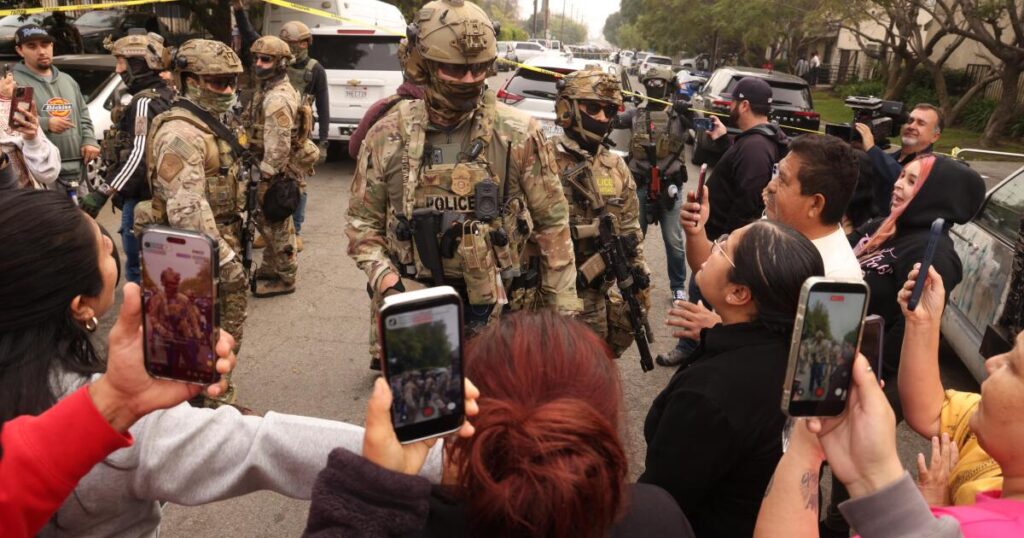
In Willowbrook, an unincorporated neighborhood nestled in South L.A., just blocks from Compton city limits, federal agents found themselves locked between angry crowds recording them last week. Two people held a sign that read: “ICE / Soldiers off our streets.”
The agents were there to arrest a man they say had been “involved in human trafficking” and had a final removal order. They alleged the man had two prior arrests for domestic violence. Homeland Security officials later said the man used his vehicle to ram federal agent vehicles in an attempt to evade arrest, prompting an agent to open fire.
But as news spread that the operation was targeting a suspected criminal living in the country illegally, most residents shrugged it off. They said federal officials had made false claims against other people they had arrested or shot at, including labeling Good and Pretti as domestic terrorists.
“They’ve shown us that they’re not trustworthy,” Rosa Enriquez, 39, said while holding a Mexican flag.
Similar scenes have played out across the country. This month, a journalist posted a video of agents — who she identified as working for ICE — calling out a driver for honking during an operation St. Paul, Minn.
“We’re here to arrest a child sex offender and you guys are out here honking,” the agent said. “That’s who you guys are protecting. Insane.”
“Just go. You’re lying!” a woman shouts.
Homeland Security has made it a point to tout the arrests of criminals across the country. The “worst of the worst arrests” in L.A. this month, according to the agency, included a man convicted of second-degree murder, another for voluntary manslaughter and one with multiple convictions for driving under the influence and disorderly conduct.
“We will not let rioters or agitators slow us down from removing murderers, rapists, pedophiles, gang members, and terrorists,” Homeland Security spokesperson Tricia McLaughlin said in a statement.
But experts say the general public has clearly witnessed a shift in who is being targeted.
In May, White House Deputy Chief of Staff Stephen Miller reportedly directed top ICE officials to go beyond target lists and have agents make arrests at Home Depot or 7-Eleven convenience stores as they sought to crank up their daily arrest numbers to 3,000.
The following month, Border Patrol agents led by Bovino were on the ground in L.A., tackling car wash workers, arresting street vendors and chasing down day laborers.
“The pressure of those numbers on enforcement agencies and mobilizing the whole of government and other law enforcement agencies, well beyond the traditional ICE and CBP, has created pressures that have led to extensive overreach,” said Doris Meissner, a senior fellow at the Migration Policy Institute, a nonpartisan think tank in D.C.
At the peak of arrests in L.A in June, around 75% of people had no criminal conviction. A Times analysis found that in the administration’s first nine months, from Jan. 1 to Oct. 15, of the more than 10,000 Los Angeles residents who were arrested in immigration operations, about 45% had a criminal conviction and an additional 14% had pending charges.
In November the Cato Institute, a libertarian think tank, reportedthat, nationwide, 5% of detainees from Oct. 1 to Nov. 15 had been convicted of violent crimes. Most detainees were found guilty of vice, immigration or traffic convictions.
“They’ve painted to the American people that they were going after the worst of the worst and that is nothing like what is happening,” said Assemblymember Mike Gipson (D-Carson), who represents the district where the recent shooting in L.A. unfolded. “We have seen all across America where they have harassed, they have murdered, assassinated, not only citizens but also people who have not had any arrest, who have not fit the bill or the description of what they have painted to the American people.
“When you turn on the news right now, the trust is absolutely gone. We don’t trust the White House, we don’t trust ICE, and the people are afraid because the trust is gone.”
Santa Maria Councilmember Gloria Soto echoed that sentiment, in part because she has seen raids in her Central Coast town.
“That’s part of the frustration,” Soto said. “There’s no transparency. There’s no information being shared before or after these enforcements have taken place.”
“We know for a fact that there are individuals who are getting picked up who did not have a criminal record, whose only quote-unquote crime was, you know, either having an expired visa, or crossing without the required immigration documentation that is needed, so it makes it really difficult for us, for me as an elected official, to trust what this agency is doing because so far there is no communication,” she said.
The challenges ICE officers are facing appear to center on cities that have been targeted with surge operations — like in Minneapolis, Sandweg said. Across the country, he said, officers are conducting operations “but not with the same amount of controversy.”
“In Minneapolis we’re at the point now when, if agents are going to go after someone with a very serious violent criminal history, they’re likely to pick up observers and a lot of attention,” he said. “The way in which they wanted to do these operations in such an overt, in your face kind of fashion, has created a dynamic that makes it really hard for the agents to execute their duties …You have these protests following the agents everywhere they go.”
While there has always been consternation over immigration enforcement, Sandweg said “the widespread tactics and the targeting of people with no criminal record, just really galvanized people in a way they’ve never been galvanized before.”
“To where now it probably is starting to bleed into and impeding operations that most of those protesters are probably not opposed to — the idea of ICE getting someone with a violent criminal history off the streets,” he said. “I think it’s created an environment where it puts the officers and the public in harm’s way.”
This week, protesters came out in force when word spread that ICE officers were eating at a restaurant in Lynwood. A video shows the crowd jeering at the officers as they’re being escorted out of the area by Los Angeles County sheriff’s deputies.
Almost immediately, Lynwood City Councilmember Luis Gerardo Cuellar posted a video on Instagram to inform the public.
“This was not ICE, these were … TSA air marshals.”
The post ICE finds targeting violent criminals increasingly fraught in backlash over indiscriminate sweeps appeared first on Los Angeles Times.