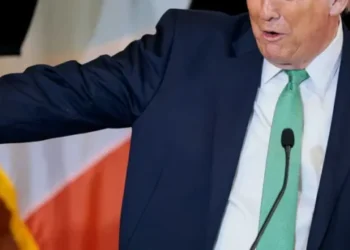
President Trump’s undisputed victory in 2024 did little to diminish his drive for revenge and redemption after his gnawing defeat in 2020, and no state has been a greater focus of this rearview mirror fixation than Georgia, which he lost by fewer than 12,000 votes.
On Wednesday, that obsession translated into action, when a team of F.B.I. agents, armed with a search warrant, descended on the Fulton County, Ga., elections hub outside Atlanta to seize ballots, voter rolls and scanner images — even though previous investigations have found no evidence to support his false claims of widespread fraud.
But if the search was rooted in the past, it might also be a harbinger of things to come, signaling Mr. Trump’s growing willingness to use the vast powers of federal law enforcement to intervene in election matters in the lead-up to the critical 2026 midterms, which will determine the extent of his authority for the remainder of his second term.
The evidence used to obtain the search warrant, issued by a federal magistrate judge, is not yet known. But Democrats and election security experts say its primary purpose is to intimidate Trump opponents while empowering Trump supporters seeking an excuse to take control of the elections office in Fulton County and to undermine confidence in the process.
The icy ripple of the search spread far beyond Georgia. Mr. Trump has said he intends to stop Democrats from stealing the election. Top Justice Department and F.B.I. leaders have refused to say he lost the 2020 election, and have used debunked or exaggerated claims of election irregularities to justify demands for access to sensitive state voter data.
David Becker, the executive director of the Center for Election Innovation and Research, a nonpartisan group that advises election officials, said it was “very unlikely” the Justice Department had major new evidence, given the frequent findings of multiple investigations that found no proof of wrongdoing.
“So if that’s not the purpose, then the purpose must be to create a false narrative around election security that’s designed to destabilize the 2026 election, and what they might use that narrative to justify in terms of executive power in the states,” Mr. Becker added.
Almost nothing about the search on Wednesday was typical, or immediately explicable.
Neither the bureau nor the Justice Department would say what prompted them to seek the warrant. But a county official confirmed the focus was on reviewing ballots from 2020.
One of the most jarring elements was the unexplained presence of Tulsi Gabbard, the director of national intelligence, at the scene.
Ms. Gabbard has seized on the issue of election fraud, in part to solidify her status in the West Wing after a rocky first year in office in which her stock rose, fell and rose again.
But she would appear to be playing out of position. The authority of Ms. Gabbard’s agency is limited to investigating international interference in U.S. elections, so her apparent involvement puzzled local Democrats, and spurred speculation about whether she had uncovered undisclosed details of foreign activity in Georgia elections.
Some U.S. officials familiar with the intelligence expressed doubts that new concrete evidence had been discovered. But other officials said that there were indications of potential foreign influence, and that Ms. Gabbard had been given authority by the White House to engage in a far-ranging hunting expedition for voter fraud in multiple states.
Democrats on the Senate Intelligence Committee called for an emergency hearing to grill Ms. Gabbard about her presence in Georgia.
It was “deeply concerning that you participated in this domestic law enforcement action,” the senators, led by the senior Democrat on the committee, Mark Warner of Virginia, wrote on Thursday in a letter to Ms. Gabbard.
Her agency, they added, “should be focused on foreign threats.”
That was not the only jurisdictional question. It was not clear why an interim U.S. attorney from Missouri, rather than the U.S. attorney in Atlanta, appears to be spearheading the investigation.
One potential explanation: Prosecutors in Missouri have been consulting with Ed Martin, an ardent Trump supporter from Missouri who runs a vaguely defined weaponization task force inside the department, according to an official with knowledge of the situation.
One day after the F.B.I. searched the Fulton County election office, Mr. Martin posted a photo of himself on social media with one of the main promoters of the conspiracy theory involving Dominion Voting Systems: the lawyer Sidney Powell, who placed the voting machine company at the heart of four failed lawsuits she filed in late 2020 seeking to overturn the results of the election.
Mr. Trump has suggested he would greatly expand the involvement of the executive branch into the running of elections, a duty the Constitution delegates to individual states, with Congress serving in an oversight capacity.
In March, the president signed an executive order that would have made sweeping changes to the electoral process. That, however, was knocked down in court.
He has since declared that he intends to end the use of mail voting and voting machines in the country, leading many election officials and voting experts to expect a second executive order seeking to do that.
In the interim, the Justice Department has demanded the private, unredacted voter rolls from every state in the country, and has sued nearly half of the states that have not yet complied — most of which are run by Democrats.
This month, Attorney General Pam Bondi sent a threatening letter to Democratic officials in Minnesota saying the administration would wind down its immigration enforcement efforts in exchange for concessions, including handing over state voter information.
The Homeland Security Department has asked states to run their voter lists through a tool previously used to check immigrants’ status for benefits in a quest to find voter fraud. So far, the search has not been fruitful.
Essentially from the moment he lost to Joseph R. Biden Jr., Mr. Trump has made false claims that the 2020 election was stolen from him.
He has never abandoned that fantasy, but his fixation seems to have flared back up in recent weeks as he has juggled multiple crises and a decline in his approval ratings on the economy and immigration.
He has focused in particular on conspiracy theories that digital voting machines were central in a plot to rig the count against him.
During an interview with The New York Times in early January, he said that he regretted not ordering the National Guard to seize voting machines in several swing states after his loss to Mr. Biden. That represented a callback to his first term, when some advisers urged him to seize machines manufactured by Dominion in an effort to turn up evidence that they had been hacked.
In December, Mr. Trump issued a symbolic, and likely unconstitutional, pardon to Tina Peters, a former county clerk from Colorado serving a nine-year prison term. She had been convicted of state-level charges of tampering with Dominion machines under her control in a failed attempt to prove that they had been used to rig the race against Mr. Trump.
In Georgia, the search warrant landed like a bomb, particularly among Democrats who have been watching for years, with a mix of concern and confusion, as election skeptics and Trump allies have sought to obtain the Fulton County ballots through various means.
Among Fulton County officials, there was a sense of fatigue, and of anger, at having been the subject of scrutiny over a vote that happened more than five years ago and certified as a victory for Mr. Biden.
Election experts warned that a host of very real scenarios could emerge from the operation that have serious implications for 2026.
Chief among Democrats’ concerns is the possibility that the Republican-dominated State Election Board will use the ballots to allege discrepancies in the elections process, and use them as a justification to take over the Fulton County elections office.
A new voting law passed in 2021 grants the election board in Georgia the authority to appoint an independent performance review panel of a county election office if there is “evidence” to suggest incompetence.
The board, which is governed by a three-member right-wing faction, has asked for the Justice Department’s help in investigating Fulton County, clearly with an interest in more oversight.
The 2021 law says that findings of the performance review could be “grounds for removal of a local election official,” as well as temporary suspension.
Even if the search does not produce sufficient evidence to warrant prosecution, it could be used to justify a forced takeover of the elections operation in the most populous county in the state. It skews heavily Democratic, with more than 70 percent of voters choosing Kamala Harris in 2024.
“Sending 25 F.B.I. agents to raid our Fulton County elections office is political theater and part of a concerted effort to take over elections in swing districts across the country,” Dana Barrett, a Fulton County commissioner and Democrat who is running for secretary of state, said in a statement on Wednesday.
On the floor of the Georgia House on Thursday, Representative Saira Draper, who represents a metro Atlanta district, was one of several Democrats to denounce the search.
“It is two thousand and twenty-six,” she said. “It has been more than five years since Trump lost Georgia, a fact that has been verified time and time again.”
By contrast, Georgia Republicans stayed mostly silent.
Among them was Secretary of State Brad Raffensperger, who is running against Mr. Trump’s preferred candidate in the coming governor’s race.
Mr. Raffensperger, a Trump supporter who manages the state’s elections, gained national stature in early 2021. In a recorded phone conversation with the president, he rebuffed Mr. Trump’s pressure to “find” enough votes to overturn the 2020 election results in the state.
For that position, Mr. Raffensperger earned the enduring ire of Mr. Trump, who called him an “enemy of the people.”
But the Georgia official with the most to lose, arguably, is Senator Jon Ossoff, a Democrat who is likely to face a tough re-election fight in November.
Mr. Ossoff has framed his campaign as a fight against Mr. Trump, and has leveraged the search into a new line of attack on what he called the president’s “sore loser’s crusade.”
“From Minnesota to Georgia, we’re watching the President unravel, weaponizing federal law enforcement for personal power and revenge,” Mr. Ossoff wrote on social media. “We must stop him.”
Glenn Thrush covers the Department of Justice for The Times and has also written about gun violence, civil rights and conditions in the country’s jails and prisons.
The post F.B.I. Search in Georgia Shows Trump’s Willingness to Pursue 2020 Grievances appeared first on New York Times.