(3.5 stars)
“Arco,” the French Oscar nominee for best animated feature co-produced and championed by Natalie Portman, is an altogether different beast from the kind of contemporary cartoons that Disney, Pixar and DreamWorks export around the world. There are no pop songs (or K-pop songs) or pop culture references to date it. There’s no scatological humor, no irony, no sarcasm. The sheer earnestness of director Ugo Bienvenu’s elegiac, even mournful tale feels as appealingly anachronistic as its lush 2D animation.
Sure, there’s a fair chance the virtues that make this such an inviting curiosity for sci-fi fans of all ages may alienate actual, you know, children. Kids anticipating a loud, fast “Shrek”- or “Zootopia”-tempo experience will probably be bored to tears. But more patient kids, and more openhearted adults, will just as probably be moved to tears by this oddball enchantment.
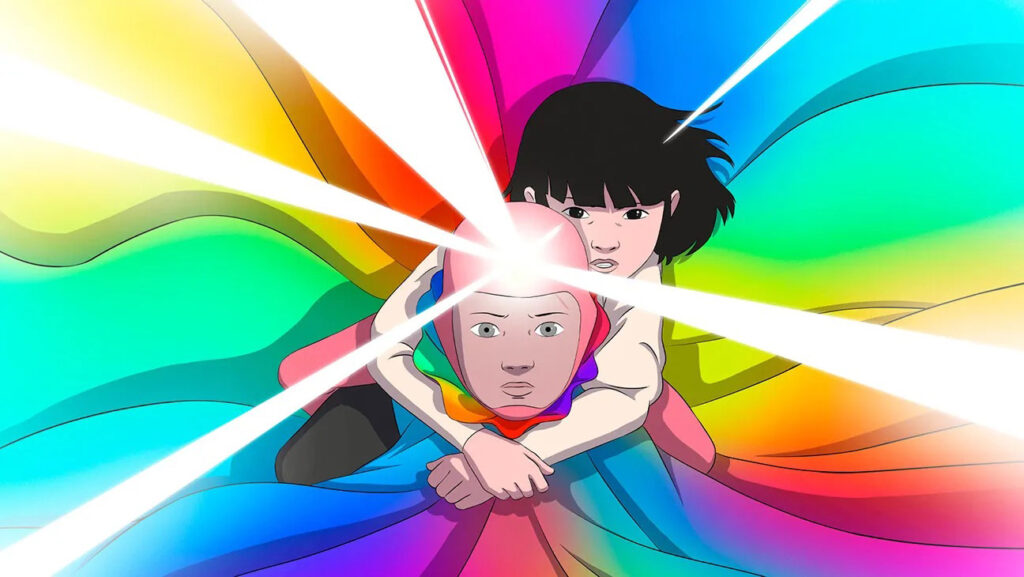
The heart of the movie is the bond that develops between two precocious preteens: Iris (voice of Romy Fay), a latchkey kid in the ecologically dicey year 2075, and Arco (Juliano Krue Valdi), an accidental time traveler who crash-lands into Iris’s lonely suburban existence from several centuries beyond.
Like Marty McFly 120 years before him, Arco finds himself stranded in a primitive era with an outta-gas time machine, forced to evade discovery until he and his weirdo ally can figure out how to get him back to the distant future. If you’re the sort of daydream believer who can entertain the notion that rainbows are evidence of temporal tourists in our midst — as Monsieur Bienvenu suggests they are — a charming, gently provocative adventure shall be your reward.
Provocative because Bienvenu (who shares screenplay credit with Félix de Givry) introduces concepts like time travel and AI sentience and even virtue without specifying exactly how they operate in this world. These notions are simply as omnipresent and mysterious as most everything about adult life and responsibility is to a kid. The co-writers also wisely abstain from overexplaining the sociological details of their expansive story’s two eras, leaving us to interpret why both time frames appear curiously underpopulated according to our own optimistic or pessimistic whims.
Iris and her neighbors seem to belong to relatively privileged strata of 2070s society, their single-family houses shielded from violent electrical storms and wildfires by transparent bio-domes. Iris’s mom and dad, voiced in the English-language dub by Portman and Mark Ruffalo, work in “the city,” she says, evidently more than a mere commuter-train ride away. With the exception of hologram-convened family dinners and occasional bedtime stories, the grown-ups return to Iris and her infant brother Peter only on weekends, outsourcing the daily chores of child-rearing to their resourceful domestic robot Mikki. (Both Portman and Ruffalo are credited as the voice of the droid, suggesting it’s been customized to reflect its owners. This implication is absent from the original French version of “Arco,” wherein director Bienvenu performs Mikki’s voice.)
Beyond privately owned bots like Mikki, it appears that all essential public-service jobs, including schoolteachers and first responders, are held by robots in 2075. The Sphere-like immersive classrooms of Iris’s school, fully autonomous and without a flesh-and-blood adult to be found, are among the casually stunning cinematic flourishes that “Arco” presents without comment.
Our glimpse of Arco’s native time zone is more sparing. Humanity has taken up residence among the clouds, in dwellings that are more like luxuriously appointed tree houses than skyscrapers, to allow the Earth to “rest,” as Arco tells Iris. His parents and older sister conduct regular excursions into the past, with the goal of retrieving and repopulating specimens of long-extinct flora and fauna.
Arco must stay behind because kids younger than 12 aren’t allowed to fly, which is apparently a prerequisite for skipping through the centuries. Whether their rainbow-hued cloaks — Technicolor dreamcoats that Joseph himself would envy — are explicitly for time travel or just for airborne transit is one of the details Bienvenu and company leave to our imaginations. (Parents, beware: “Arco” includes more than one instance of its title character doing a header off a rooftop to test the gravity-defying abilities of the cape he’s borrowed from his big sis without permission.)
The majority of the film unfolds in the relative dark age of 2075, where Iris must protect Arco from a trio of sunglass-wearing dudes dressed individually in red, blue and yellow who are tracking him for unknown ends. They’re voiced by Will Ferrell, Andy Samberg and Flea, instantly getting across that they’re more bumbling than threatening. Still, they’re enough of a menace that Iris must eventually call on her parents for help, struggling like so many juvenile protagonists before her to convince the olds that the wild yarn she’s telling them is the truth.
“Arco” reminds us that suspension of disbelief is a quality of youth worth preserving.
PG. At area theaters. Contains action/peril and mild thematic elements but nothing vulgar or otherwise objectionable. 89 minutes.
The post Oscar nominee ‘Arco’ is a vibrant French dispatch from the future appeared first on Washington Post.