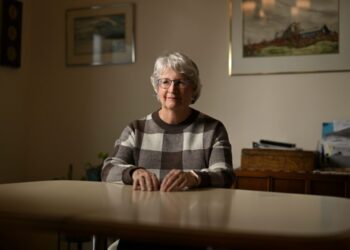
The 42-year-old woman walked with her twin sons and older daughter through the nearly empty walkways at Legoland. She was grateful that her children were old enough to go on the rides without her but sad that she felt too awful to join them. For the past five months, she had been tortured by pain boring into her back, an inch to the left of her spine. It was as if a drill were driving past her ribs to someplace deep inside, so specific, so localized that she felt she could draw a circle around it. She helped her kids board each ride, pointing out the bench where she would be waiting for them. Sitting barely helped — no position was comfortable anymore — but standing for a long time was simply impossible.
The pain had come on suddenly. One June morning she woke up, and there it was. When it lasted all day and was still present when she awoke the next morning, she went to the Medstar Georgetown University Hospital emergency room, near her home in Washington. Imaging and blood tests didn’t reveal the cause. She had a pretty significant anemia, she was told. But the medical team didn’t find anything that could have caused this agony. Over the next several months, the pain spread to her left flank, just above her hip bone. It was a pressure-like pain unlike anything she had ever felt.
A Life Altered by Pain
The woman was a pediatric ophthalmologist. For most of her career, she spent her days on her feet, examining children in her office and at the Children’s National Hospital. It was a physically demanding job. She was often tired, and from the very first days of her residency training, she became lightheaded with the hospital rounds that kept her standing for hours. This despite the fact that she wore prescription-grade compression stockings to help her throbbing varicose veins. Between patients, she often had to rest on the metal trash cans that dotted the hospital hallways. But that — though uncomfortable, and unexpected given her age — was manageable. These new pains in her back and side made patient care too difficult. That fall, she made the transition to a desk job, far away from the part of doctoring that she loved most.
Her primary-care doctor and longtime OB-GYN were baffled by her pains. She sought opinions from a long list of subspecialists: a rheumatologist who looked for evidence of an autoimmune disease but found none. A hematologist who suspected that her anemia resulted from her heavy periods but saw nothing more. A specialist in rehabilitation medicine, who sought a cause for her pain in her spinal column but didn’t find that either.
She had a dozen imaging studies and an uncountable number of tests of her blood and urine. They confirmed the anemia but shed little additional light. She started having trouble sleeping; the only position that didn’t worsen the pain was on her stomach.
There were other symptoms, more irritating than painful, but new and hard for her to understand. She developed constant nausea and heartburn. Her appetite vanished, and she lost a lot of weight. She saw a gastroenterologist who found mild gastritis; treating that helped enough that the weight loss subsided. And she couldn’t raise her arms past the level of her shoulders without them falling asleep. After just a few minutes of reading in bed, they would go numb.
The woman, frustrated by the lack of answers, began to review her own medical records. She noticed that several of the imaging studies reported a finding she had never heard of: pelvic congestion syndrome. She asked her doctors about it, but none of them thought it was likely to be the cause of the symptoms she had developed.
Pelvic congestion syndrome (P.C.S.) occurs when blood doesn’t move through the veins normally, whether because of some kind of obstruction or because the valves that normally keep blood moving against gravity, back toward the heart, stop working. This causes the veins coming from the organs in the pelvis, including the uterus and ovaries, to dilate and blood to pool — a type of varicose vein of the pelvic vessels. Like varicose veins on the more visible parts of the body, P.C.S. is more common in women who have had children because pregnancy itself causes the vessels to enlarge. Patients with this syndrome often describe a kind of pelvic heaviness and report that sex becomes painful. While P.C.S. is a common cause of pelvic pain, many women with no pain at all have imaging that shows some evidence of the syndrome. So the significance of the finding is not always clear to physicians.
Crucial Help From a Friend
As the woman read about the various causes of pelvic congestion, her interest was piqued by the colorfully named nutcracker syndrome. In this unusual disorder, a change in anatomy — often weight loss — spurs a shift in the position of a large blood vessel called the superior mesenteric artery, causing it to press on the vein draining the left kidney and blocking the flow of blood through the vessel. The blood that needs to return to the heart and lungs to be reoxygenated and repumped has to find a new path from the kidney back to the heart. The unimpeded veins fatten with the additional blood, and new collateral veins form. These changes cause pelvic congestion.
The woman was intrigued. The location of her pain seemed close to where the compression would be happening. She called a gynecologist friend. Had she ever heard of nutcracker syndrome? Was it a thing? Her friend was quiet for a moment. “Not really,” she answered. That was discouraging to hear, and yet, as the woman read more about the symptoms, it seemed as if she were reading about herself.
Last summer, two years after her pain first started, the woman and her husband invited two friends, a couple, over for lunch. The husband, Emmett Lynskey, is an interventional radiologist who specializes in treating pelvic pain and fibroids. He and his wife had known the woman since medical school and ended up practicing in the same hospital. Because of their long friendship, the woman felt comfortable bringing up the topic of her pain at lunch. She hoped he would offer to review her scans, and he did. She gave him written permission and crossed her fingers.
That night, her phone buzzed. “Took a look at your M.R.I.,” Lynskey texted. “Pretty sure you have nutcracker on the M.R.I.” He said there was “no question that most of your symptoms are from those findings.” Her relief at the certainty of this diagnosis was immediate. She wrote back: “This is (ironically) the best news I have heard in two years. To possibly have an answer (and a way forward) is really promising.” She and her husband celebrated the diagnosis with a glass of Champagne.
Nutcracker syndrome and P.C.S. are each rare enough that many doctors don’t know much about them. Treatment is still controversial. Historically, it involved surgical replacement of the renal vein or moving the left kidney down or over to the right side. Stents were thought to be a less invasive method of opening up the crimped vessel, but in the early attempts, some stents would migrate to the heart or another organ. In 2019, newer stents were introduced that were said to carry a lower risk of being dislodged, though only a handful of studies of these new devices have been published.
The patient had a stent placed last October. Almost as soon as she woke up from the procedure, she could feel the difference. The pain in her left side was completely gone. The pain in her back was better. But it was more than just that. The terrible lack of appetite, the nausea and heartburn that had plagued her were gone. The rerouted blood and congested veins had somehow slowed venous drainage from her GI tract as well as the kidney. She felt really hungry for the first time in two years. She was able to read in bed once again, a pleasure almost as great as being hungry again. And she finally had an answer for why she developed varicose veins at an early age.
I spoke to the woman recently. She acknowledged how important it had been for her to have a friend who could help her confirm the diagnosis she suspected — a luxury not available to many. “Even with good insurance, it can be hard to find someone to help you,” she said, adding, “I fully appreciate how lucky I am.”
Lisa Sanders, M.D., is a contributing writer for the magazine. Her latest book is “Diagnosis: Solving the Most Baffling Medical Mysteries.” If you have a solved case to share, write to her at [email protected].
The post Her Sudden Back Pain Was Unbearable. What Could Ease It? appeared first on New York Times.