At a bar on Main Street in Park City on Monday night, a gaggle of veteran movie producers gathered to share war stories and bid farewell to the Sundance Film Festival as they’d known it.
Over more than four decades, the Sundance Institute, founded by Robert Redford, who had a mountainside home nearby, challenged Hollywood to be less formulaic, more personal and original. It succeeded. Indie films became the subject of frantic bidding wars in the lobby of the Eccles Theater auditorium (which, because Park City is basically a small town, was attached to the local high school, which remained in session). Two generations of filmmaking stars were born.
“Hustle and Flow,” “The Spitfire Grill,” “Beasts of the Southern Wild,” “Garden State” and “CODA” — all these Sundance classics weren’t just legendary because of the movies’ originality, but also because they were part of the festival’s legendary FOMO. If you were cool and in the movies, you had to be there. Buyers didn’t want to miss out on the next “Blair Witch Project.”
That is mostly over. In recent years, Sundance has seen anemic sales activity, with one or two films selling for a good price, and a majority settling for no-or-low-cash streaming deals — or nothing at all. Hollywood studios long ago shuttered most of the independent distribution arms they founded in the 1990s and 2000s (CBS Films, Paramount Vantage, Warner Independent Pictures, to name a few). And the streamers have clearly signaled they are not all that interested in cluttering their home screens with arty, singular-voiced movies with unfamiliar subjects and talent.
Yes, there are exceptions to this industry-wide flight from quirk. Notably, A24: its indie-spirited “Marty Supreme” has made a $110 million at the box office. But a struggling indie sector and rising costs prompted the Sundance board to decide to pull out of this ski town and move the festival to Boulder, Colo., starting next year. Then in September, Mr. Redford died, adding to a sense of both nostalgia and uncertainty as to the future of the festival and what it has stood for.
At the bar on Monday, Killer Films’ Christine Vachon and the sales agent Kevin Iwashina each tried to remember just how long they’d been coming. The producer Jamie Patricof reminisced about the bidding war over his film “Half Nelson,” a 2006 indie starring Ryan Gosling. He remembered turning down a $500,000 offer from Harvey Weinstein’s Miramax, against the recommendation of his agents. When the bidding cooled, he sold it for just $50,000. The movie made $4.6 million worldwide and got Mr. Gosling his first Oscar nomination.
Nobody is overpaying anymore just for buzz. Fear is gripping Hollywood now, with the consolidation of the studios and the streamers. Theatrical releasing is on the ropes, and smaller films are having a hard time finding a paying audience.
The decline of Sundance matters because it has nurtured the creative independence that drives innovation in all filmed storytelling. The Hollywood studios translate it into big-budget moviemaking, a cycle that has gone on since the late 1990s. If independent film suffers, that will, too.
This is turning into something like an identity crisis for both Sundance and independent film. What is the meaning of this festival going forward, and what role do its movies play in our society?
“It is always a question about art in the face of tragedy, art in the face of turmoil, political turmoil, that you really have to question what you’re making, why you’re making it, and if it has validity,” the filmmaker Kogonada told TheWrap. His film “Zi” premiered at the festival.
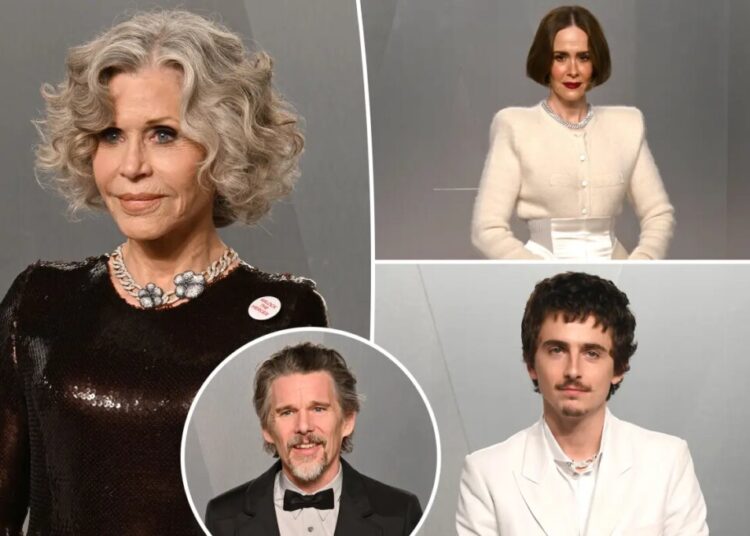
Natalie Portman, Olivia Wilde and Zoey Deutch wore “ICE Out” pins at the festival. Other high-profile celebrities made statements denouncing the brutality in Minneapolis.
“It’s hard to be somewhere like this … wear nice outfits and talk about film, when something so ugly is happening right next to us,” actor Jenna Ortega told reporters ahead of the premiere of her new movie, “The Gallerist,” on Saturday.
So many at the festival said some version of this.
Starting in the 1990s, when Hollywood discovered it could make good money releasing cheap, edgy independent films like “Sex, Lies and Videotape,” the festival became the epicenter of discovery for new cinematic talent.
Emerging filmmakers honed their work at the Sundance Institute Labs, an incubator for screenwriters and filmmakers. Indeed, the directors behind three of the front-runners in this year’s Oscar race — “One Battle After Another” by Paul Thomas Anderson, “Hamnet” by Chloé Zhao and “Sinners” by Ryan Coogler — are alums of the Labs, led by another Sundance legend, Michelle Satter.
The themes at this year’s festival are broadly situated in Sundance’s traditional worldview championing the marginalized, the forgotten, the goofy and the weird. As always, there are gems mixed with the vast undistinguished middle, notably “Bedford Park,” a first work by the filmmaker Stephanie Ahn, which is a devastating Korean American story of two broken souls finding one another. “The Invite,” starring and directed by Ms. Wilde and about a neighborly dinner party that goes off the rails, was much talked about. Many others are unlikely to make it on Netflix, or anywhere else.
Where does Sundance — and indie film in general — go from here? That’s harder. What the festival will become in a new location and without the inspiring presence of Mr. Redford is a question to which no one has yet found a satisfactory answer. A number of the attendees I spoke to mused aloud about whether they would even go to Boulder next year.
Joe Pichirallo, a producer and film professor at N.Y.U. Tisch School of the Arts and a former executive at Fox Searchlight, has returned to Sundance nearly every year to check out the new and innovative. He agreed that the festival needs a re-examination. “What are the new issues that are important that we aren’t tackling in film?” he asked.
Josh Sapan, who was the chief executive of AMC Networks for more than two decades, said, “The media and communication systems of today are going through evolution, and they cannot reflect on themselves.” Mr. Sapan, who now attends Sundance as a producer and film buyer, continued, “There’s a systemic problem here. Art plays a role in surfacing our monsters.” He said, “But right now we are disoriented and destabilized.”
Source photographs by Valiantsin Suprunovich and DBenitostock/Getty Images.
Sharon Waxman is the founder, chief executive and editor in chief of The Wrap, and author of “Rebels on the Backlot: Six Maverick Directors and How They Conquered the Hollywood Studio System.”
The Times is committed to publishing a diversity of letters to the editor. We’d like to hear what you think about this or any of our articles. Here are some tips. And here’s our email: [email protected].
Follow the New York Times Opinion section on Facebook, Instagram, TikTok, Bluesky, WhatsApp and Threads.
The post Sundown at Sundance appeared first on New York Times.