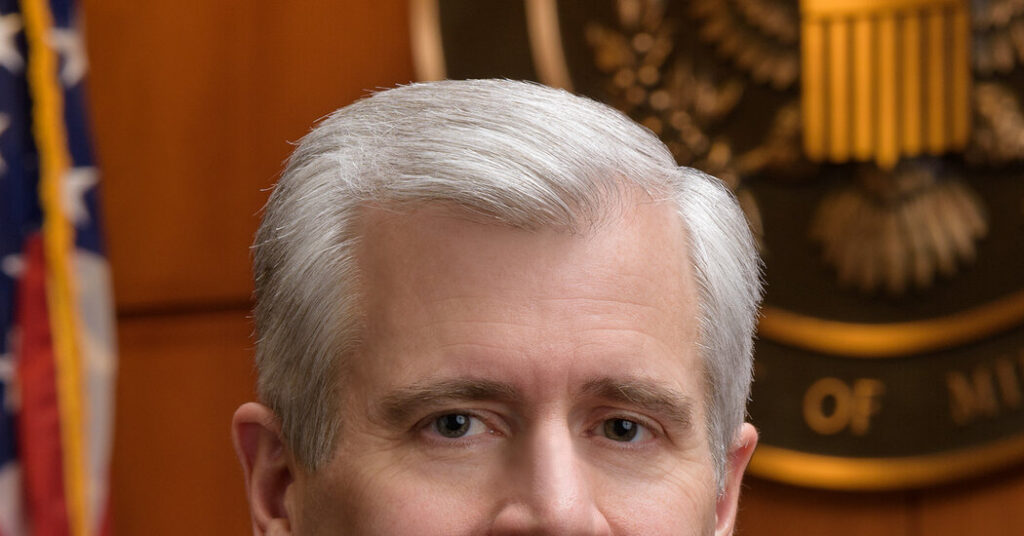
Until January, Patrick J. Schiltz, the chief judge of the District of Minnesota, had steadily managed one of the federal court system’s heavier workloads with little fanfare. He was more widely known in the legal community for penning a revered law journal article 27 years ago that advised young lawyers how to become ethical members of an “unhappy, unhealthy and unethical profession.”
But starting this year, as federal agents surged into Minnesota, hundreds of immigration cases began to overwhelm the courtrooms of Judge Schiltz’s district.
Since then, in increasingly sharp opinions, Judge Schiltz, 65, has flashed growing frustration and anger with the Trump administration, emerging as an unexpected new critic of the administration’s tactics in court.
“The court’s patience has run out,” he wrote in an order on Monday, demanding that Todd Lyons, the acting director of U.S. Immigration and Customs Enforcement, appear in his courtroom to explain why scores of people arrested by immigration agents have been held without an opportunity to challenge their detentions.
On Wednesday, he backed off that threat after one migrant at the heart of the standoff was released, as he had previously ordered. But he attached to his order a list of 96 court orders that he said ICE has violated across 74 cases.
“This list should give pause to anyone — no matter his or her political beliefs — who cares about the rule of law,” he wrote, assessing that ICE has most likely violated more court orders in January alone than “some federal agencies have violated in their entire existence.”
Reacting to Judge Schiltz’s Wednesday order, Tricia McLaughlin, a spokeswoman for the Homeland Security Department, dismissed his concerns about the violations as a “diatribe from this activist judge,” and noted his decision to relent on having Mr. Lyons appear.
“We will not be deterred by activists either in the streets or on the bench,” she said in an emailed statement.
The attacks came in spite of the judge’s résumé, which is studded with conservative credentials, and his nearly 20-year career on the federal bench. Before being appointed by President George W. Bush in 2006, Judge Schiltz cut his teeth with several of the most celebrated conservative jurists of recent generations.
After graduating from Harvard Law School in 1985, Judge Schiltz clerked for Justice Antonin G. Scalia in Mr. Scalia’s final stretch as an appellate judge in Washington, arriving just before Mr. Scalia was nominated to the Supreme Court.
At his confirmation hearing in 1986, Justice Scalia turned around to thank Judge Schiltz for helping him prepare for questions.
“I would also like to introduce, behind me, my law clerk, Patrick Schiltz, who has helped me in getting together the materials I will probably need for this hearing,” he said, immediately after acknowledging his family.
Judge Schiltz looked on from the row immediately behind the revered conservative jurist. Before the nomination, he had planned to clerk next for Justice Sandra Day O’Connor, according to a biography written by his career clerk. But with his mentor joining the Supreme Court, Judge Schiltz maneuvered to become one of Justice Scalia’s first clerks at the Supreme Court, working for the justice until 1987.
Aaron Van Oort, a partner at Faegre Drinker who clerked for Justice Scalia years later, recalled standing vigil with Judge Schiltz over the justice’s casket during the wake after Justice Scalia’s death in 2016. He said Judge Schiltz carried on the standards the justice taught, namely that “the job of a judge is to determine what the law is and apply it, not determine what it should be.”
“He’s directly in the Scalia mold: he believes deeply in the rule of law, and he doesn’t go out of his way to make up anything,” Mr. Van Oort said. “He believes in looking at what the law is and applying it — as it is — to whomever is in front of him, whether that’s an individual pro se person or whether that’s the United States.”
Trump Administration: Live Updates
Updated
- Trump says he shut his eyes at the last cabinet meeting because it was ‘boring.’
- Democrats block spending package as D.H.S. talks continue.
- Another top Kennedy Center official resigns.
After his clerkships, Schiltz spent eight years as a lawyer before joining Notre Dame as a law professor in 1995. But in his first years on the faculty, he expressed misgivings about academia, worrying that professors were plagued by the same character flaws as most working lawyers.
“The professional lives of both are increasingly dominated by greed,” he wrote in a 1998 critique of American legal education. “For lawyers, it is greed for money; for law professors, it is greed for academic prestige.”
In other writing, he lamented that so many Supreme Court clerks graduated from the same elite law schools. Most clerks, he wrote, were “generally privileged and sheltered” and trained by professors who were “overwhelmingly leftist in political orientation and lacking in substantial ‘real-world’ legal experience.”
Above all, Judge Schiltz was concerned that academic and professional mentors were failing to impart ethics to young lawyers.
The article for which he is best known was published in 1999 in the Vanderbilt Law Review. In the paper, he presented something of a self-help guide to aspiring lawyers on navigating the misery and the high rates of alcoholism, drug abuse, divorce and mental health struggles he described as pervasive across the legal industry. Collecting the available studies at the time on job satisfaction, he recommended pursuing meaningful public interest work and eschewing big firms and big paychecks.
“Don’t get sucked into the game,” he wrote. “Don’t let money become the most important thing in your life. Don’t fall into the trap of measuring your worth as an attorney — or as a human being — by how much money you make.”
While at Notre Dame, Judge Schiltz has said, he taught one standout student — Amy Coney — who followed his path to clerk for Justice Scalia. Later, Amy Coney Barrett would return to teach at Notre Dame for 15 years before President Trump named her to the Supreme Court.
In 2000, Judge Schiltz left Notre Dame to help relaunch the University of St. Thomas, a Catholic law school in Minneapolis, after the original school closed during the Great Depression.
The effort to revive the school was a shared effort among a number of Catholic figures, including Judge Diana Murphy of the U.S. Court of Appeals for the Eighth Circuit, to bring a Catholic perspective back to higher education locally. Judge Schiltz joined as the law school’s founding dean in 2000, helping shape the curriculum and teaching there until his nomination by Mr. Bush in 2006.
At his commemoration of the school’s fifth anniversary, he said his vision for the school was a “community of faith,” which “would graduate lawyers who would integrate their religious and moral values into their professional identities and who would have a passion for using their legal training to serve God and their fellow human beings.”
His Senate confirmation in 2006 was done by unanimous consent, and supported by both Minnesota’s Republican and Democratic senators, Norm Coleman and Mark Dayton.
Judge Schiltz has now joined a long list of judges appointed by Republicans whom Trump aides have cast as “activists” after they ruled against the administration.
The administration similarly fumed when Judge James E. Boasberg, who was also first appointed to the bench by Mr. Bush, tried to order the administration not to fly several planeloads of migrants to El Salvador. Mr. Trump referred to Judge Boasberg, a longtime friend of Justice Brett M. Kavanaugh, as “a Radical Left Lunatic, a troublemaker and agitator.”
When Judge William G. Young, an appointee of President Ronald Reagan with more than 40 years on the bench, criticized the Trump administration’s deportation tactics as “authoritarian” this month, a White House spokesman accused him of “left-wing activism.” And when Judge Karin J. Immergut, whom Mr. Trump appointed in his first term, ruled against the administration over its deployment of the National Guard in Portland, Ore., Mr. Trump lashed out, saying she should be “ashamed.”
Judge Schiltz first publicly took on the administration last week, after the Justice Department asked an appeals court to force him to issue arrest warrants for the former CNN host Don Lemon and others who participated in a protest during a church service in St. Paul, Minn.
He excoriated the Justice Department for overheating the situation, calling its demands “frivolous,” and adding that he had surveyed all his colleagues and chief judges in other states in the same circuit. None, he wrote, could recall anything like the department’s approach.
A courthouse spokesman, replying on the judge’s behalf, declined to comment on the clash.
In a letter to the appeals court, he wrote that he had been blindsided by the request, in part because he had been working at home and caring for one of his four children who was born with Down syndrome. His wife, Elizabeth Schiltz, is a law professor at the Catholic law school where Judge Schiltz used to teach.
It was a broadside that served as a notable departure from the quiet and professional persona he has otherwise cultivated.
Speaking to The Minnesota Star-Tribune after assuming the seven-year role of chief judge in 2022, he said he hoped for a term that would be defined by a return to calm after the pandemic and the civil backlash in Minnesota stemming from the murder of George Floyd.
“My hope is to be the Benjamin Harrison of chief judges: One that no one remembers,” he said.
Zach Montague is a Times reporter covering the federal courts, including the legal disputes over the Trump administration’s agenda.
The post An Ethicist ‘in the Scalia Mold’: The Minnesota Judge Blasting ICE appeared first on New York Times.