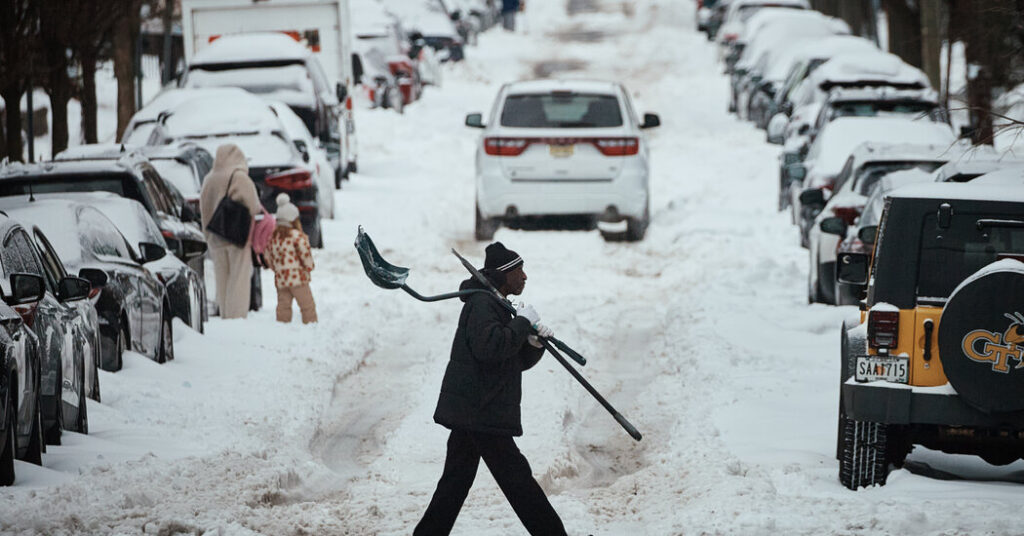
On a typical winter day, the Arctic air that has gripped much of the United States this week should be a few thousand miles to the north, sitting atop the North Pole.
But as man-made climate change continues to disrupt global weather patterns, that mass of cold air, known as the polar vortex, is straying beyond its usual confines.
The escaped polar vortex is just one instance of extreme weather playing out right now around the world. With so much cold air much farther south than usual, typically frigid regions have become relatively balmy.
“While cold conditions in the U.S. have made headlines, Greenland and the Arctic have quietly had a remarkably mild winter,” wrote Ben Noll, a meteorologist at The Washington Post.
Elsewhere, extreme heat is raging. Australia is reeling from a record heat wave that has pushed temperatures past 120 degrees Fahrenheit, or about 49 Celsius, in some areas, leading to fires and power outages. In central Africa, brutal heat has shattered records in recent days, with countries north of the Equator hitting temperatures above 101 degrees Fahrenheit.
Colder colds. Hotter hots. These are the intense bouts of unusual weather that scientists for decades warned would become more common with global warming.
“This is the thing we’ve talked about with climate change,” said Judson Jones, a Times meteorologist and reporter. “The extremes are going to be more extreme.”
Around the world, climate change is making heat waves more intense, more persistent and extending heat over larger areas, said Jennifer Francis, a senior scientist at the Woodwell Climate Research Center.
“On top of that, increased moisture in the atmosphere makes the heat more dangerous because sweating as a cooling mechanism doesn’t work as well,” she added.
Global warming is also intensifying droughts. With a warm atmosphere holding more moisture, water is evaporating faster, drying out soils. “The combination of heat and drought is a recipe for wildland fires, which are becoming more numerous and destructive,” Francis said.
And when it rains, it pours. All that additional moisture in the atmosphere is leading to an uptick in heavy precipitation events. “When a storm does form, it has more moisture to dump as rain or snow,” she said.
Meanwhile, another winter storm — this one coming in from the Atlantic Ocean — is set to hit the eastern U.S. this weekend. There’s even a possibility of snow in Tampa, Fla., something that hasn’t happened in four decades.
A blast of cold air
The polar vortex is a large, rotating expanse of cold air that generally swirls over the Arctic. And it’s normally an afterthought.
“The stratospheric polar vortex exists only in winter, and usually has little influence on our weather,” said Francis.
“But when it is disrupted — which means instead of being strong and circular over the North Pole, it becomes weak, elongated or split,” she said, “it can bolster cold spells like the one happening over the eastern U.S. now.”
Some scientists believe that one cause of the disruption of the polar vortex is melting sea ice. Less ice means that the difference in temperature between the Arctic and areas farther south is not as large. This has the effect of weakening the westward winds of the jet stream.
And “when the jet stream is weaker, it tends to take bigger swings north and south,” Francis said, adding that “those southward dips are what allow the Arctic air to plunge southward.”
There’s reason to believe these disruptions may become more common as the planet continues to heat up.
Overall, the Arctic is warming much faster than the rest of the planet, and the polar vortex has already been disrupted a number of times this year.
The effects of extreme weather
A disrupted polar vortex may sound abstract, but the consequences are very real.
The effects of the last winter storm are still being felt around the country. More than 60 people around the country died, including several in New York City who died from exposure to the cold.
Around the country, tens of thousands of people were still without power days after the storm had passed. More than a foot of snow fell in 19 states, and cities including Washington were still struggling to dig out, leading much of the federal government to work remotely.
And with temperatures staying low, there has been no chance for the snow and ice to thaw, putting much of the country into a sort of frozen paralysis.
In Central Arkansas, many school districts remained closed for much of the week with roads impassable. Highways in Mississippi were snarled for days, leading to the National Guard being brought in to help clear the ice.
And while the next storm is not expected to be as widespread as the previous one, it is poised to have crippling impacts across the already battered East Coast.
Journey to Antarctica
Life on a glacier: Tea, cheese and lots of shoveling
On Tuesday, a week after scientists from Britain and South Korea pitched tents on Antarctica’s remote Thwaites Glacier, they were pretty much ready to start drilling into the half-mile-deep ice.
The multiday drilling operation would be the culmination of the eight-week voyage of the icebreaker Araon. If successful, it would allow the researchers to lower instruments through the glacier into the ocean below, providing never-before-seen data on how the water is melting the ice from the bottom up
But days of fierce winds could cause their drill equipment to freeze up or become buried in snowdrifts. They would also make it difficult for the scientists to stay outside.
After a week on the glacier, their clothing was grimier, the men’s facial hair bushier. Some people’s faces were lightly bronzed by snow tans. Everyone had been shoveling a lot of snow, both to clear it from their tents and equipment, and to gather a supply of water for starting the drilling.
“Save me from this hell,” one researcher said. — Raymond Zhong
And follow our journey to Antarctica here.
Energy prices
New discounts in cold states are making it cheaper to run a heat pump
For many Americans, installing a heat pump to heat and cool a home can lower household bills in addition to reducing emissions. But in some places, that financial advantage has a big weak spot: winter.
High electricity costs and cold temperatures can make heating through the cold season with a heat pump more expensive than using a gas furnace.
Now some states are trying to change that, by lowering winter rates specifically for people with heat pumps. And they’re doing it by taking advantage of the fact that most of the U.S. grid is built for the summer.
Essentially, utilities decide how much customers will have to pay for electricity based on how much peak demand the grid will have to handle.
Related: Why a New Mexico developer quit natural gas.
One last thing
This little invertebrate, known as a cuban spiky, is about the size of a pinkie fingernail. And they carried a hefty price tag at a recent pet expo in White Plains, N.Y.: $350 for just a few.
They are among the exotic isopods that collectors covet most, part of a robust and largely unregulated online trade in isopods, Madeline Shaw reports. They are known to exist only in a Cuban nature reserve and are illegal to import without a special permit. Researchers think they’re critically endangered.
More climate news from around the web:
-
According to new research highlighted by Carbon Brief, climate change could lead to 500,000 more deaths from malaria in Africa over the next 25 years.
-
For the first time sales of electric vehicles in Europe in December were higher than gasoline-powered cars, The Financial Times reports. And the news comes as annual Tesla sales in Europe fell 38 percent compared with the year prior.
-
The Washington Post reports that the United States’ fast-charging network for electric vehicles grew by more than 30 percent in 2025, with over 18,000 new ports installed.
Read past editions of the newsletter here.
If you’re enjoying what you’re reading, please consider recommending it to others. They can sign up here.
Follow The New York Times on Instagram, Threads, Facebook and TikTok at @nytimes.
Reach us at [email protected]. We read every message, and reply to many!
David Gelles reports on climate change and leads The Times’s Climate Forward newsletter and events series.
The post Climate Change Is Fueling Extremes, Both Hot and Cold appeared first on New York Times.