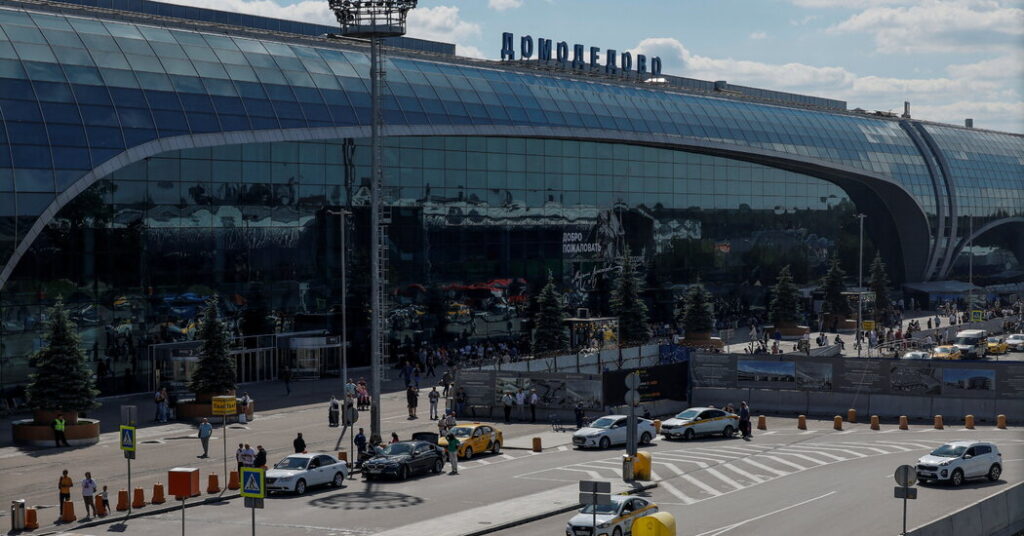
For years, Domodedovo Airport was a Russian success story. After being privatized in the 1990s, it grew to become Moscow’s second-largest airport. British Airways, Lufthansa and other international airlines chose Domodedovo over its state-owned rivals as a base, making it the Russian capital’s primary gateway to the world.
It has now been sold — at a fire-sale price.
The Russian government, which seized Domodedovo last year, received no offers when it put the airport up for sale last week, setting the minimum bid at $1.7 billion. On Thursday, it held an auction that allowed the bidding to go as low as 50 percent of the initial asking price. That half-off price is about what the airport fetched in the end, offered by another Moscow airport, the Kremlin-linked Sheremetyevo.
The sale of Domodedovo Airport highlights Russia’s international isolation and weakened economy after its invasion of Ukraine. The airport is also the most prominent example in a wartime campaign to nationalize and sell off private enterprises, a push that has rattled the Russian business community.
Domodedovo’s decline began with the Covid-19 pandemic. Then, just as global air travel was rebounding, international sanctions over the war in Ukraine shut the door to Europe for Russia.
Now, a shining new terminal at the airport, inaugurated in 2023 after years of delays, stands half-empty. Flights to hundreds of European destinations, as well as to Japan, Australia and other countries, have been suspended. Even as the airport has doubled its square footage, its passenger traffic has fallen by half from pre-pandemic levels, to 14 million people a year.
“The second terminal was badly needed for the pre-Covid traffic. When it was finally put into operation, they had no use for it anymore,” said Andrei V. Kramarenko, who studies Russian aviation at the Higher School of Economics in Moscow.
Saddled with an estimated $1 billion in debt, Domodedovo was easy prey when the government targeted it for nationalization. A Russian court ordered the seizure of Domodedovo from a reclusive billionaire, Dmitry Kamenshchik, deeming it a strategic enterprise that should not fall into foreign hands.
That made the airport the most valuable business caught up in an asset grab that President Vladimir V. Putin greenlighted at the start of the war in 2022. The wave of nationalizations started with the seizure of Western-owned businesses. It has since expanded to a range of Russian companies, from those related to the military-industrial complex to something as innocuous as a pasta factory.
The Russian state has nationalized assets worth at least $79 billion since 2022, according to some estimates.
While the government says the companies were seized for national security reasons, they have been targeted seemingly at random. That has driven a belief in Russia that the nationalizations were “never about filling up the coffers,” said Alexander Kolyandr, a fellow at the Center for European Policy Analysis.
Instead, the seizures were intended to enrich friends of the Kremlin, Mr. Kolyandr said. “It gets done simply because someone needs or wants this or that asset,” he said.
The airport is not the only major nationalized enterprise that has struggled to find a buyer as the Russian economy suffers from the war and isolation. A sale of Raven Russia, the country’s largest warehouse owner, had to be scrapped in December after it was put on the market at $1.2 billion.
The failure to sell both businesses at a prewar market price shows that even formerly moneymaking Russian assets “should be priced with a hefty discount,” said Andrei Yakovlev, a researcher at the Davis Center for Russian and Eurasian Studies at Harvard.
“Most of the former owners of the companies that were nationalized and then sold off are going to go to court” to contest the seizures, Mr. Yakovlev said. “Major players that have some autonomy from the Russian state are very much aware of that risk.”
To return to profit and make up for the expenses of the new terminal, Domodedovo would need to restore its passenger traffic to prewar levels, analysts say. That would require a full reversal of international sanctions and a restoration of ties with Europe, something that is not on the horizon anytime soon.
In a post on Telegram last week, Oleg V. Deripaska, an oligarch who co-owns three airports in Russia’s south, ridiculed the idea of buying Domodedovo at its asking price.
Sheremetyevo Airport, co-owned by the Russian government and investors including Mr. Putin’s childhood friend Arkady Rotenberg, won the auction for Domodedovo with a bid of $880 million, Russian state media reported.
Many of Russia’s wealthiest businessmen once relied on assets and businesses abroad as an exit strategy from Russia. But Western sanctions have undercut any remnants of financial independence from the Kremlin.
“In that sense, sanctions proved to be extremely useful to the Kremlin,” Mr. Kolyandr, the analyst, said. “They locked up all Russian business inside Russia.”
Business leaders have pleaded with Mr. Putin to lay down ground rules for the nationalization drive. A task force he appointed has not offered a clear answer.
The post Moscow Airport Sells for Half Off, a Sign of Russia’s Global Isolation appeared first on New York Times.