Noche Flamenca, New York’s foremost flamenco troupe, is known for many virtues: no-nonsense integrity, high artistry, consistently excellent musicianship. But since its founding more than 30 years ago, it has been recognized above all for its world-class star, Soledad Barrio.
What is a Noche Flamenca performance without her onstage? That question is unintentionally being answered during the company’s two-week run at the Joyce Theater. Because of a broken foot, Barrio is not performing.
The program, “Irrationalities,” is a mix-and-match selection of pieces from the group’s last two shows, supplemented by a few new numbers and altered by some cast changes. The guiding theme is the work of the Spanish artist Francisco Goya, chiefly a late series of enigmatic prints called “Los Disparates,” which can be translated loosely as “Irrationalities.”
The show — choreographed by Barrio and the troupe’s director, Martín Santangelo — begins with the company huddled on a raft-like table. The image corresponds to Goya’s “Disparate Ridículo,” in which a group of people balance precariously on the bough of tree, like the nursery-rhyme cradle. Onstage, though, the mood is light and convivial. The performers pass around verses of a song, warmed by togetherness.
Then comes war, heralded by rhythmic pounding on the table and the stomping of feet. Flamenco dancers can march menacingly and also make the sounds of gunfire. Their bodies sprawl as the slain. It is a dark time, like Goya’s when he made “Los Disparates.” “Irrationalities” strikes parallels between the ignorance and fear in his time and ours. It proposes a counterforce in fellowship and art.
Along with the absence of Barrio, the program includes a planned break with precedent: the company’s first use of recorded music. During a new piece for three women who wield red fans wittily, we hear bouncy strains of “La Picarona,” a 1930s zarzuela or operetta, then some sadder strings by Goya’s contemporary Boccherini. The recordings have an expressively jarring effect that heightens the satire of frivolousness, but the idea, not repeated elsewhere in the program, sticks out as an unintegrated experiment.
A more conventional novelty is a new face. Gabriel Matias, a Brazilian dancer trained in Spain, is clean in technique and genuine in manner, with the freshness and still-developing quality of an ingénue. He holds his own against the show’s three more seasoned male dancers in a bullfight-themed masculine show-off number, and in a later death-haunted solo, he finds moments of breathtaking beauty. He’s a find.
Without Barrio, the show is a little male heavy, despite an equal gender ratio of dancers. The veteran Juan Ogalla takes Barrio’s star slot in the intense form known as seguiriya. Where the rest of the show artfully plays with composition, backing solos with other dancers, the format here is traditional, just Ogalla and the musicians in an escalating rhythm of outburst and recovery. A lion in winter, Ogalla reaches for moves that he can’t execute smoothly, but he puts on a show.
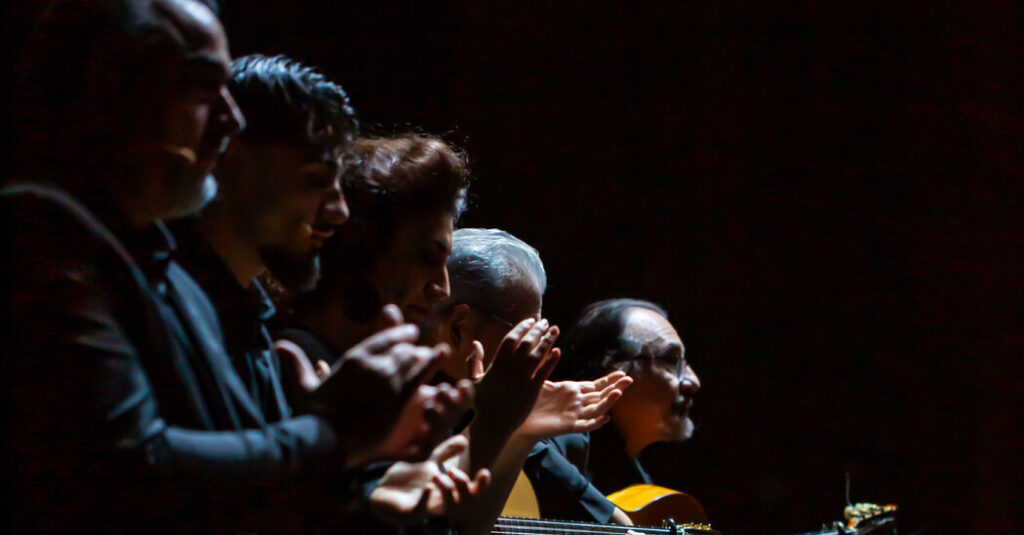
The whole production is like that: disappointing only if you are expecting Barrio. The usual musicians (the guitarist-composer Salva de María, the singers Emilio Florido and Carmina Cortés) hold the fort. The choreography and direction flow. With Barrio, Noche Flamenca is great; without her, it isn’t. But it’s still good.
Noche Flamenca
Through Feb. 8 at the Joyce Theater; joyce.org.
The post Review: Without Its Star, Noche Flamenca Still Shines appeared first on New York Times.