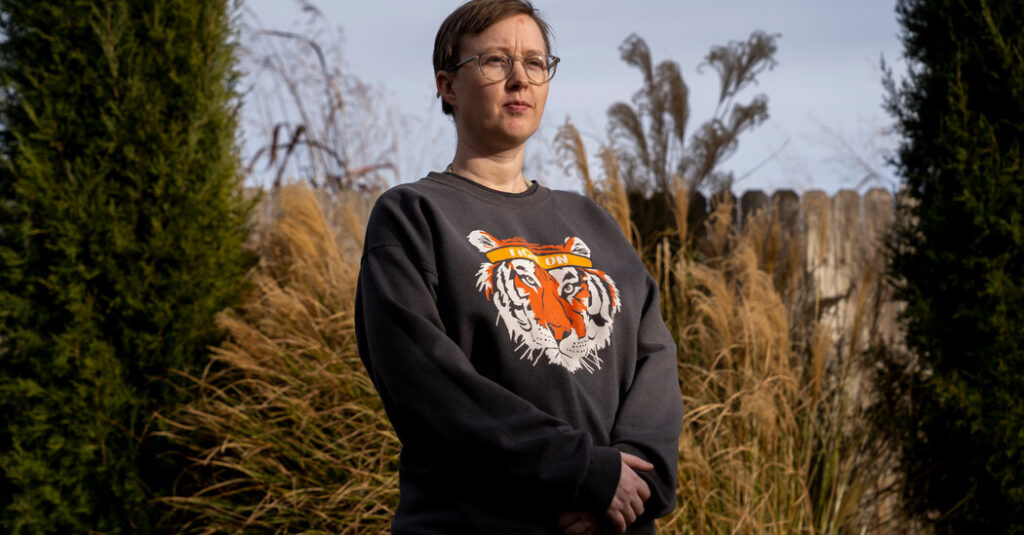
Summer Boismier hauled open the garage door of her storage unit and searched for the boxes of books that ended her career.
She lugged a few into the trunk of her car and drove to her mom’s suburban house in Yukon, Okla., where she now lives. Kneeling on the rug in the living room, she began peeling off the dried packing tape, opening the cardboard tops for the first time since she had closed them in 2022.
In eight years and one day of teaching public school in her home state, Ms. Boismier, 37, had amassed a 500-volume classroom library, procured on her $58,000 salary. She lent the books to high school students in an effort to get them reading something that sparked their interest in a screen-addled world.
She began pulling books out to show a reporter: “Night,” “The Sound and the Fury,” “Lord of the Flies.” But also more contemporary choices: “Long Way Down,” about a Black teenager confronting gun violence and racism. “The Girl From the Sea,” a lesbian coming-of-age graphic novel.
She remembered when one student who was often absent and rarely participated in class took her copy of “March,” about the life of John Lewis, and never returned it. Ms. Boismier didn’t mind. Recommending a book that a teenager fell in love with was “a high like no other,” she said.
When Oklahoma passed laws that pressured teachers to remove books on race, gender and sexuality from their classrooms, she refused. Other teachers resisted, too — but Ms. Boismier did so loudly. She plastered her 10th-grade English classroom with signs of protest, posted to social media and advised her students on how they could find books online. Eventually she resigned.
She knew that in her conservative state she would be criticized, but the reaction was much more severe than she expected. And in 2024, the state took away Ms. Boismier’s teaching license.
It was an extraordinary punishment. More than 20 states, including Oklahoma, have passed laws over the past five years restricting the curriculum around race, gender, sexuality and American history. Hundreds of teachers have faced discipline or lost their jobs as a result of these laws. But Ms. Boismier is perhaps the only one whose certification has been fully revoked.
She was accused of bringing politics into the classroom, and in a way, she doesn’t dispute that. “What it was about for me,” she said, “was my students would understand where I stood on the issue of censorship.”
Without a license, she cannot teach public school in Oklahoma. The revocation also makes it difficult for her to become certified in other states, in part because it’s a punishment generally used in egregious cases like child abuse or fraud.
Ms. Boismier tried to start a new life in New York, outside the classroom. But last year she returned to Oklahoma. This fall, she filed a federal lawsuit against the state and the man who led the charge against her, Ryan Walters, the former state superintendent, arguing that her free speech and due process rights had been violated.
Sprawled on the living room floor, she surveyed the books around her. She lamented that some of them still had a new book smell. The spines hadn’t even been cracked. “Trying to find, like, a purpose and a reason for getting out of bed every morning can be challenging,” she said. “I love working with high school students.”
Shifting Winds
Ms. Boismier grew up west of Oklahoma City, among a conservative family, who, for a time, attended a Southern Baptist church. When her mother took Ms. Boismier and her two sisters to the library after school, they could choose any books they wanted — a thrilling freedom that defined her childhood. She read widely, and especially loved fantasy novels, with “The Lord of the Rings” and Harry Potter her favorites.
After studying English at the University of Oklahoma, she interned in Washington for a Democratic congressman. Eventually, she became a high school teacher in the small town of Piedmont.
Matilda Harvey had Ms. Boismier as her ninth grade English teacher in 2016. When the class read “To Kill a Mockingbird,” Ms. Boismier drew parallels between the racism and false accusations against Tom Robinson and the cases of Michael Brown and Trayvon Martin, Black teenagers who were killed.
In a conservative town, “I was shocked,” said Ms. Harvey, who is now 24 and working as a substitute teacher. She said her teacher’s liberal views and high academic expectations had rubbed a few students the wrong way. “But I was very glad.”
In 2018 Ms. Boismier was named her school’s teacher of the year, and more awards followed, including one from the state. She led student groups, including the gay-straight alliance. When she assigned “A Raisin in the Sun,” she prompted students to consider why their own area was so overwhelmingly white. She taught them about the history of sundown towns, which essentially barred Black people from homeownership by not allowing them to be present after dark.
In 2020, the state’s Republican governor, Kevin Stitt, appointed Mr. Walters as the state secretary of education. Mr. Walters had been a popular Advanced Placement U.S. history teacher. His students had little idea of his personal views, but he would later say he had been shaped by seeing fellow educators inject liberal ideas into the classroom.
Once in office, he pivoted to a harder-right, Christian conservative agenda, directing public schools to teach the Bible. In 2021, he became a primary supporter of the bill that changed Ms. Boismier’s life, HB 1775 — one of the first laws of its kind nationwide.
Mounting a Protest
The Oklahoma law barred public schoolteachers from discussing a long list of so-called “divisive concepts” related to race and sex, borrowing language from an executive order signed by President Trump in 2020. The Legislature also passed a law requiring that books in schools be “age appropriate,” a term that was not defined.
Mr. Walters sought to reassure critics that the nation’s full history could still be discussed, including incidents of discrimination. In a recent interview, he told The New York Times that schools that removed classic works of literature about racism, or by Black authors, had misinterpreted the law — perhaps intentionally.
“It does not shock me the left would create a fake controversy to try to push their agenda,” he said.
But there was real pressure on schools. In the summer of 2022, the state Board of Education threatened to strip two districts of their accreditation because of lessons and staff training sessions about privilege and implicit bias.
By then, Ms. Boismier had moved to a new job, as a 10th-grade English teacher at Norman High School in Norman, Okla. That August she was setting up her classroom for the year ahead when she and other English teachers were called into a meeting. Norman High’s principal, Hallie Wright, told teachers the district was worried about the new laws and advised that they carefully review and cull their classroom libraries. The assistant principal, Greg Willis, suggested teachers could cover classroom book shelves with paper or turn book spines inward, according to Ms. Boismier’s court filings.
Each teacher was also presented with a document to sign, attesting that they had reviewed all books in their classroom for appropriateness on a broad range of topics: drinking, drugs, tobacco, mental health, sex, “racial sensitivity,” “frightening content,” violence, language, religion and weapons.
Norman Public Schools declined an interview request. In a written statement, a spokeswoman said the district had sought to equip teachers with “clear expectations and definitive guidelines.”
Ms. Boismier watched several colleagues pack their book collections into boxes, realizing that many of the other teachers had mortgages to pay and children to support. They might have objected to the new rules, but they couldn’t afford to lose a job. Ms. Boismier was renting an apartment. She was unmarried and didn’t have kids. Somebody should protest this, she thought.
In the days before school was set to open, Ms. Boismier covered her classroom shelves with bright red butcher’s paper and a handwritten message: “Books the state doesn’t want you to read.” She posted a blown-up QR code that linked to the Brooklyn Public Library’s Books Unbanned project, which provided any teenager in America with digital access to the library’s full catalog.
At the end of each class on the first day of school, she gestured toward the display and told students she was no longer allowed to lend out the books. She also pointed out the QR code.
A parent complained that day, a Friday. After school, the principal told Ms. Boismier not to report to her classroom Monday morning.
When she met with the district’s head of human resources the next week, she told her she could return to the classroom, but her protests could not. In the district’s view, Ms. Boismier had improperly brought “personal, political statements” into the classroom.
She left the meeting and called her mother. How could she not protest what she saw as censorship? That violated so much of what she believed about English education. She wanted to quit in protest, she told her.
Could this derail her career? her mother countered, trying to talk her out of it.
Ms. Boismier resigned.
In the following days, her phone pinged constantly, with social media messages, emails and interview requests from national media outlets. She told reporters she did not regret her actions. “I would do it again in a heartbeat,” she said.
Some Norman parents rallied to support her, putting up yard signs with the Brooklyn Public Library QR code, but others were angry. In one TV interview, the parent of a student in Ms. Boismier’s class noted the Brooklyn Public Library was promoting an event to discuss “Gender Queer,” a coming-of-age memoir about the author’s discovering their nonbinary gender identity, with illustrations of sex.
“This is pornographic material,” the mother said, adding that Ms. Boismier “should be stripped of her certifications. To be perfectly frank with you, she should have criminal charges against her.”
Mr. Walters, who was then running to be the state superintendent, posted a video to Twitter, discussing “the teacher at Norman.”
“What matters is that teachers don’t indoctrinate our kids,” he said. He sent a letter to the state Board of Education asking them to revoke her teaching certificate.
Ms. Boismier began to receive a flood of threatening messages: Pedophile. Groomer. Die.
One evening she came home to find a threatening email from someone who knew her address. She spent several days at her mom’s house and filed a police report.
It was the first time in her life when she couldn’t focus on a book.
But she was also becoming a liberal darling. She spoke on an anti-censorship panel and received messages of support from across the country. The Brooklyn Public Library offered her a job.
She accepted. As her grandparents drove her to the airport, she carefully took in the strip malls and big, starry skies she had seen ten thousand times. She thought she might never live in Oklahoma again.
A New Life, Interrupted
Ms. Boismier found a studio apartment, and for the first time, she walked everywhere: to work and to the grocery store and down four flights of stairs to do her laundry. She visited the Manhattan headquarters of the free-speech group PEN America and worked with teen anti-censorship activists at the library. Colleagues became new friends.
But Mr. Walters and allies in Oklahoma’s state government were continuing to pursue a revocation of her teaching certificate. It felt as though there were claws in her back, she said, painfully preventing her from moving forward. She began having panic attacks.
In June 2023, the state held an administrative hearing to consider Mr. Walters’s case against Ms. Boismier. She attended from New York, over Zoom, where she was repeatedly asked to comment on sexually explicit illustrations from “Gender Queer.”
Taken as a whole, she eventually said, she believed “Gender Queer” was “appropriate for high school students,” though she denied a report that she had the book in her classroom.
When she was asked if she could teach in Oklahoma while HB 1775 remained law, she said, “I would say, for me personally, absolutely not.”
Her lawyer argued, however, that while she had protested the law, she had not broken it.
The hearing officer, Liz Stevens, a state assistant attorney general, ruled that Ms. Boismier should keep her license. She noted there was no evidence Ms. Boismier had used any banned titles in her instruction — or had ever given those books directly to students.
But the ruling was just a recommendation, and a year later, members of the Oklahoma State Board of Education, led by Mr. Walters, voted unanimously to end her right to teach public school. Ms. Boismier wrote on X that losing her license felt “a bit like losing a fundamental part of myself.”
By then, she had been diagnosed with post-traumatic stress disorder, which she said was related to the years-long fight in Oklahoma. She had already left her job at the library. She decided to leave New York and move into her mother’s ranch house.
She also decided to sue. One lawsuit, for defamation, was dismissed, but she filed two others in state and federal courts to have her certification reinstated. She was determined to fight for the right of students to read widely, but she veered between hope and despondency as she wondered what work she would be allowed to do or when she might be able to afford her own apartment again.
“I genuinely am not sure what’s next for me,” she said.
A Legal Gray Area
In September, Mr. Walters stepped down as state superintendent before his term ended, amid accusations of politicizing the classroom and mismanaging the state Education Department.
The new superintendent, Lindel Fields, said he would reverse course on requiring Bibles in classrooms. The state will also drop an effort to screen out teacher candidates with liberal beliefs. But Ms. Boismier’s case lies in a gray area.
In their private lives, public schoolteachers generally have the right to political speech. But in the classroom, their free speech is curtailed, and they must teach the curriculum set by their states and districts.
In its revocation order, the state board of education did not claim that Ms. Boismier was teaching a restricted book or concept; instead, it said that she had intended to “entice her students” to read prohibited books, in violation of HB 1775.
Derek Black, a constitutional law scholar at the University of South Carolina, said that states that have defended laws restricting classroom books often argue that students can still have access to the books outside schools, such as in public libraries.
“I don’t know how you could logically make the argument that a teacher is precluded from making students aware of the fact that there are libraries out there in other states,” he said, though he noted that her protest had been risky and bold.
Ms. Boismier’s lawsuits could take months or years to conclude. Her lawyer, Iris Halpern, said she was in discussions with the state about the possibility of Ms. Boismier regaining her license. She is also seeking back pay and damages.
The Oklahoma Department of Education did not respond to written questions. But Mr. Walters, who now heads an advocacy group that opposes teachers’ unions, said he was confident Ms. Boismier’s cases would fail.
“It was a very cut-and-dry issue,” he said of her license revocation, noting that HB 1775 remains on the books. “She said she would break the law, would continue to break the law.”
Ms. Boismier is not sure that her future lies in Oklahoma. Over the past year, she has applied for jobs that don’t require a public school teaching license — at nonprofits, working for private and charter schools — and has been turned down, again and again.
“I can understand why they would look at someone else over me,” she said. Any school or organization hiring her would no doubt find itself at the center of an instant news story.
On a recent weekday, her mother, Christy Boismier, arrived home from work wearing her nursing scrubs to find her daughter still surrounded by boxes of books and mementos from her teaching life.
She sat down across from Summer in an easy chair. It had been painful to see how her daughter had been demonized, she said, for standing up for her beliefs.
Having Summer home had been wonderful, she said, but Christy knows their future is likely apart. Summer speaks wistfully about her time in New York. If her license is reinstated, maybe she will have better luck finding a teaching job there.
She paused, and the two women met each other’s eyes.
“I just don’t think,” Christy said, “that it would ever be possible for her to work in this state again.”
Audio produced by Tally Abecassis.
Dana Goldstein covers education and families for The Times.
The post She Fought a Book Ban. She May Never Teach Again. appeared first on New York Times.