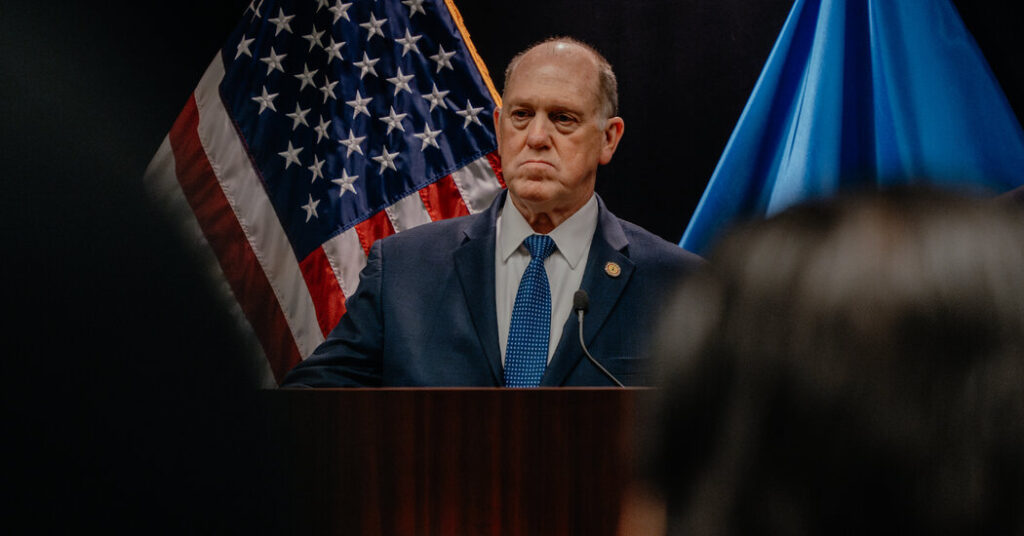
Tom Homan, the White House border czar, acknowledged on Thursday that federal deportation actions in Minneapolis have been flawed, but said there could be a “drawdown” if local officials allow his immigration agents access to local jails.
The two-month federal crackdown, known as Operation Metro Surge, has seen thousands of ICE and Border Patrol officers descend on the city. The operation has led to protests and violent confrontations in the streets and the killings of two residents shot by federal agents.
“I’m not here because the federal government has carried out this mission perfectly,” Mr. Homan said at a 7 a.m. news conference at the B.H. Whipple Building just outside of Minneapolis. “Certain improvements could and should be made.”
President Trump sent Mr. Homan to Minnesota this week, days after the death of Alex Pretti, 37, a Veterans Affairs nurse who had been recording a woman being arrested by an immigration agent when he was shot multiple times. His death came about two weeks after the fatal shooting of another Minneapolis resident, Renee Good, 37.
While Mr. Homan’s remarks were a rare acknowledgment of fallibility from the Trump administration, he refused to say how he felt about the killings.
“Do I have an opinion? Yeah. A personal opinion. I’m not going to share that with you,” he said.
“We’ll let the investigation play out,” he added.
Mr. Homan said that targeted immigration enforcement operations in Minnesota would continue, but skirted questions about how many federal agents are still in the region. “There have been some rotations,” he said.
He also defended his agents’ actions. “They are performing their duties in a challenging environment,” he said, “but they’re trying to do it professionally.”
Since arriving in Minnesota, Mr. Homan said that he has held meetings with Democratic state officials including Tim Walz, the governor; Mayor Jacob Frey of Minneapolis; and Keith Ellison, the state attorney general.
Those meetings centered on ICE operations and access to local jails. That access, he said, would make arresting people safer and more efficient.
Such an agreement with Minnesota officials would “allow us to draw down on the number of people we have here,” said Mr. Homan, who led ICE deportation efforts when the agency had access to many more correction facilities than it does now.
Policies regarding cooperation with immigration enforcement inside Minnesota jails vary from county to county. Some officials have made agreements with ICE to assist federal agents in deportations. Other corrections facilities alert the agency when a person subject to deportation is about to be released.
The Hennepin County jail — the state’s largest — does not share information with ICE as a matter of policy.
The Department of Homeland Security launched a website listing scores of immigrants it said had been taken into custody during the Minnesota crackdown.
But state officials said that several of the people that the agency said it apprehended were actually handed over by state prison officials after they completed their sentences. The state launched its own website: “Combating DHS Misinformation.”
Ernesto Londoño contributed reporting.
Chelsia Rose Marcius is a criminal justice reporter for The Times, covering the New York Police Department.
The post Homan Says ‘Improvements Could and Should Be Made’ in Minneapolis appeared first on New York Times.