1 p]:text-cms-story-body-color-text clearfix”>
You are a beginning or intermediate skier, allergic to long lift lines, more interested in peace and quiet than après-ski action. Or you have young kids, ripe for introduction to skiing or snowboarding. Or you simply want a rustic mountain getaway, one where you can amble through a woodsy little village with zero Starbucks.
These traits make you a good candidate for June Lake, the eastern Sierra town that lives most of its life in the shadow of bigger, busier Mammoth Lakes.
“It’s way family-friendlier than Mammoth,” said Daniel Jones after a day of June Lake snowboarding with Lorena Alvarado and children Gabriela Gonzales, 7, and Amirah Jones, 2. They had come from Riverside, a first-time visit for the kids.
Like me, they’d arrived in time to savor the sight of the Sierra under all the snow that fell in late December. That storm knocked out power for several days, but led to the opening of all the trails on June Mountain, the town’s ski resort.
The main road to June Lake is the 14-mile June Lake Loop, a.k.a. State Route 158, which branches off from U.S. 395 about 10 miles north of the exit for Mammoth, roughly 320 miles north of Los Angeles.
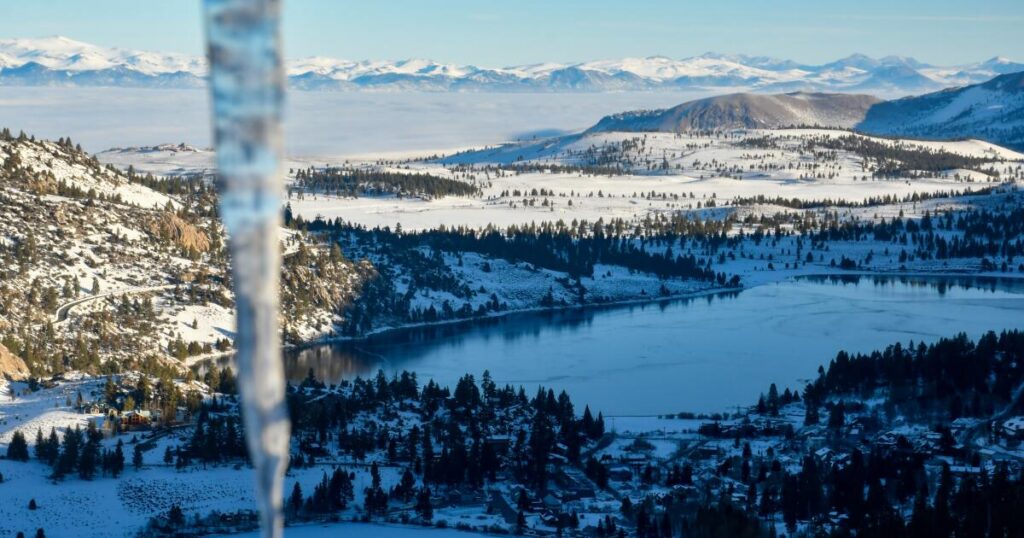
Once you leave 395, things get rustic quickly. The two-lane loop threads its way among forests and A-frames and cabins, skirting the waters of June Lake and the lake’s village, which is only a few blocks long. Check out the three-foot icicles dripping from the eaves and keep an eye out for the big boulder by the fire station on the right.
After the village, you pass Gull Lake (the tiniest of the four lakes along the loop) and the June Mountain ski area. Then, if you’re driving in summer, the road loops back to 395 by way of Silver Lake and Grant Lake.
But in winter, the northern part of that loop is closed to cars, Maybe this is why the village, mountain and environs so often feel like a snowbound secret.
As for the June Mountain ski area, its 1,500 accessible acres make it much smaller than Mammoth Mountain (with whom it shares a corporate parent). And it has a larger share of beginner and intermediate runs — a drag for hotshots, maybe, but a boon for families.
By management’s estimate, June Mountain’s 41 named trails are 15% beginner level and 40% intermediate. (At Mammoth, 59% of 180 named trails are rated difficult, very difficult or extremely difficult.) Leaning into this difference, June Mountain offers free lift tickets to children 12 and under. (Adult lift tickets are typically $119-$179 per day.)
The ski area is served by six chairlifts, and just about everyone begins by riding chair J1 up to the June Meadows Chalet (8,695 feet above sea level). That’s where the cafeteria, rental equipment, lockers and shop are found and lessons begin.
That’s also where you begin to notice the view, especially the 10,908-foot Carson Peak.
“Usually, me and my family go to Big Bear every year, but we wanted to try something different. Less people. And a lot of snow,” said Valeriia Ivanchenko, a 20-year-old snowboarder who was taking a breather outside the chalet.
“No lines and lots of big, wide-open runs,” said Brian Roehl, who had come from Sacramento with his wife.
“The lake views are nice, too,” said Roxie Roehl.
June Lake is a 30-minute drive from Mammoth. Because both operations are owned by Denver-based Alterra Mountain Co., Mammoth lift tickets are generally applicable at June. So it’s easy to combine destinations.
Or you could just focus on June Lake, an unincorporated community with about 600 people, one K-8 public school and one gas station (the Shell station where 158 meets 395).
In summer, when it’s busiest, fishers and boaters head for the lakes and you can reach Yosemite National‘s eastern entrance with a 25-mile drive via the seasonal Tioga Road.
In winter and summer alike, the heart of June Lake‘s village is dominated by the 94-year-old Tiger Bar & Café (which was due to be taken over by new owners in January); Ernie’s Tackle & Ski Shop (which goes back to 1932 and has lower rental prices than those at June Mountain); the June Lake General Store and June Lake Brewing.
At the brewery — JLB to locals — I found Natalie and Chris Garcia of Santa Barbara and their daughter Winnie, 18 months old and eager to chase down a duck on the patio.
“This is her first snow,” Natalie Garcia said, adding that June Lake “just feels more down-home … less of a party scene.”
“We built a snowman,” said Chris Garcia.
It’s fun to imagine that rustic, semi-remote places like this never change, but of course they do, for better and worse. The Carson Peak Inn steakhouse, a longtime landmark, is closed indefinitely. Meanwhile, Pino Pies, which offers New Zealand-style meat pies, opened in the village last spring. (I recommend the $13 potato-top pie.)
Next time I’m in town I hope to try the June Deli (which took over the former Epic Cafe space in the village last year) and the June Pie Pizza Co. (New York-style thin crusts) or the Balanced Rock Grill & Cantina. And I might make a day trip to Mono Lake (about 15 miles north).
I might also repeat the two hikes I did in the snow.
For one, I put crampons on my boots and headed about 3 miles south on U.S. 395 to the Obsidian Dome Trail, a mostly flat route of just under a mile — great for snowshoes or walking dogs.
For the other hike, I headed to the closed portion of June Lake Loop and parked just short of the barricade. Beyond it, a hiker or snowshoer finds several miles of carless, unplowed path, with mountains rising to your left and half-frozen Rush Creek and Silver Lake to the right.
“You get up to the lake and you hear the ice cracking. It’s wonderful,” said Mike Webb, 73, whom I met on the trail with his son, Randy, 46, and Randy’s 10-year-old and 12-year-old.
“This is serenity up here,” said Webb. “If you’re looking for a $102 pizza, go to Mammoth.”
2
Getting there
p]:text-cms-story-body-color-text clearfix”>
It’s a 320-mile drive from Los Angeles to June Lake, which is about 7,500 feet above sea level. Depending on weather conditions, snow tires or chains are sometimes required on U.S. 395 or State Route 158. Before any visit, be sure to check the status of those roads.
3
Where to stay
p]:text-cms-story-body-color-text clearfix”>
If you can afford its rates ($299 and up), the year-round Double Eagle Resort is the most comfortable hotel in the area. It stands along the June Lake Loop, about three miles beyond the village, 1.6 miles past the ski resort, with 32 rooms and cabins, a spa, a 60-foot indoor pool and a pair of ponds that staffers stock with fish in summer. I had breakfast and dinner, both pleasant, in the resort restaurant, Eagle’s Landing.
In the Heidelberg Inn, which opened in 1927, visitors find an enormous stone fireplace and stuffed bear in the lobby. Converted to vacation condos in the 1980s, the building looked tired to me (Jacuzzi closed, discoloration in lobby ceiling, DVD/VCR player beneath my TV) but service was helpful. Rates for one-bedroom units (with kitchens) start around $239.
Also in the village, with lower prices, the June Lake Villager Motel is a rambling property beneath a vintage mid-century sign. The Villager (roughly $150-$300 per night) has 24 units, of which 16 have kitchens. No two units are alike, but the several I saw were clean and comfortable.
The post ‘No lines and big, wide-open runs’: This woodsy ski town is like Mammoth without the crowds appeared first on Los Angeles Times.