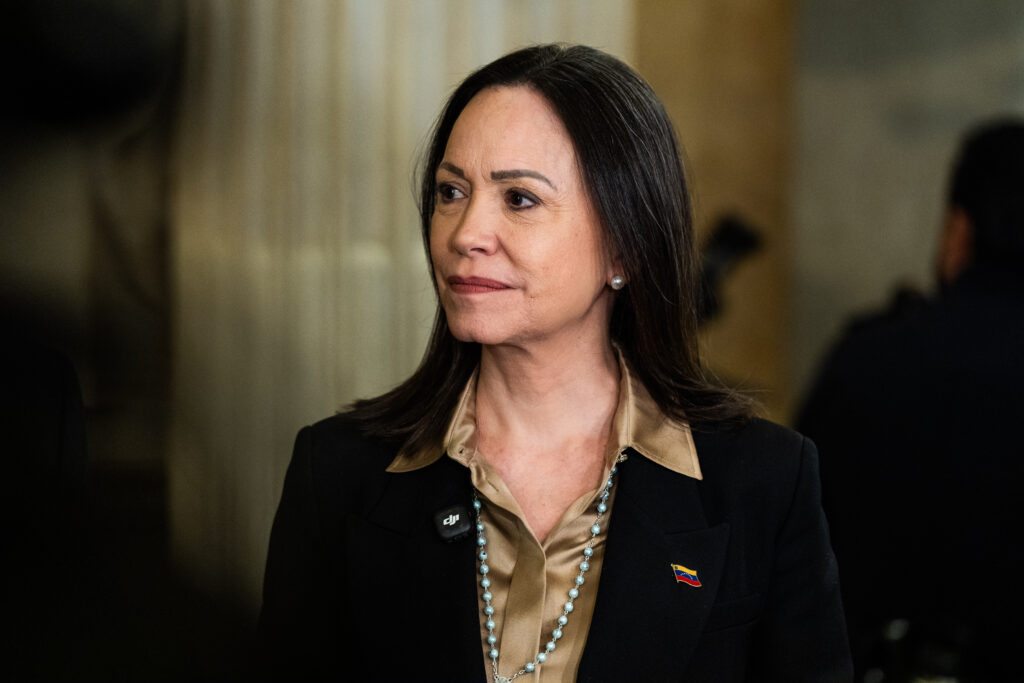
Venezuela’s leading opposition figure made a solemn request to House lawmakers during a closed-door meeting on Capitol Hill last week: “Tell the president that I want to go back to Venezuela as soon as possible,” said María Corina Machado, according to notes taken by a person in the room and reviewed by The Washington Post.
Her request for the message to be relayed to President Donald Trump suggested a disconnect between Machado and the Trump administration, which has praised the pragmatism of Nicolás Maduro’s successor, Delcy Rodríguez, and declined to provide a timeline for Machado’s return.
Advocates for the opposition leader, who saw Trump’s ouster of Maduro as a potential watershed moment for self-governance, have become anxious that Washington may prefer reliability over democracy.
“The administration should allow Machado’s return,” said Diego Area, who was forced to leave Venezuela after campaigning against Maduro in the 2015 parliamentary elections. “The administration has to use its leverage to induce political opening and structural reform.”
“Order without reform only postpones instability,” said Area, now the president of Global Americans, a think tank focused on Latin America.
Trump has made clear that the primary goal of ousting Maduro was not democratic change — the stated goal of past failed U.S. regime change efforts— but controlling the energy resources of Venezuela, which has one of the world’s largest oil reserves. “We take the oil,” Trump told the New York Post earlier this month.
The White House, State Department and Machado declined to comment.
On Wednesday, Secretary of State Marco Rubio hailed the progress Rodríguez was making in providing U.S. companies “preferential access” to oil production and “using revenues to purchase American goods.”
“It is our belief that her own self-interest aligns with advancing our key objectives,” Rubio wrote in prepared remarks to senators on Capitol Hill.
While leaving open the possibility of future military action if Rodríguez does not obey U.S. orders, Rubio approvingly noted her pledges to “cooperate with the United States” and “end Venezuela’s oil lifeline to the Cuban regime.”
The surprisingly durable relationship between Trump and Rodríguez, a longtime Maduro ally who oversaw Venezuela’s ruthless intelligence services, has been a disappointment to Machado’s advocates, who view the Nobel Peace Prize laureate as the country’s legitimate leader.
That’s because ballot audits by The Washington Post and independent monitors showed Edmundo González, the stand-in for Machado after Maduro’s government barred her from running, won more than two-thirds of the 2024 vote. Maduro claimed reelection regardless.
Democrats have accused the Trump administration of putting a positive spin on Rodríguez’s compliance to justify Trump’s brazen decision to stage a military attack on Venezuela and apprehend its leader under the guise of a law enforcement action without congressional approval.
“We’ve traded one dictator for another,” Sen. Jeanne Shaheen (New Hampshire), the top Democrat on the Senate Foreign Relations Committee, told Rubio during Wednesday’s hearing.
Rodríguez has taken “no steps to diminish Iran, China or Russia’s considerable influence in Venezuela,” Shaheen said, and her cooperation with the United States “appears tactical and temporary, not a real shift in Venezuela’s alignment.”
Rubio stressed that democratic transition takes time after so many years of rigid authoritarianism under Maduro and his predecessor Hugo Chavez.
“This is the first time in over a decade that we see even the glimmer of an opportunity to change conditions,” he said.
When pressed whether it would be a “success or failure” if Rodríguez was still in power in six months, Rubio said “in six months, we expect to be further along,” but he did not provide specifics.
A huge factor will be reconciliation among the Venezuelan opposition, which Rubio called a “very diverse” collection of longtime Maduro opponents and more recently disaffected Venezuelans.
What’s left unspoken is that Machado returning to Venezuela poses a near-term threat to Trump’s plan for stabilizing the country and opening it up to massive investments from multinational oil companies, said David Smilde, a Venezuela expert and professor at Tulane University.
“You could imagine Machado holding a big rally in Venezuela with hundreds of thousands of people marching on the palace and creating conflict in the streets,” he said. “That doesn’t align with the economic normalization policy that Trump is trying to implement.”
The United States would also be unable to guarantee Machado’s safety, said Geoff Ramsey, a Venezuela expert at the Atlantic Council.
“The Trump administration’s focus now seems to be stabilizing things and laying the groundwork for economic recovery,” he said. “It would be easy to envision the arrest of Machado upon her return as throwing a wrench into Washington’s plans.”
Rubio met with Machado at the State Department on Wednesday.
When she emerged from the meeting, she told reporters she would not accept a power-sharing agreement with “criminal” elements in the current government.
“We are willing to facilitate a genuine transition,” she said, “but not a Russian-style transition where mafias remain in control. Venezuela does not need stability for criminals — it needs justice, truth and freedom.”
She reiterated her desire to return to Venezuela soon and said Caracas must provide security guarantees to the opposition, including the millions of Venezuelans living abroad.
Trump raised serious doubts about Machado’s prospects as a leader following Maduro’s capture in early January, saying she did not have the support necessary to run the country. In a bid to win over his support, Machado gave him her Nobel Peace Price but he has since offered only middling support for her. “Maybe we can get her involved some way,” he said after accepting her Nobel Peace Prize.
During her meeting with lawmakers last week, Machado asked GOP lawmakers to convey to Trump that she would be most effective in her home country. “I am more helpful to his cause from Venezuela than here,” she said, according to notes from the meeting that were reviewed by The Post.
Multiple lawmakers who met with Machado during her appearances on Capitol Hill said she didn’t say whether the administration would facilitate, or support, her return.
“She wouldn’t answer specifically the conversation she had with the president on democracy,” said Rep. Gregory W. Meeks (New York), the top Democrat on the House Foreign Affairs Committee. “She just said that clearly they did not have probably the same time table.”
There is widespread bipartisan support inside Congress for a transition to democracy within Venezuela, led in large part by Florida Republicans who have long called for an end to the Maduro regime.
“She’s very excited to go back to Venezuela … but certainly understands the security concerns,” said Rep. Brian Mast (Florida), the committee’s Republican chair, who said he fully expected the administration to support Machado’s return.
Rep. Carlos A. Gimenez (R-Florida), who has met with Machado multiple times in recent months, said that the Trump administration would first need to reach an agreement with the interim government in Caracas to ensure the security of Machado and any other opposition leaders.
It remains unclear if securing such an agreement is in line with the Trump administration’s plans.
“The Trump administration has shown no interest in democracy anywhere else in the world. Why would they here?” said Smilde, the Tulane professor. “Their plan is to stabilize the country and it’s easy to see how they might not view Machado as part of that plan.”
The post Friction emerges between Trump and Venezuelan opposition over Machado’s return appeared first on Washington Post.