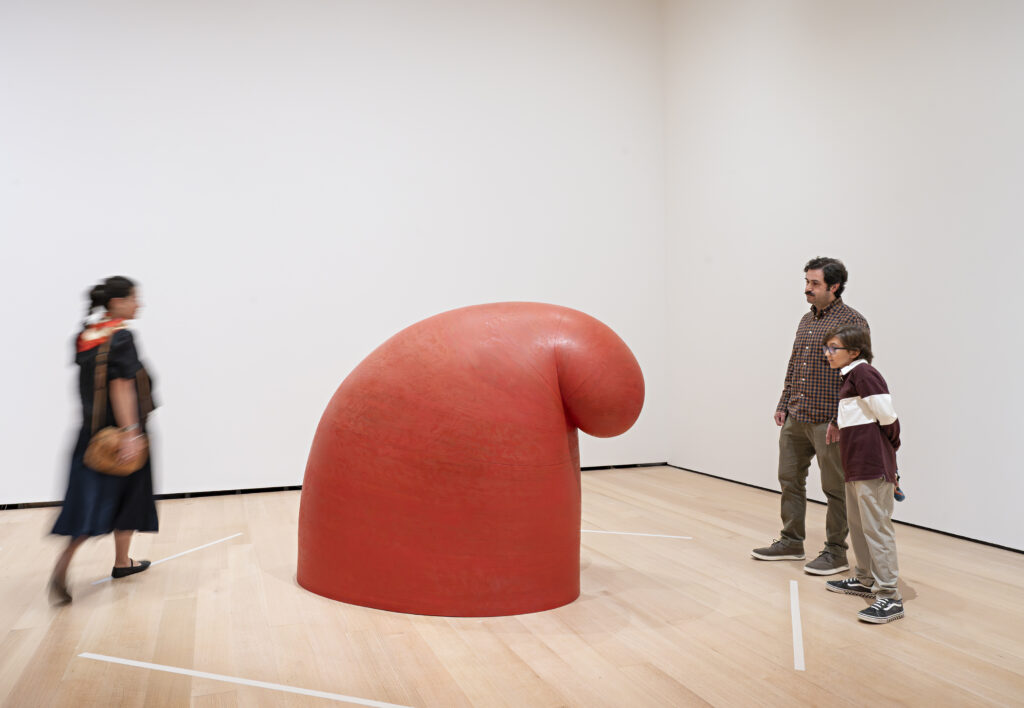
BOSTON — Coming upon a sculpture by Martin Puryear can be like greeting a cowled monk standing sentry at the gates of a mountain monastery. You can try using your words. But chances are nothing will come back. You’re best off finding some other way to build rapport.
The great American artist, who represented the United States at the 2019 Venice Biennale, is the subject of a traveling career survey at the Museum of Fine Arts, Boston, this winter. Organized by Emily Liebert with Reto Thüring, it will travel to the Cleveland Museum of Art in the spring and the High Museum of Art in Atlanta in the fall.
Puryear is a first-rate draftsman and printmaker, but he’s best known for his sculptures, which register as both three-dimensional forms and poetic images. They may, over time, produce meanings. But Puryear’s ambivalence about this second function is palpable. Meanings, after all, are just another kind of noise. So much of Puryear’s work, as the architect Billie Tsien notes in the catalogue, “feels as if it is trying to make the world more quiet.”
Having come across a Puryear masterpiece in a Swedish forest last year, I can vouch for Tsien’s take. “Meditation in a Beech Wood,” as the piece is titled, seemed to be imploring even the birds and the breeze to quit their histrionics.
Deranged by noise, we crave quiet. To spend time with Puryear sculptures like “Alien Huddle,” “On the Tundra,” “Big Phrygian” and “Noblesse O” is to sense the power of certain kinds of silence or opacity.
But there’s more to them than that.
“I am soft sift/ In an hourglass,” wrote Gerard Manley Hopkins — “at the wall/ Fast, but mined with a motion, a drift,/ And it crowds and it combs to the fall.” Hopkins’s image of sand in an hourglass, undermined by its own weight, is both sculptural and kinetic. To read it is to imagine yourself circling around the hourglass looking for signs of the sand’s silent, ineluctable motion.
You circle around the sculptures of Puryear, 84, in a similar spirit. But, as Hopkins wrote, we are “mined with a motion, a drift.” It’s that drift — call it doubt, call it mortality — that powers the production of meaning.
Like the wake formed by an advancing boat, the meanings of Puryear’s sculptures trail behind their formal and material richness. They’re suggested as much by the recurrence of a form in different contexts as by the forms themselves.
One bronze sculpture, for instance, was inspired by a type of headwear, a fila gobi cap, worn by the Yoruba people of West Africa. Cast from an open-mesh-like structure made from rattan and twine knots, it has a drooping component that links it to Phrygian caps worn by formerly enslaved people, freed by manumission, in ancient Rome. These Phrygian caps were adopted in turn by French revolutionaries to symbolize freedom and democratic values, and they also appeared in the context of the American Revolution.
The very elasticity of these meanings — their adaptability to different situations in history and to different forms in Puryear’s work — keeps the assertion of meaning both in play and at bay. Whenever the noise of interpretation around his work rises to a din, Puryear is always there, smiling like a benign monk, with a gentle hand gesture that signals “hush.”
Puryear has a penchant for rounded, three-dimensional forms that are heavier or more bulbous above than below. As a result, many of them appear in tension with gravity. A recurring theme in his work, as Julia Phillips notes in the catalogue, is “the dramatic turning point, the moment gravity gets the best of the volume.”
What happens then — at least in the viewer’s imagination — is that the static sculpture begins to move, transforming itself from a mere object into a kind of event. Not just evidence of a process (how was it made?) but a prompt to speculation (what will happen next?).
Hopkins again: His poem “The Windhover” describes the flight of a falcon as a phenomenon, an expression of natural virtuosity and the achievement of a dynamic equilibrium: “Striding/ High there,” he wrote of the falcon, “how he rung upon the rein of a wimpling wing/ In his ecstasy! then off, off forth on swing,/ As a skate’s heel sweeps smooth on a bow-bend: the hurl and gliding/ Rebuffed the big wind. My heart in hiding/ Stirred for a bird, — the achieve of, the mastery of the thing!”
On the face of it, Puryear’s sculptures are much less dynamic than this. Even those suggesting animals (perched falcons, crouching cats, pointy-nosed moles) are in states of repose. They are conspicuously still.
But they’re enlivened by a tremendous latent energy. Puryear’s forms can be (among other possibilities) open, closed, elliptical, spherical or conical. But as you try to describe them, verbs begin to feel more useful than adjectives: circling, spiraling, slumping, drooping, creasing, connecting, tapering, twisting, pleating, looping.
Birds are one recurring motif. Puryear fell in love with gyrfalcons when he was a boy, having discovered them in folios of John James Audubon’s “Birds of America” at the Smithsonian’s Museum of Natural History. (He was born and raised in Washington.) He went to the zoo, too: “A zoo can be as stimulating as an art museum,” he rightly notes.
You can feel the spirit of Constantin Brancusi’s abstracted birds behind “On the Tundra,” a hooded, avian form that Puryear has addressed in bronze, white marble, glass and wood. But Brancusi’s drive toward a sublimated purity of form holds limited interest for Puryear, who also rejects the modernist avant-garde’s aversion to anything looking like “craft.”
Puryear loves vernacular traditions and is fascinated by utilitarian objects. A committed and curious traveler, he has been a student of local craft traditions wherever he has lived. Those places include Sierra Leone and Stockholm, where he lived in the ’60s, and Japan, which he visited in 1982, on a Guggenheim fellowship, to study architecture and garden design.
Like any good woodworker, Puryear, who lives in Upstate New York, sees his work as a collaboration with the living material. Wood, as he points out, is always moving as you work. “It’s shrinking and swelling all the time.”
Puryear sometimes works with softer woods, including red cedar, basswood, pine and spruce. Elsewhere he will choose dense, durable woods such as black locust, pear wood, maple or oak. Each decision makes sense for the form, although not always with a straightforwardly modernist form-follows-function logic.
Puryear also works with cast iron, aluminum, gold leaf, hemp rope, rawhide and marble. All his works are distinct — they all emanate silent power — but certain forms and ideas recur. Cumulatively, they create a kind of soft and beautiful babble, a murmuration.
Sometimes the babble speaks of politics and history. As his exhibition in Venice made clear, Puryear, who is African American, has long grounded his work in an appreciation of liberty and justice — and what it means to be deprived of them.
He has made works concerning Sally Hemings (the enslaved woman believed to be the mother of some of Thomas Jefferson’s children), Booker T. Washington, Jim Beckwourth (a biracial frontiersman who was born to an enslaved woman and an enslaving father) and the Great Migration (via Jean Toomer’s novel “Cane”). His appreciation of various cultural traditions in Africa is at one with his ethical approach, as is his love of the natural world.
Puryear’s sculptures can be as solid and opaque as a brickwall. But he also loves basketry and mesh and other open forms. When he wants extra malleability, he might use birch plywood or rattan. But, as if to keep us guessing, he will cast a woven rattan and twine structure in hardest bronze. Some of his most commanding works involve thatching or rawhide.
Some artists’ importance isn’t established until after their death. What I find striking about Puryear is how timeless his work already seems. You feel that his sculptures’ latent energies will keep folding over in the imagination, like rich cake batter in a mixer, for decades to come.
Martin Puryear: Nexus Through Feb. 8 at the Museum of Fine Arts, Boston. It will travel to the Cleveland Museum of Art (April 12-Aug. 9) and the High Museum of Art in Atlanta (Sept. 25-Jan. 17).
The post A great American artist who urges us all to hush down appeared first on Washington Post.