Benedict Bridgerton is a rake.
At least, he is according to his sister Eloise (Claudia Jessie), who playfully tosses at him the 17th-century insult for a promiscuous man unbothered by propriety — an enduring trope of the romance genre. Their mother, Lady Violet (Ruth Gemmell), thinks similarly of Benedict (Luke Thompson). She worries her second son will never settle down or, worse, that his irresponsible behavior will besmirch the family’s good name and somehow ruin the chances of his younger siblings marrying.
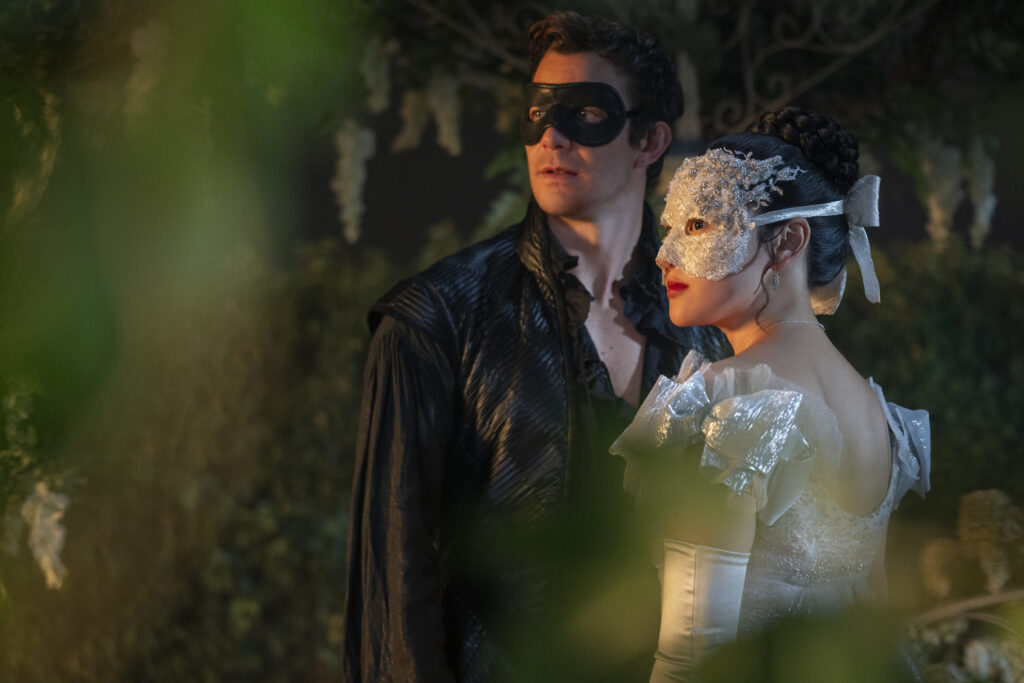
So imagine her excitement when Benedict, bullied into attending a masquerade ball, is finally allured by a young lady. But her identity eludes him, save for the satin glove she accidentally leaves behind. Violet encourages her lovestruck son to find the glove’s owner, not knowing — as the audience does — that it was worn by Sophie Baek (Yerin Ha), the illegitimate daughter of an earl, whose stepmother, Araminta Gun (Katie Leung), makes her work as a maid after her father’s untimely death.
This Cinderella story fuels Part 1 of “Bridgerton’s” conventional fourth season, which consists of four episodes (now streaming on Netflix) that entertain but fail to make much of an impression beyond that. Part 2 will premiere Feb. 26. As in previous seasons, the Regency-era drama based on the book series by Julia Quinn centers on a single Bridgerton sibling but loops in supporting storylines involving the others, including Eloise, who rejects high-society expectations and resolves to become a spinster; Francesca (Hannah Dodd), a bashful newlywed who struggles with intimacy in her marriage to Lord John Stirling (Victor Alli); and Hyacinth (Florence Hunt), the youngest Bridgerton sister, who cannot wait to be out in society.
Part 1 — members of the press received screeners for only those four episodes — sticks with what has worked for the show so far. Characters attend lavish balls while dressed immaculately, thanks to costume designer John Glaser. They discuss gossip from Lady Whistledown’s latest column while promenading through the park, as Penelope (Nicola Coughlan) has not allowed her marriage to Colin Bridgerton (Luke Newton) or the revelation of her secret identity among close friends, family members and even Queen Charlotte (Golda Rosheuvel) stop her from continuing her pot-stirring literary pursuits.
Given this formula, whether or not a specific season of “Bridgerton” clicks relies on how compelling its main couple is; this time around, their chemistry captivates enough. No pairing has been able to replicate the electricity between Season 2’s Anthony Bridgerton (Jonathan Bailey) and Kate Sharma (Simone Ashley), but Benedict and Sophie still intrigue because they are polar opposites. While he has enough privilege to defy societal expectations without a second thought, she must operate more carefully. He offers her freedom, while she provides him with some stability. When he meets her again as a maid, not realizing she is the same woman he encountered at the ball, it introduces a level of class consciousness the show has sorely needed.
Thompson is charming as ever, luxuriating in his character’s bisexual chaos — we witness Benedict kissing at least one man this season — while commanding enough dignity to convince viewers that this rake is, in fact, capable of becoming an honorable gentleman. Ha deserves a great deal of credit for playing Sophie with a degree of stubbornness, lending spice to a character written rather blandly (in Part 1, at least). Perfect heroines are a bore; why should men get to have all the fun?
This season goes down as smoothly as its predecessors. “Bridgerton” doesn’t strive to be much more than fluffy entertainment, and that seems to satisfy its loyal audience. But you have to wonder what the show could become if it ever broke through the fantasy, like its superior spin-off “Queen Charlotte,” which delved into King George’s mental illness. We know “Bridgerton” takes place in a society free of period-accurate racism — the queen, who is Black, establishes early on that her interracial marriage basically eradicated such prejudice — but the accompanying lack of cultural specificity denies deeper characterization to a non-White protagonist such as Sophie. (It was said Kate traveled to England from India, but Sophie’s ethnicity — the actress who plays her is of Korean descent — has not been mentioned.) It also remains unclear whether Benedict would be cast out of society were his sexual fluidity ever publicized.
The stakes aren’t high enough to elevate the season. Araminta, for instance, would make a more compelling villain if the reasons behind her malice toward Sophie were more clearly explained. Instead, all we get is the implication that she is still upset, seemingly more than a decade later, that she didn’t know the earl had a child out of wedlock before she married him. Leung, known for playing Cho Chang in the Harry Potter film series, is a capable actress who doesn’t quite receive the material she deserves here.
Some of this may change when the latter half of the season drops, but it would be a (pleasant) surprise for the series to switch gears this late in the game. When one of high society’s scheming mothers declares, “Reformed rakes make the best husbands,” it’s pretty clear where the rest of this story will go. Great gowns, beautiful gowns — and not too much more.
Bridgerton Season 4: Part 1 (Four episodes) is now streaming on Netflix. Part Two (Four episodes) premieres Feb. 26.
The post ‘Bridgerton’ tells a Cinderella story in its predictable fourth season appeared first on Washington Post.