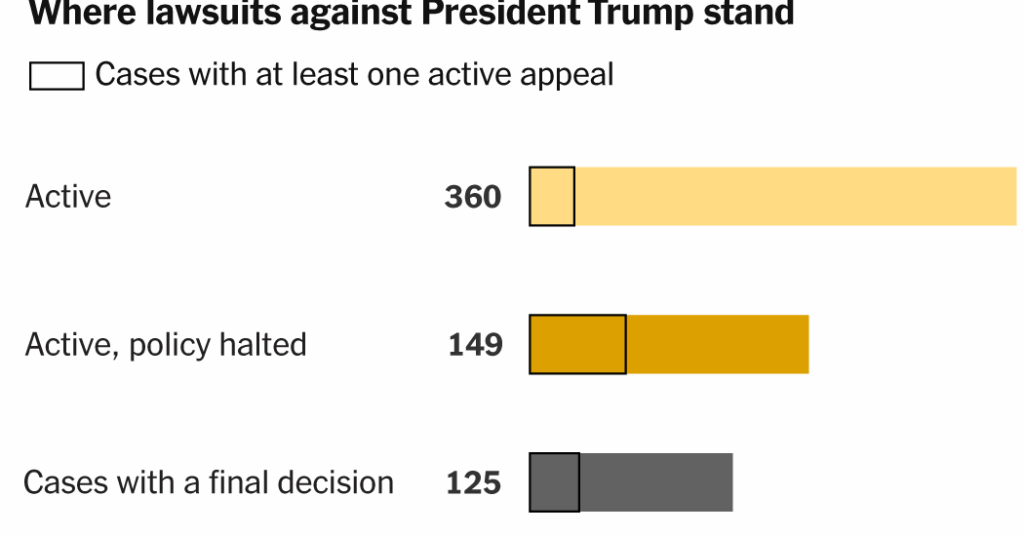
The New York Times has been tracking every lawsuit challenging President Trump’s policies since he returned to office in January 2025 — more than 600 cases and counting.
The plaintiffs span the wide range of people affected by Mr. Trump’s agenda. Immigrants have challenged their removal from the country. States have asked the courts to unfreeze billions of dollars in congressionally appropriated funds. Schools and universities have pushed back against attempts to set new parameters around speech and research on their campuses.
The Times has sued as well, over restrictions that the Defense Department has imposed on reporters covering the military.
The volume and stakes of the litigation have put an unusually bright spotlight on the often unheralded work of district court judges. Normally, the 677 active-status judges toil at the bottom rung of the federal judiciary. Today, they are on the front lines of a clash between two branches of government. They have faced harsh criticism from the White House and rising threats to their safety, and have complained about the Supreme Court’s penchant for overriding their rulings on its emergency docket.
The Times’s tracker for the many lawsuits against the Trump agenda can be found here. Looking back over the administration’s year in court, here’s what we found:
Trump often lost in the district courts.
On the whole, the district courts tended to push back on Mr. Trump. On final merits rulings from district court judges, the plaintiffs who sued the administration won 48 times and lost only five times.
An earlier Times analysis also found that district court judges tended to rule against the administration. Counting preliminary rulings as well, that analysis found that the judges ruled in favor of Mr. Trump’s agenda only 25 percent of the time in 2025.
The administration’s record appears somewhat better, however, if you look more broadly at the number of times Mr. Trump’s policies have been halted. Out of 509 active cases, the administration’s policies have been halted 149 times — about 30 percent of the time.
In the remaining 70 percent of active cases, Mr. Trump’s policies remain in effect despite court challenges. Many of those wins by the administration came after it appealed cases to the circuit courts and the Supreme Court.
Trump won more often on appeal.
Appeals court judges treated Mr. Trump more favorably than their district court counterparts, ruling in his favor 51 percent of the time in 2025.
Much of that support at the appellate level came from judges whom Mr. Trump appointed during his first term. In 2025, they voted in his favor 92 percent of the time.
Mr. Trump’s comparative success on appeal is most likely driven in part by the selection of cases that reach those courts. Not every ruling is appealed, and the government has a greater incentive to appeal rulings when it believes the chances of winning a reversal are strong.
Other factors driving Mr. Trump’s appellate record that have been cited by experts include changes to the judicial confirmation process that made it easier for Mr. Trump to appoint judges in his first term who share his views, the rise of maximalist theories of executive power among the conservative legal community and the unique characteristics of judges appointed by Mr. Trump during his first term.
The Supreme Court usually sided with Trump, but that could change.
In 24 cases in 2025, the Supreme Court started to contemplate the Trump agenda, mostly considering whether to issue temporary orders allowing pieces of it to take effect even as they were challenged in court. It ruled in Mr. Trump’s favor 21 times. However, the vast majority of those rulings were on the court’s emergency docket. That means that while they carry some weight as precedents for the lower courts, they are not final decisions about the underlying legality of the contested policies.
There are some early indications that the Supreme Court may take a different approach in 2026. The court’s final ruling of 2025 blocked Mr. Trump’s deployment of National Guard troops to Illinois and had implications for other states.
This year, the nation’s highest court is starting to hear a series of what are called merits cases related to Mr. Trump’s second-term policies. These are cases that have already been fully heard by the lower courts. The parties have then appealed to the Supreme Court, filing extensive written briefs and appearing before the justices for oral arguments.
The court took a skeptical tone in two cases it heard recently related to Mr. Trump’s agenda. One involved Mr. Trump’s attempt to reshape the economic order by unilaterally imposing tariffs, and the other was about his attempt to fire a member of the Federal Reserve’s Board of Governors.
Rulings on both matters are expected in the coming weeks and months, along with a third case in which the court appeared warmer to Mr. Trump’s views, testing his ability to fire independent regulators. The court has also said it will hear arguments in a fourth Trump-related case this year to decide whether an executive order Mr. Trump issued revoking birthright citizenship is constitutional.
The lawsuits will continue.
The Times’s tracker is following 634 lawsuits against the administration. Of those, 509 are still active. New cases are filed most every day.
During the first weeks of the administration, almost all of the significant action took place within the district courts, as Mr. Trump signed a raft of executive orders and state attorneys general and other litigants rushed to courthouses around the country in an attempt to block them. District court judges will continue to play an important role in deciding the legality of the administration’s agenda.
But today, a greater share of cases have percolated upward to the appellate level. Dozens have also been consolidated, or combined with similar cases to be decided together. Appeals courts have begun to issue final rulings that are binding precedent in the region of the country where they sit, and the Supreme Court has said that even its emergency rulings are intended to guide the actions of lower-court judges in similar cases.
So compared with the start of Mr. Trump’s second term, appellate courts and the Supreme Court now play a larger role in deciding the legality of administration policies. Moving forward, the role of the circuit courts and the Supreme Court in weighing Mr. Trump’s agenda is likely to increase further.
The post What We Learned After Tracking Every Lawsuit Challenging Trump’s Policies appeared first on New York Times.