If you want to understand how Robert F. Kennedy Jr. became the face of American public health, you have to go back to the Covid era.
In the face of a once-in-a-century — we hope — pandemic, medical authorities felt they needed to respond with absolute certainty: Trust the science. Wear a mask. Postpone your wedding. Don’t open the schools. And definitely don’t listen to the cranks, the skeptics and the purveyors of “misinformation.”
The problem is that those confident authorities, inevitably, got some big things wrong. And the outsiders and skeptics sometimes got things right. And as pandemic-era life got more and more miserable, big parts of the public simply stopped trusting the experts entirely.
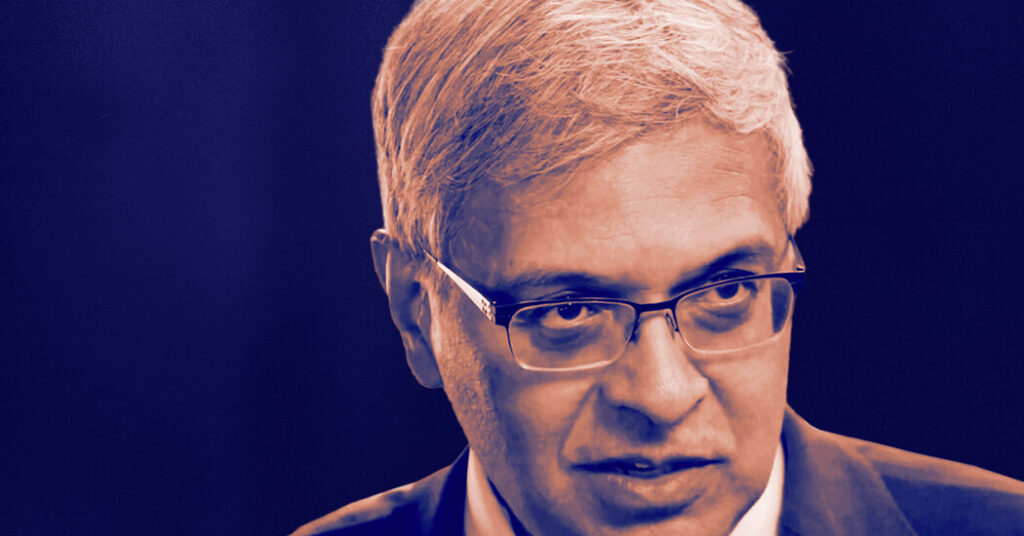
So now here we are in 2026, and the outsiders are in charge. One of them is Dr. Jay Bhattacharya. He’s in charge of the N.I.H., tasked with reforming the world’s largest biomedical research agency. But the more important task, to my mind, is proving that an outsider perspective can succeed in restoring public trust in science and medicine — as opposed to undermining that trust even further.
Below is an edited transcript of an episode of “Interesting Times.” We recommend listening to it in its original form for the full effect. You can do so using the player above or on the NYTimes app, Apple, Spotify, Amazon Music, YouTube, iHeartRadio or wherever you get your podcasts.
Ross Douthat: Dr. Bhattacharya, welcome to “Interesting Times.”
Jay Bhattacharya: Thanks for having me on, Ross.
Douthat: I want to start with a general diagnosis of the collapse of public trust in the medical establishment in America and how I think the Covid-19 pandemic played into it.
So just start by talking me through your view of what happened during Covid, which was also, I should say, when you first became a public controversialist.
Bhattacharya: [Chuckles.] Am I that now?
Douthat: I mean, you’ve joined our ranks. I’m sorry to say. But, yeah, talk about Covid as a public health phenomenon.
Bhattacharya: Can I just start with where I came from into the Covid era?
Douthat: Yes.
Bhattacharya: I was a professor at Stanford for 20-some years up to that point, in 2020. I’d written what I thought were provocative papers.
Douthat: I mean, I read them obviously,
Bhattacharya: Obviously. No, like five other people have.
But the Covid era, to me, represented a fundamental break in my understanding of how science and public health operated.
I guess I was naïve before the pandemic. I would tell my students: “Don’t join Twitter” — it was Twitter back then. “Just publish your papers in scientific journals. That’s how you make a big difference in the world.”
I thought public health had the best interest of the working class, the poor, in mind. And the Covid era shattered my illusions on all of those fronts. In particular, what happened in March of 2020 represented a fundamental break that public health authorities had with the public.
And I can understand why it happened. I mean, you have a virus floating around that’s new. You get reports out of China, essentially, that it’s a 3, 4, 5 percent mortality rate.
Douthat: Right. You have videos of people collapsing on the street.
Bhattacharya: And so I could understand at the time, especially in the face of deep uncertainty, that something had to be done to guide people.
But what you’re not allowed to do is assume that the thing you’re doing is going to work. Right? “I’m going to do a lockdown; that’ll solve the problem.”
You’re also not allowed to assume that the thing that you’re doing will have no harms. So you close the schools. You know for certain that you’re going to harm a generation of children. That’s a certainty. Will that suppress the spread of the disease? We don’t know how the disease spreads. Is it aerosol? Is it droplet?
There’s a hundred uncertainties. You still have to do that kind of honest calculation, and you have to convey that deep uncertainty to the public at large.
Douthat: So you’re deeply critical of lockdowns and closures. But from my perspective, at the time, it seemed like we didn’t know how serious the disease was. We didn’t know how it affected children, for instance, in schools. I had little kids in school at the time, and it seemed to me that there was an argument, essentially, for two weeks, a month, of these policies as extreme but temporary measures. Do you think that there is room for taking extreme measures like we took in that period as a means of buying time?
Bhattacharya: I could be persuaded that that could be a reasonable thing potentially, but let’s think about the actual context. So in March of 2020, I wrote an op-ed in The Wall Street Journal — it’s the first time I ever wrote an op-ed in my life. You’re an old hand at this, but it was a weirdly scary thing. [Chuckles.]
Douthat: Once you’ve crossed that line, you can never recross it. It’s true.
Bhattacharya: I wrote this op-ed and I did some calculations using the Diamond Princess — remember that cruise ship that was floating around?
Douthat: Yep.
Bhattacharya: You could see the relative risk really, really easily in the data. It was really older people that were at high risk of dying from the disease. So that key epidemiological fact was known, I’d say, by January 2020.
And so, I fully expected two things to happen almost immediately in, say, March or April of 2020. One was that we would do a much better job protecting vulnerable older people and conveying to the public at large the absolute necessity of doing that. For instance, not sending Covid-infected patients to nursing homes.
The second problem was a lack of urgency on the part of public health authorities to develop scientific evidence to clear up uncertainties to guide decision making. So I wrote a study very early on in the pandemic, in April of 2020, estimating how many people in Santa Clara County, where I used to live, had been infected. And it was about 3 percent of the population in early April 2020. That doesn’t sound like a lot, but for every infected person who had been identified as having had the disease, there were 50 people walking around with antibodies.
I did a replication study in L.A. County a couple weeks later — same result. And then dozens and dozens of studies all around the world, including at the N.I.H., found this very, very similar result, that the disease has spread much more widely than people had thought.
This is how naïve I was, Ross: I thought that that result would change everybody’s mind about how to manage the pandemic. This is a disease that’s obviously spread much more widely than people realized despite — I mean, I call them draconian measures to try to keep the spread down. That means the infection fatality rate on average for the whole population was much lower than we thought.
I thought that would’ve changed our approach, but that didn’t happen. Instead, I faced, essentially, attacks on my character, an attempt to destroy my career, questions about the integrity of my work that were completely spurious.
Douthat: What form did those attacks take?
Bhattacharya: At the university, there was an investigation into the study’s funding, all of which had been cleared up before the study was even done. It was entirely spurious. At the N.I.H., the former head of the N.I.H. wrote an email to Tony Fauci in October 2020 calling me a “fringe epidemiologist” — I love that term, by the way.
Douthat: Yes.
Bhattacharya: It’s fantastic. It’s hopefully going to go on my grave.
The whole thing was absolutely extraordinary. What was needed was an honest scientific debate.
I might’ve been wrong. Like, look, let’s have a scientific debate and discussion. Let’s have alternate voices. But instead, the ethos of public health was that just having the debate at all was a dangerous thing.
That’s, if you want to ask me — you started with what went wrong — that is the fundamental thing that went wrong.
Douthat: And what is your diagnosis of why there was such a closing of ranks?
Bhattacharya: So I think there’s two levels to this, all right? First of all, this is an analogy to this. When you’re a third-year medical student — I was in medical school once — that’s the first time you see patients. You put on a white coat and, my God, the effect that putting on a white coat has on the desire for the patients to tell you stuff. People tell you everything about their lives. And they have problems that they want you to solve. And the instinct that you have with the white coat on — you’re 24 years old, 25 years old — is to answer their questions, even when you don’t know the answer.
All of public health found itself in that position. They’re facing an uncertain threat. There’s no real science yet about it. It’s a brand-new disease. The entirety of society is looking at them, saying: “What should we do about this? What’s the wise, right thing to do about this?” And you don’t know the answer.
As a med student, you have to learn to say, “I don’t know.” You have to learn to say that. It’s not an easy instinct. And public health failed at that, at large. So they looked to leaders, like Tony Fauci and others, to guide them on what to say in that setting. And those leaders also failed at that.
The second element is what happened to potentially cause the pandemic. I believe — and I think a lot of scientists agree with me — that the best available evidence suggests that the pandemic was the result of a lab accident that happened in Wuhan, China.
Douthat: What are the percentage odds of that being true would you say?
Bhattacharya: My view is it’s pretty close to certain. But again, scientists disagree with me on this. I don’t want to — —
Douthat: Well, and we don’t have the smoking gun in terms of the minutes of the Communist Party meeting where they acknowledge it’s a lab leak or something like that. So it is as much a scientific debate still as a kind of intelligence community debate.
Bhattacharya: I think if you just focus on the scientific evidence alone, I wouldn’t say it’s certain. Again, there’s legitimate, excellent scientists who don’t think it was a lab leak. I tend to be on the side of the scientists who think it was a lab leak, based on other things.
There was a whole effort by the scientific community — by the N.I.H., the Chinese scientific groups and European groups — to essentially prevent all pandemics. The research program was: You go into the wild places. Find viruses in those wild places — —
Douthat: Right. Find the bats.
Bhattacharya: Find the bats.
There’s one trillion or more viruses out there, most of which do not have any chance of infecting humans. But you don’t know which of those viruses that you’re pulling out of the wild places and into the lab are likely to jump into humans.
And so the argument was, in this 2003-to-2020-something era, that we have to manipulate those viruses and make them potentially more dangerous and more infectious to humans, in order to triage and identify the viruses and pathogens that are closer to making the leap into humans in some evolutionary sense. And then prepare countermeasures.
Douthat: This is what so-called gain of function research is trying to do? It’s trying to essentially hype up multiple viruses, and the ones that become the most deadly are the ones you try and treat?
Bhattacharya: Yes. Or in advance of it ever infecting a human being. The utopian promise was that we are going to prevent the world from ever having to suffer from a virus making the leap from a natural location into humans ever again. That was the utopian vision.
Obviously there’s problems with the vision, but the countermeasures that you develop for those pathogens in the lab, that you’ve never made leap into humans, will obviously never have been tested in humans. Like the vaccines you develop, because no human has ever been infected by that ——
Douthat: Right. So you’ll have a set of vaccines whose efficacy is hypothetical.
Bhattacharya: Right. Or it could be other kinds of measures, but let’s say vaccines.
Douthat: So, part of the scientific establishment was committed to this project — —
Bhattacharya: Including the N.I.H.
Douthat: Including the N.I.H. And there was, at the very least, a good chance that that led to Covid-19 and the pandemic. Why then do you think that overcommitted the establishment to school closures, mask mandates and everything else? What is the link there?
Bhattacharya: OK, so what if you opened Pandora’s box? What would you do? You’ve unleashed hell on the world. And you’ve done it. You’re responsible for it. What would you do?
Douthat: Go to confession.
Bhattacharya: [Laughs.] Well, you’re a Christian.
Douthat: What would you do?
Bhattacharya: God willing, I never have to be in that position, but the idea is I’m going to try to shut it — —
Douthat: Shut it down.
Bhattacharya: With whatever means I can, at my fingertips, to make that happen. Powerful people in public health have a lot of means, it turns out — we learned in 2020 — to try to do that.
Douthat: But are you saying they tried to shut down knowledge and debate about the origins? Or are you saying that the attempts to crush Covid itself through lockdowns and so on were a kind of expression of guilt? Like, “I have to be able to crush this disease because I, myself, released it.”
Bhattacharya: I’m saying both. So imagine that you’ve done this. You’ve recommended the lockdowns, you’ve recommended the school closures, you’ve recommended a set of measures that are going to harm the poor, you know are going to harm the children, but you’re doing it because you want to suppress the spread of this deadly disease that, in the back of your mind, maybe you think you might have been responsible for. Maybe you can’t admit that to yourself.
You do it, and it doesn’t work. It doesn’t work. It’s summer of 2020 and it’s very, very clear the disease is still there. The Chinese claim that they got rid of the disease, but that result is not replicated anywhere on earth other than there.
And so you’re like: “Well, what went wrong? We just didn’t do it hard enough.”
The problem is a lot of people have been hurt. There are people in the scientific community, pesky “fringe epidemiologists,” who are saying: “Look, this is a really bad idea. And you can’t get the political will to do this unless for something so extraordinary.” In the scientific community, you need absolute unanimity. And if there’s debate, it’s not going to happen. You’re not going to have another lockdown.
And so what you do is you suppress speech, you suppress dissent, and you make sure that anyone who dissents, that their reputation is destroyed so that other people won’t speak up.
Douthat: So we don’t have Anthony Fauci here to argue with you, but let me try and offer a couple of arguments to you for what you could imagine people in his position were thinking.
First argument would be: OK, Covid-19 did not have a 5 percent mortality rate. It was not particularly dangerous to children, thank God. It did have a much higher mortality rate, you would agree, than any sort of seasonal flu that we have encountered in ——
Bhattacharya: There’s still some arguments over that, but yes, I’ll grant that.
Douthat: Yes, you’d grant that. OK.
Bhattacharya: The 1918 flu was really bad.
Douthat: Yes, certainly.
Bhattacharya: Meets that seasonally, I think.
Douthat: And it is profoundly risky for older Americans, senior citizens, and so on. It might be that it’s just really hard in a big, diverse, fluid society to design a set of policies that separate off old people from the rest of society. Maybe you can do that to some degree with nursing homes, but most old people — we have a lot of old people in America, and they’re embedded in communities, towns, cities, families. They, too, want to go to Thanksgiving dinner, everything else.
You already mentioned briefly the Great Barrington Declaration, a document that you and other “fringe” epidemiologists put out arguing for essentially a strategy that tried to bring back normal life while protecting the elderly. Isn’t that really hard to do?
Bhattacharya: Yes. It’s really hard to do.
Douthat: So how would you have done it, against a strategy that basically said: To protect the elderly, we have to limit circulation in the general population?
Bhattacharya: First, I wouldn’t have recommended sending Covid-infected patients back to nursing homes.
Douthat: Right. Let’s establish that in the early months of the pandemic, frankly, terrible mistakes were made. But once you are four to six months in— —
Bhattacharya: But, the question is: Why were they made? It was the wrong goal. There were measures that could have been taken very quickly that could have helped.
For instance, there was a paper published in The Proceedings of the National Academy of Sciences, finding that part of the way that nursing home disease spread happened in 2020 was that you had the same people working in multiple nursing homes, and so they tracked the disease from one to the other. You could have restructured nursing home staffing so that you only worked in one nursing home. Less movement for the workers in and out.
There were a whole host of things we put in the Great Barrington Declaration with the hope that local public health would embrace this challenge. In my view, we didn’t try it at all sufficiently. In fact, the criticism I got — one of the criticisms I got — for the Great Barrington Declaration was that we were already doing this. We were doing everything we could already to protect old people. It was self-evidently not true, even in October 2020.
Douthat: Isn’t there, though, at some level, a trade-off where people in charge of public health in the United States could look at the period 2020-2021 and they could say: No. 1, we did not do the kind of draconian lockdowns that parts of Western Europe, Australia and other places did. Parts of the U.S. opened up. We did have a certain kind of Covid federalism. That was real.
Second, we did eventually get a vaccine. It arrived sooner than a lot of people had expected. And at that point, a lot of old people got the vaccine and became more likely to survive Covid. Would you agree with that?
Bhattacharya: Yeah.
Douthat: Right. So then the official public health narrative becomes: This was an imperfect policy. We went too far. We closed schools for too long, maybe. But we also probably kept a bunch of old people alive until the vaccine arrived. And the more open approach might have been better for some people, but also might’ve cost more lives. Right?
Bhattacharya: I don’t think it would’ve cost more lives. I think ultimately lockdowns ended up killing more people than would’ve been killed had those lockdowns not happened.
Douthat: Just to clarify what you mean: Through missed cancer screenings? Through secondary — what is the mechanism?
Bhattacharya: Yeah, exactly. People died at home with heart attacks in 2020 because they didn’t go to the hospital. But also, more broadly, the economic dislocations caused by the lockdowns certainly killed vast numbers of people.
I think the fundamental error is: People think that “well, the lockdowns sort of worked.”
Douthat: Just in the sense of pushing some potential deaths into the future, past the point where we got the vaccine, that seems to me to be the strongest case.
Bhattacharya: Yeah, so that’s the argument. But I’d say a couple of things about that. So one, we didn’t know the vaccine was going to work.
Douthat: Right.
Bhattacharya: That was not a certainty. And the idea that when there’s this kind of uncertainty, you must do this extraordinary draconian measure and you take away basic civil liberties at scale for nine months or however long until you get the vaccine, that, I think, is the end of civilization. If that is our paradigm for managing these kinds of risks, we can’t have at least a free civilization. Because you can’t make plans. You don’t know if your kids are going to be able to go to school. You can’t make basic plans.
If all of the basic promises that we have about our civil liberties are premised on there not being uncertainty over the spread of an infectious disease, then you just don’t have a free country.
Douthat: You were a skeptic and a critic of the public health response. There were a lot of different kinds of skeptics and critics of the public health response. There were people who agreed with you that the death toll wasn’t going to be 5 percent, and there were people who said: “It’s no worse than the flu. It’s hyped. It’s a total myth.” There were people who said that it was a planned pandemic designed by evil global authorities to cull the population.
And then once we had a vaccine, there were critics of how the vaccine was promoted who said, “Well, we shouldn’t be mandating it, and we’ve oversold its benefits.” I think those critiques are correct.
And then there were people who said, “This vaccine doesn’t work at all and it’s going to kill millions of people itself,” which I assume you would agree that’s incorrect.
Bhattacharya: I agree. That’s incorrect.
Douthat: So part of what happened with public health authorities is that they were concerned about the wilder, crazier outsider narratives. And there’s a question here that I wrestle with a lot, which is: Once you yourself are an outsider critic, how do you maintain your own equilibrium and not get pulled into the wilder world of conspiracy theories? Because that happens to a lot of people. They start out with a reasonable critique of an establishment, they discover something the authorities have gotten wrong, and then they move from that to a worldview where the authorities are always wrong about everything.
Bhattacharya: OK, so let me answer the immediate question, and then the broader question. So the immediate question is: How do I personally — I mean, I do my very best to be grounded by the data, and I read pretty broadly, including people that I disagree with. I have always had as a scientist this idea that the best way for me to always be right is to change my mind when I’m wrong. You have to have this epistemic humility in the face of very complicated questions or you’re going to be wrong.
I’ve never met an excellent scientist who didn’t believe they were wrong all the time. Because there are just complicated questions where you don’t know the answer. You have a hypothesis. The data you develop don’t match the hypothesis. You have to be open to the possibility of changing the hypothesis.
So that kind of scientific training, and especially the epistemic humility around that scientific training, has helped me a ton on that. And it’s hard because you get enamored with your own ideas very, very easily, especially if you’ve invested a lot in them.
Now let me answer the broader question about the responsibility of scientific leaders, because that’s really what your question’s about, right?
Douthat: Yes.
Bhattacharya: I don’t believe that you can control a conversation in the direction you want by suppressing people’s ideas, fundamentally. I really do believe in the religion of free speech. Especially for science, it’s important. That means that you have to tolerate even wild opinions that you fundamentally disagree with, because who knows? Maybe they’re right.
And there’s a secondary effect to this. If you start to suppress those ideas, and that’s what happened during the Biden administration — they systematically used the power of government to suppress that speech online.
Douthat: Through pressure on social media companies.
Bhattacharya: Exactly. But if you do that kind of suppression, it’s not as if you actually suppressed the idea, really. That idea is still in existence in populations. There are other people thinking it, and the very act of suppression actually elevates it in the public eye, rather than allowing it to just burble up and have the normal kind of debate that you would expect.
Douthat: But don’t public health authorities at some level have to take their own side in the argument?
Bhattacharya: They’re very good at taking their own side.
Douthat: Well, no, but now you’re a public health authority. So this is a question about how really everyone involved in public health under the Trump administration approaches their job.
Take the Covid vaccine. I think, again, it’s fair to say that the efficacy of the Covid vaccine, the need to make it universal, the need to mandate it was dramatically oversold by the Biden administration and by public health officials. And this created a lot of suspicion and paranoia around the vaccine.
At the same time, my own reading of the evidence is that the vaccine was very good for older people. It was good that lots of older people took it, and it would’ve been better if more older people took it.
Do you think that that is a perspective that public health authorities should be salesmen for? Should it be possible to say, “Yes, we’re not suppressing speech, we’re not suppressing vaccine critics, but we are going to sell this vaccine to 57-year-old Americans if it seems to work for them?”
Bhattacharya: Yeah. So in October 2020, when we wrote the Great Barrington Declaration, if you go read it, we actually have vaccines as one of the mechanisms of focused protection. Again, I had this naïve view that if you have this countermeasure, you use it to protect older people, and then you lift lockdowns.
But that wasn’t what public health authorities actually said at the time. I can show you examples essentially promising zero Covid, if only we can get the entire population — or some version of this — to take it.
That was the problem. It wasn’t that they weren’t saying what they believed, it’s that what they were saying was false given what the data actually showed. They should have known it at the time.
What happened instead was you have the public health authorities doubling down on falsehoods: “If you don’t take the vaccine, you are committing a social evil. You are unclean.” And that message then is met by a whole bunch of people who are like, look, you’re just wrong.
Douthat: But if that is the sin, I’m just curious how you think we get out of the trap where the sin of the public health authorities leads to this larger discrediting, which leads to people, for understandable reasons, having their own set of false beliefs.
Bhattacharya: Yeah. I just want to make sure people understand that I don’t want the public health authorities to be discredited permanently. I want reform of the public health authorities so that they become worthy of trust.
I’ve pointed to, I think it was a Pew poll in 2024 that said 25 percent of Americans don’t believe that scientists have the best interest of the public at heart. One in four. And then people will come back to me — scientists — and say, “Well, look, 75 percent trust us.”
That’s too low a bar, Ross. It needs to be 100 percent. It’s not politics, where if I get 50 plus one, I’ve succeeded. If only 75 percent of the public thinks that the work that the N.I.H. does benefits them, it’s an utter failure.
Douthat: OK, so, you are in charge of the N.I.H. The N.I.H. is obviously in charge of funding scientific research, which is distinct in some ways from some of the public health interventions that we’ve been talking about. But what does a reform agenda at the N.I.H. look like? What are you actually trying to do?
Bhattacharya: So three big things, and they’re all designed — or aimed at — establishing a trustworthy scientific establishment in the United States for biomedicine.
The mission of the N.I.H. is that we do research that advances the health and longevity of people, specifically American people. If we achieve that mission, we’ve gone a long way to achieving trust. And if you look at the last 15 years, from 2010 to now, life expectancy has been flat. There’s a collapse that lasted almost three or four years. And in 2024, I think we have roughly ——
Douthat: It’s just started growing again. Yep.
Bhattacharya: It’s just back to where it was in 2019, which was roughly where it was in 2010. All these amazing advances in science, which I just marvel at — a cure for sickle-cell anemia, which I would’ve thought was science fiction if you told me in med school in the mid-90s — and yet American health has not really, by the most basic measure, improved since 2010.
The way to solve that problem is the N.I.H. The N.I.H. has the capacity to solve it.
Douthat: How?
Bhattacharya: That’s a complicated and diverse set of things. But one of the things is to address the barriers that make those advances available for the American people.
I just mentioned sickle-cell anemia. So let’s invest in research. It costs $3 million for treatment. If it cost $30,000, there would be no more sickle-cell anemia in the United States. If it cost $300, there’d be no more sickle-cell anemia on earth.
Douthat: So that means that you’re trying effectively to do research into the cost structure.
Bhattacharya: Research and technologies that reduce the price of or the cost ——
Douthat: The cost of things where we’ve already had breakthroughs.
Bhattacharya: Yeah.
Douthat: Do you feel like the N.I.H. has not been doing enough research into cost issues as opposed to discovery issues?
Bhattacharya: Yeah. Well, I mean, I guess what you mean by cost issues, like investments in research that would reduce cost of ——
Douthat: Yeah, I’m trying to figure out what you think is wrong with the existing system that you inherited.
Bhattacharya: Yes. I think the answer to that is yes.
Douthat: OK.
Bhattacharya: I’ll give you another example. The N.I.H. has some investments in repurposing of drugs, but not sufficient level of investment.
I’ll give you an example of where I think this is a very promising thing. A colleague of mine at Stanford found that the old Zostavax vaccine for shingles reduces the progression into Alzheimer’s disease. For a drug that’s basically free and very well tolerated, he’s had a lot of trouble getting resources to run a large randomized trial to convince the world that his results are true.
That’s something that the N.I.H. should invest in. Those kinds of drug repurposing possibilities, I think, are a really, really important potential tool for addressing the health problems of the country, while simultaneously doing it in a way that doesn’t break the bank.
Douthat: In terms of the practical side of medical bureaucracy, what orders do you give to N.I.H. bureaucrats to make people interested in someone doing research in off-label drugs or something?
Bhattacharya: The biggest power really is to point to a problem and get everyone to agree that it is a problem, and then inspire people to bring their ingenuity to solve the problem.
I can put out guide notices, priority statements that say, “Look, this is a priority for the N.I.H.” And if I’m sufficiently convincing to various institute directors and scientific directors, if many, many brilliant people all across the N.I.H. agree that this should be a priority, then they’ll start to make decisions about their grant portfolios to align with that.
One thing I’ve done that I think is a really important change is that I’ve given the scientific directors of the N.I.H. more leeway in crafting their portfolios to meet the strategic aims of the institutes and of the country.
In the old days of how the N.I.H. decided what grants to fund, you have the scientific review. You have 100,000 applications, and tens of thousands of scientists around the country sit around the table, deciding what to score each application. The scoring — and I sat on scientific reviews for decades before I became N.I.H. director — really strongly emphasized the methods. They would tend to score highly projects that looked like they were likely to work, but underemphasized innovation. I saw so many grant proposals where new ideas — I didn’t know if they would work or not — would get killed by the group because they didn’t know if it would work.
I’ve given the folks who run the institutes now the capacity to craft a portfolio where they take innovative ideas with the goal of — I’m not going to judge them if, let’s say, in a portfolio of 50 projects, 49 of them fail, and the 50th cures Type 2 diabetes. I’m going to view that as a successful portfolio. That’s the freedom I’ve given them.
Douthat: Let’s use diabetes as a bridge to chronic illness. Because this is something, obviously, that R.F.K. Jr., the head of H.H.S., has emphasized. I have a personal interest in chronic illness.
Bhattacharya: I know. You do.
Douthat: As someone who has had an interesting longstanding encounter with the highly contested chronic form of Lyme disease, when you talk about, when the Trump administration talks about chronic illness as a category, what kind of illnesses are you talking about? What is the range?
Bhattacharya: There’s, of course, chronic illnesses like Type 2 diabetes and obesity, if you want to call it a chronic illness — certainly a chronic condition — that can have all kinds of effects that make people’s lives worse.
But also, take chronic Lyme. We’ve underinvested, frankly, in the science, in ways that could actually help patients get good answers. You go to the doctor, and the doctor doesn’t know what to say because the science isn’t there and they just don’t believe you.
Douthat: One thing that was startling to me was realizing that there’s a certain number of conditions where there’s a label that just describes symptoms. It doesn’t describe origin or a theory of what’s causing it. So if someone tells you that you have chronic fatigue syndrome, they’re not like, oh, and we know what causes this and here’s a treatment. It’s just like, no, this is a label that we put on a certain set of symptoms that we don’t fully understand.
Bhattacharya: And then the next step from that is, because I don’t know a physical thing that causes it, then therefore, it must be psychological.
And so patients leave the doctor thinking that the doctor thinks they’re crazy.
Douthat: What do you think are the most plausible lines of research here? When I listen to Secretary Kennedy, I think he places a really strong emphasis on pre-existing health of the patient. Maybe it’s connected to obesity, it’s connected to diet, it’s connected to exercise, and you need to fix the terrain of the patient in order to bring them back to health.
In my own experience, I did not find a dietary solution to Lyme disease. I took insane levels of antibiotics for a very long period of time, treated it basically as an active infection, and that was, in the end, successful in terms of getting the condition under control.
So I have a bias toward the idea that a lot of chronic illnesses might have a direct cure. I’m just curious where you think the most promising lines of research are.
Bhattacharya: It’s going to be heterogeneous. There’s no one answer to that because the kinds of diseases or conditions we’re talking about are so varied.
Even chronic Lyme is a good example of this. There are patients who have had exactly the story you’ve told. And then there are patients who’ve had long bouts of antibiotics to try to address it, and they still have the same chronic Lyme symptoms. Same thing with autism.
Characterizing that is a scientific question. A lot of the problems are that people have their sense of what works and what worked for them that doesn’t necessarily generalize over.
Douthat: I should say, it’s really hard for me — and again, this is my sympathy for the skeptics of chronic Lyme — to look at my own experience and come up with a randomized controlled trial set of experiments. It’s like, oh, we’re going to randomize a controlled trial of someone taking six different antibiotics for four and a half years.
It seems like there are areas where there’s just some sort of limitations on what scientific research can do with some of these conditions.
Bhattacharya: I guess I’m an optimist about that. I am really high on the ability of the scientific method applied honestly — where I don’t think you’re crazy just because you say you have a condition that I don’t understand — to lead to improvements in treatment and prevention and things like that.
This is like autism. Let’s just be specific — I worked very early on when I became N.I.H. director on this Autism Data Science Initiative. And explicitly in the call for proposals I said, “I don’t know what the answer is. I don’t know what the etiology of autism is. And so I want a wide range of hypotheses to be tested.”
I want to emphasize, I don’t know the answer. And I want to let all of these people make their case for their hypotheses using data. That’s how science advances when we don’t know.
Douthat: Along with chronic diseases, another issue that you’ve been very focused on, at least in public commentary, is the replication crisis. I think probably a lot of listeners don’t know what the replication crisis is, so tell me what it is and what you can do about it.
Bhattacharya: OK. So this will come as a shock to folks who haven’t heard about this. It turns out that for some chunk, maybe a large chunk — there’s a lot of debate about exactly how much — of the published peer-reviewed scientific literature, even in top journals, when independent research teams look and try to answer the same question, do not find the same answer. That is, a large chunk of the scientific literature is not reliable.
And this happens in field after field after field — neurosciences and cancer biology and psychology. As a result, drug manufacturers, developers actually do their own private replication efforts because they don’t trust the literature.
This is a disaster. It’s a disaster for everybody.
Douthat: But what do you do about it? You can’t go around paying for the replication of hundreds of thousands of scientific papers, right?
Bhattacharya: You’re absolutely right. You can’t replicate every single paper. It’s hundreds of thousands — like, millions — of ideas. And I also don’t want the government to decide which ideas ought to be replicated. [Chuckles.] Frankly, as a conservative, that makes me really queasy.
What you have to do is you have to crowdsource — have the scientific community identify what are the key ideas that need replication. If they turn out to be true, then they would send science one way. If it turns out to be false, it would send science in another way.
You do that by essentially using the normal process of the N.I.H. to seek grant applications from the scientific community to do replication. And that has a big effect on essentially creating a cadre of researchers who are honored by the scientific community, because if I give them N.I.H. grants, then that’s a marker of scientific success.
Now, that’s really hard to do. If you are great at replication work, it’s really hard to make a career out of it.
Douthat: It’s an unsexy thing to say that’s what you’re doing: “I’m a replicator.”
Bhattacharya: Actually, can I say it another way? It’s a second scientific revolution. The first scientific revolution was authority deciding what’s true or false. And the revolution was a guy with a telescope gets to decide what’s true or false in physical reality.
Replication then is essentially democratization of who gets to decide what’s true and false in science. The replicator, then, is not just some unsexy thing — it’s fundamental for the scientific community in deciding what’s true or false. That’s the second scientific revolution.
Douthat: Is that something the N.I.H. is capable of doing?
Bhattacharya: Yes. We’re going to do that.
Douthat: OK.
Bhattacharya: And people ask me what percentage. I don’t know. It’ll depend on the field. It’ll depend on a whole host of things — I’m going to let the scientific communities weigh in on that.
Then second, you have a journal where you can actually publish your replication work. Also, your negative findings. I have a drawer full of hypotheses that failed. I should be able to publish them and put them in a journal somewhere. Again, something the N.I.H. can do.
Douthat: “Journal of Failed Results.” You won’t call it that, but ——
Bhattacharya: I’m really bad at marketing, Ross.
Douthat: I think “second scientific revolution” was good marketing. I’m on board.
Bhattacharya: OK. Then third, you make a set of metrics that track good scientific behavior. If someone comes to you and says, “Ross, I’m going to try to replicate your paper,” you’re going to view it as a threat, because the culture is wrong.
If someone comes to a scientist and says, oh, I want to replicate your paper, or your idea — that is actually an honor. And we can put metrics around that so that people at the scientist level get credit for that.
I think the N.I.H. can, and under my leadership, we’re working to try to do all three of those things.
Douthat: I’m going to push us from reforms into political controversy, starting with something that you just said a few moments ago, which I thought was really interesting, that basically, if you have a world where 75 percent of the public trusts scientific authorities and 25 percent of the public doesn’t, that’s 25 percent too many.
I think very clearly there’s a big percentage — more than 25 percent of the country — that doesn’t trust anything that is associated with the Trump administration generally, and is very skeptical of public health efforts specifically. So that is your problem. That is the percentage of people you need to win over.
And I just want to go through three areas of controversy and see what you have to say about them. Let’s start with diversity, equity and inclusion as something that became a really big factor in scientific research grant making proposals and so on.
This has been something that you have pushed hard against. So tell me why, and then I’ll ask you a follow-up.
Bhattacharya: OK. The primary reason why — there’s many reasons why — but I think for me, the most important reason is that that research has not improved the health of minority populations. Minority populations have had flatline life expectancy. They continue to have very, very high rates of chronic disease, and none of that research has made any difference whatsoever in addressing those health needs.
Douthat: What kind of research are you talking about?Give me an example.
Bhattacharya: I’m not going to give you, like, a particular person’s thing. I’ll just give you a prototypical kind of example: A paper that says that structural racism is the reason why African Americans have higher deaths rates from heart attacks — that’s a hypothesis one might have. The reason why that does not actually translate to better health for African Americans is because it’s not science.
Think about the word structural racism, the idea of structural racism. That means that it’s pervasive. That’s the hypothesis that every aspect of society is affected by this sort of animus that people have against African Americans.
And that if every aspect of society’s corrupted by this, including the medical care systems, then how can you have a control group in testing the hypothesis? You, in principle, couldn’t construct a control group. So that kind of work has literally no chance of actually translating over to better treatments, better cures, better ways of managing disease, better ways to prevent disease for minority populations — because it’s bad science. It’s not even science at all, I’d say.
Second, I’d say it presumes an answer even before you have done any testing of it. And because it presumes an answer, it essentially corrupts the scientific process.
And third, finally, what action could you take in response to it? Suppose you believe it’s true. What action, within the context of what’s actually possible in the health care systems or whatever, could you actually take to address it?
Douthat: But that is different from, for instance, research that is focused on diseases that disproportionately affect certain minority populations ——
Bhattacharya: That I’m in favor of.
Douthat: Or just to take an example, again, from my own experience, my wife wrote a book on the science of the maternal transformation. And something that became very clear in her research was that there’s just been far more research on the male body as the fundamental form of humanity than on the female body. But that means, then, if you were trying to correct that, you would essentially be funding more research into women, reproduction, pregnancy and so on.
Bhattacharya: I mean, I am fully in favor of research that improves the health of everybody — minority populations, women. And it is absolutely true that there are — like, I think there’s been underinvestment, for instance, in research on menopause. There’s underinvestment on a whole host of things that could translate over to better health for people, and especially minorities, who do have higher rates of chronic disease and a whole host of other conditions that need to get addressed.
My beef with D.E.I. is that it does not actually address those needs. And in fact, it diverts attention away from the kinds of investments that would address those needs.
Douthat: But I guess that’s a useful question, though, because there have been reports in the Trump administration of people going through grants and just striking out particular words and phrases and so on. But is there — —
Bhattacharya: You see, I put up, I sent an email to all the N.I.H. that I do not believe in banned word lists. They’re not supposed to use banned word lists because that’s — you know, the word “equity” shows up in many different contexts.
Douthat: Yes. [Chuckles.]
Bhattacharya: So it’s crazy to use banned word lists. I mean, I told the N.I.H., and you can look at my emails and in my director statements, no banned word list.
Douthat: OK.
Bhattacharya: But instead, to assess — because, let’s say, a new grant proposal comes in trying to establish a difference in prevalence in hypertension for African Americans and whites. That is an old idea that has already been replicated a million times. There’s no reason for us to fund that. A proposal comes in that’s a new way of addressing hypertension that doesn’t require you to take a pill every day, but is more effective and cheaper. That will have a huge benefit for the health of African Americans.
What I want is improvements in the health of African Americans, improvements in the health of white Americans, improvement in the health of every American. And research that advances the health of people is really what I care about. Putting an equity lens around that essentially undermines the real thing we care about, which is improved health.
Douthat: Next area of controversy: vaccines. Again, you are a face of public health in the Trump era. American vaccine uptake is declining. Trust in vaccines is declining. You have outbreaks of measles and whooping cough and other diseases that vaccines are supposed to conquer.
What do you think is the Trump administration public health strategy around vaccines, if you were to describe it generally?
Bhattacharya: Broadly, it’s trying to solve that trust problem. That’s the central pillar. And you have to try to understand, I think, what has led to the position we’re in. We talked so much about Covid. I think that you can’t think about why there’s this lack of trust in some vaccines without understanding the failure of public health on the Covid vaccine. I think it’s spilled over.
And it’s extremely distressing to me to watch this, because I think the M.M.R. vaccine, for instance, is a tremendously important vaccine, the best way to prevent measles, which is a preventable illness that can kill kids. And I think the uptake now is like 92 percent, which is too low. It should be 95 percent.
Douthat: And it’s lower in rural counties. It’s lower in some immigrant communities. There’s a bunch of different zones. Some red states, some blue states. Yes, but go on.
Bhattacharya: Yeah. And one of the major root problems is the decline in trust in those kinds of basic traditional vaccines that are vital to the health of children, and also some vaccines that are vital to the health of adults.
The Trump administration policy, as far as I understand it, is to take actions to address that distrust. That’s the core philosophical underpinning for the actions that we’ve taken.
Douthat: Right.
Bhattacharya: And now there’s a tremendous amount of controversy within the public health community about how to restore that trust. And let me just characterize it in two basic camps.
One camp says: Well, the problem is misinformation. You have a lot of people going around saying crazy things about vaccines, and we just need to suppress them from having their way and their say.
The other camp, which I’m much closer to, is that we actually have to take actions that demonstrate the kind of epistemic humility we were talking about before, in the context of trying to show people the evidence. For instance, the measles vaccines, if parents are listening, I would very, very strongly recommend that you have your child vaccinated with the measles vaccines, the polio vaccines, the D.P.T., all these childhood vaccines.
Recently we took an action of distinguishing vaccines on the childhood schedules that are common all through the rest of the world from vaccines on the childhood schedule that are not common all through the rest of the world.
Take the Danish vaccine schedule, which is really widely trusted in Denmark. Then you can say to the American public: Look, world public health agrees with this, places where public health is much more widely trusted agree with this.
The idea then is to instill confidence that this set of vaccines — it’s a narrower set of vaccines that are focused on — but they are tremendously important to the health of the kids. I want the uptake of those vaccines to go up.
It’s a different approach than the traditional public health approach, which is to say: You’re wrong. Go away.
Douthat: But some people are wrong. Right?
Bhattacharya: Yes.
Douthat: I mean, I don’t find the language of misinformation helpful. I do think there are people who misinform people. But in my experience, and I’ve had a lot of it in the weird zones of beliefs about health in America, people who have wild ideas or paranoid ideas tend to be very, very sincere about them. And so I agree with you, there’s a lot to be said for trying to engage with sincere people.
At the same time, there are a bunch of ideas about vaccines that are just false. And it seems to me that part of what the Trump administration has done is bring inside its tent, in terms of appointments, people whose ideas I would say are probably just wrong.
I don’t know if you would agree with that, but it seems like there’s a risk — an obvious risk, right?
Bhattacharya: I do, but — can I just point out? — I think I would agree with that, but it’s not unique to the Trump administration. Tremendous parts of public health, people inside the tent during the Biden administration, in public health, were deeply wrong about so many things in public health, related directly to public health. So it’s — —
Douthat: But no one in the Biden administration started out and said: “I think this person is wrong, but nonetheless, I want to bring them into the conversation and give them a platform.” Like, they were wrong, but they didn’t know it.
Bhattacharya: Just so we’re clear about this, I don’t think anyone does what you just said. I think people are brought in, not because people here think they’re wrong. I mean, I’m not the one bringing anybody in.
Douthat: No, I know.
Bhattacharya: But they add something to the conversation potentially. And do I think that some of those people are wrong? Yeah, I do. But that’s normal. I normally think a lot of people in science are wrong or in public health are wrong. So that’s not unique.
I think the issue is, and what’s different in the Trump administration, is that we are allowing a wider range of public debate over these issues than public health in the United States is traditionally comfortable with. That’s the crucial difference.
Douthat: Do you think, though, that there is a danger that for every person who may feel more trust in this and may be more likely to get at least some vaccines for their kids, there’s someone else who just feels profoundly validated in their vaccine skepticism and says, “Look, even the government of the United States is open to my ideas about vaccines,” and those ideas are false and are leading to collapsing vaccine rates? Isn’t that a risk?
Bhattacharya: It certainly is a risk, Ross. But the risk in the other direction is that we just keep going with “Well, trust me, I’m a high public health official in the U.S. government, and so therefore you should just do what I say.” That approach, I think, has already failed.
Douthat: Isn’t there a middle ground — again, this is similar to what I was suggesting with the Covid vaccine — where you say: “We have been too highhanded, too sweeping. We have gotten things wrong. But nonetheless, it is our job to tell you straightforwardly what we think and not just present an ongoing debate?”
Isn’t there a way to be humble, but also try and tell the truth as best you can?
Bhattacharya: I think I’m trying to do that, Ross. I don’t know if you agree that I’ve succeeded, but that’s my goal also. I think the way I would characterize the vaccine policy is exactly that.
For instance, I’ve very, very clearly and straightforwardly said and recommended that parents vaccinate their kids for M.M.R., for polio, for D.P.T. — diphtheria, pertussis, tetanus. I very clearly and cleanly said that I think that the evidence is strong, and you should do that for the vast majority of kids — probably all kids. You heard me say that, right?
Douthat: Yes.
Bhattacharya: Do I think that 6-month old kids should get the Covid vaccine? Most kids, I think the answer is no. And yet, the C.D.C., up until relatively recently, was recommending that kids as young as 6 months old get the Covid vaccine.
So I think there’s room for nuance, there’s room for humility, and that’s exactly what we’re trying to bring in.
Now, are you — —
Douthat: But there is also, as I look at the secretary of health and human services — and hopefully, someday I can interview him. You don’t have to speak for him, but he obviously has a long history of casting doubt on lots of different vaccines. And the enthusiastic case that you just made for different vaccines just doesn’t seem like one he’s comfortable making. He’s comfortable saying something positive about some vaccines, but he’s not a salesman for vaccines.
Bhattacharya: I think we’ve had enough of salesmen. I actually have tremendous respect for Bobby. I don’t always necessarily agree with him substantively, but he listens to me and he tells me his points of view. He points me to papers and I learn from those papers.
The caricature of him I’ve seen in the press is just totally unfair. I’ve seen him change his mind when I’ve sent papers to him or given him evidence or reasoning. And if I had the choice between someone like the former head of H.H.S., who was not a doctor either and was much more in this politician salesman mode, or Bobby, I think Bobby will ultimately be better for American public health, or else I wouldn’t have accepted this job.
Douthat: Would you hope that vaccine uptake rates would go up at the end of the Trump era?
Bhattacharya: Yes. Well, especially for the most important vaccines, yes.
Douthat: OK. All right. That’s a good metric, and I’ll be back here in three years to talk about it.
Last controversy question: funding. The Trump administration — your administration — proposed to operationalize substantial cuts through DOGE, proposed substantial cuts in its budget. Congress has resisted some of those cuts. It’s an ongoing debate. But the administration that you’re part of is formally on the side of spending less money on various forms of scientific research and public health. Why?
Bhattacharya: I mean, I’ll tell you, when the president asked me to be the N.I.H. director, the task that he gave me was to make sure that the American biomedical research establishment was the best in the world. There’s a real sense inside the Trump administration of a tremendous challenge from the Chinese biomedical infrastructure. That’s the task that he gave me.
Now, Congress and the budget folks fight over the exact amount of the budget, and my job is to take the budget that we get. And I’m actually quite delighted that Congress just voted through the House a bill to fund the N.I.H. at higher levels than it did last year.
Douthat: But again, higher levels than the White House proposed.
Bhattacharya: Higher levels than last year.
Douthat: So you are delighted that Congress is ——
Bhattacharya: I’m delighted that I have the opportunity to spend the money to fulfill the task that the president gave me, which is a task that I fundamentally believe in: Take those research dollars. Put them to research that improves the health and longevity of the American people. Remove politics out of it. No more D.E.I. Refocus on establishing the rigor and reproducibility of scientific ideas. Establish the N.I.H. as the place where you’re looking at frontier ideas.
I mean, it’s hard to — —
Douthat: But money helps. And you wouldn’t say that it’s the case that the big problem in public health is just too much wasteful spending.
Bhattacharya: Well, I think the money spent on D.E.I. grants was probably wasteful spending.
Douthat: Right, but that was not the vast majority of funding for public health.
Bhattacharya: Yeah, no, I think it’s very, very productive. I think economic estimates are somewhere between every dollar invested by the government produces $2 to $5 of economic growth.
I don’t think that’s enough, though. I think it actually has to improve health. So in a sense, the last 15 years of investments, because life expectancy hasn’t improved, has not been as productive as it might otherwise be.
Douthat: Right. I’m just — —
Bhattacharya: My job is to try to make those more productive, and I’m delighted to have the opportunity to do that.
Douthat: Right, OK. Now that I’ve established your profound disagreement, at least with Elon Musk, and possibly the Office of Management and Budget, and gotten you into deep trouble — —
Bhattacharya: I don’t — no, no, no, hold on — —
Douthat: I’ve succeeded completely. And this leads to my final question, which I — —
Bhattacharya: Oh, hold on. Can I just — —
Douthat: Yes, you can. Yes.
Bhattacharya: I think that there’s a legitimate need to address the budget problems that the United States has. I have a Ph.D. in economics. I share the sense that if we do not address this structural budget deficit that the federal government has, it’s an existential crisis for the United States. So I completely understand what they’re trying to achieve, and I share their goal entirely.
How it’s achieved, I think that’s done in context working with a broader set of people, including people in Congress — also who I have a tremendous respect for.
Douthat: Respect all around.
[Bhattacharya laughs.]
Last question, which I saved for the end, because I’m so grateful to you for coming on this podcast, but it is also the case that in the public criticisms of you, one of the critiques of the Bhattacharya era at the N.I.H. is, and I quote — this is from an Atlantic piece that was critical and said you’re too busy podcasting to do anything.
[Bhattacharya laughs.]
So, are you too busy podcasting?
Bhattacharya: The short answer is no, because I spend most of my time at the N.I.H. making — like, all the hard problems come up to me, so I spent a lot of time on the management challenge of the N.I.H. A lot of time at the White House, a lot of time at H.H.S., a lot of time in Congress. That’s my job, to talk to people. So the short answer is no.
But I’ll say, that criticism was interesting to me. The reason I like podcasts is I can talk to the American public about what my ideas are for things that they presumably care about. They care what the N.I.H. does because it might produce cures and treatments, so I can communicate those ideas. It’s kind of like the modern fireside chat that F.D.R. would have.
And the criticism from that Atlantic article is trying to get me to feel bad about that public communication. That’s my job.
Douthat: To be clear: I don’t think you should feel — no one should feel bad about podcasting is my personal opinion.
Bhattacharya: I agree, Ross. But the point is, they’re trying to get me to think twice about doing that kind of public communication, in part because I think they don’t want me talking to the public. They’re trying to use name-calling in place of actually arguing, in place of actually engaging. I just don’t have a lot of respect for that.
Douthat: To prove those critics wrong, let’s say you’re here through 2028. We already touched on vaccines and vaccine uptake, but what’s something that you would hope is concretely apparent by the end of your tenure as proof of Bhattacharyan victory?
Bhattacharya: [Chuckles.] If life expectancy in this country goes up over the next three or four years; if the health care system starts adopting more effective ways to address the chronic health conditions of the country, but in ways that are less expensive than they currently are; if the culture of science establishes replication as the core basis of truth and the scientific literature then becomes much more trustworthy as a result; and if the kinds of frontier scientific ideas, especially that early career scientists tend to have, get funded more, and that some of those ideas pan out, as with fundamental changes that we think about biomedicine, resulting in treatments and cures — that’s the measure of success.
Douthat All right. Jay Bhattacharya, thank you so much for joining me.
Bhattacharya: Thank you.
Thoughts? Email us at [email protected].
This episode of “Interesting Times” was produced by Sophia Alvarez Boyd, Victoria Chamberlin and Emily Holzknecht. It was edited by Jordana Hochman. Mixing and engineering by Pat McCusker and Sophia Lanman. Cinematography by Nathan Daniel Shinholt and Marina King. Camera operators were Austin Tanner Reeves and William Card Nusbaum. Production assistance by Jacob Konstantin Langenberg Manson. Video editing by Arpita Aneja and Dani Dillon. The supervising editor is Jan Kobal. The postproduction manager is Mike Puretz. Original music by Isaac Jones, Sonia Herrero, Pat McCusker and Aman Sahota. Fact-checking by Kate Sinclair and Mary Marge Locker. Audience strategy by Shannon Busta, Emma Kehlbeck and Andrea Betanzos. The executive producer is Jordana Hochman. The director of Opinion Video is Jonah M. Kessel. The deputy director of Opinion Shows is Alison Bruzek. The director of Opinion Shows is Annie-Rose Strasser. The head of Opinion is Kathleen Kingsbury.
The Times is committed to publishing a diversity of letters to the editor. We’d like to hear what you think about this or any of our articles. Here are some tips. And here’s our email: [email protected].
Follow the New York Times Opinion section on Facebook, Instagram, TikTok, Bluesky, WhatsApp and Threads.
The post A ‘Fringe Epidemiologist’ on What’s Wrong With Public Health appeared first on New York Times.