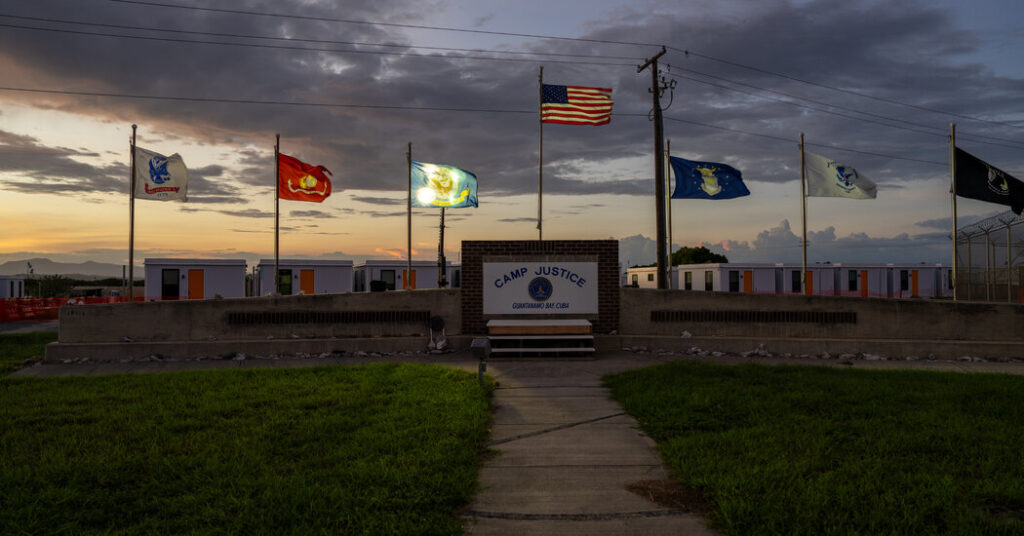
Dozens of Cuban men designated for deportation from the United States have been stranded at the U.S. naval base at Guantánamo Bay, Cuba, since before Christmas in one of the most puzzling episodes in the Trump administration’s crackdown on illegal immigration.
The men were rounded up in the United States last year and in some instances thought they were being sent to the capital, Havana. Instead, they wound up at the U.S. military base in southeast Cuba.
But in a cruel twist of fate, their arrival brought them no closer to being released. Cuba restricts air travel between the base and the rest of the island, so U.S. immigration agents will have to shuttle the men back to the United States before turning them over to Cuban authorities.
The Cubans — about 50 men who range in age from their 20s to about 50 — were being housed in a prison that previously held suspected members of Al Qaeda, according to people familiar with the operation who were not authorized to discuss it publicly.
“Some of the Cubans there now thought they were agreeing to be deported and were shocked when they landed at Guantánamo,” said Lee Gelernt of the American Civil Liberties Union, which has been challenging the deportation detention operation.
Officials did not respond to questions about why the administration chose these men in particular to be held at Guantánamo from among the tens of thousands in the United States awaiting deportation.
The tale of the Cubans who are trapped in the U.S. controlled corner of their homeland illustrates the Trump administration’s inefficient and expensive operation that emerged from President Trump’s order on Jan. 29, 2025, his ninth day in office, to prepare Guantánamo to hold up to 30,000 “criminal aliens” being removed from the United States.
In response, the military hastily put up rows of tents, then tore them down months later, never occupied, and has since developed a plan to hold at most 300 Immigration and Customs Enforcement prisoners in two secure buildings.
Now, a year later, about 780 men have been held at base — not the 30,000 Mr. Trump imagined, according to a timeline maintained by The New York Times. The administration has not provided proof that most of them had criminal records.
The Pentagon and Homeland Security Department have spent undisclosed millions of dollars establishing the deportation center, chartering planes, retrofitting facilities and deploying hundreds of troops and ICE agents for an operation that periodically housed no migrants.
In fact, the ICE facilities at Guantánamo had been empty for weeks when agents suddenly transferred 22 Cubans there on Dec. 14 from a holding site in Alexandria, La.
A flight to Guantánamo, not Havana
Government officials were saying the plan was to load those men onto a plane, fly them to a U.S. airport, probably in Puerto Rico, then on to Havana, a workaround from the ban on direct flights.
Mysteriously, that never happened.
Homeland Security officials have declined to discuss the dilemma but said those first 22 Cubans included “illegal aliens” with “criminal histories” of homicide, kidnapping, assault, battery, obstructing law enforcement and cruelty toward a child. The officials did not provide details.
But relatives of some of the men, who spoke on the condition of anonymity to avoid being singled out for reprisal by either government, said at least six of the men had work permits and had applied for asylum.
Their cases could have taken years to resolve. Instead, they agreed to return to Cuba. They were taken to several regional holding sites, including in Florida, Georgia and Texas, then sent to Louisiana and eventually put on a flight to Cuba on Dec. 14.
To their surprise, they landed in Guantánamo, not Havana.
More shuttles brought more Cuban citizens designated for deportation on Dec. 19 and in early January. Most of the men were housed in an old barracks near the airstrip, after being evaluated as not presenting a significant threat to those holding them.
But by this week, because of an undisclosed maintenance problem at the facility, all of the Cubans were consolidated at Camp 6, the former prison for Al Qaeda suspects.
Cuba’s restrictions on direct flights from the base mean that a person wanting to reach Havana from Guantánamo would have to fly to Miami or another U.S. city that has a commercial flight to Cuba.
Soon after the revolution, the United States rejected a request from Fidel Castro to evacuate the base it acquired through a 1903 lease. Guantánamo has functioned in isolation ever since, connected to the outside world by U.S. planes and vessels.
Trump Administration: Live Updates
Updated
- The Trump administration moves to sell a landmark D.C. building that was once a Trump hotel.
- Rubio says Venezuela will submit a monthly budget to the White House.
- Why the Cold War pact known as NORAD is in the news.
A few Cubans who ended up on the base were sent back through a gate near the security fence that separates the outpost from a Cuban military zone with a minefield leading to the rest of the island. The last time that happened was two years ago.
Repatriating Cubans is a particular problem
The Cuban government has been silent on the plight of the deportees at Guantánamo.
But, as a measure of troubled relations, the Cuban government has accepted only one repatriation flight from the United States each month even as the Trump administration has rounded up or revoked the legal status of thousands of its citizens in the United States and sought to deport them.
The U.S. government’s requests for Cuba to allow more than the one monthly flight of deportees have been repeatedly turned down, according to a person familiar with the matter who spoke on the condition of anonymity about what is considered to be a sensitive diplomatic topic.
Yael Schacher of Refugees International recently described Cuba as “one of the most intransigent countries in the world in terms of taking its nationals back.”
The nation is in a spiraling economic crisis marked by power outages, food shortages and dwindling Venezuelan oil supplies and “the Cuban government doesn’t want to take them back,” Dr. Schacher said. “It’s really hard to make ends meet in Cuba right now.”
To kick out more Cubans, the U.S. government got Mexico to let the United States send some people there, she said, leaving Cubans in their 70s or older without means or papers to go any farther.
But the motivation for housing dozens of them at Guantánamo, rather than, say, the deportation hub at Louisiana, where they were last held, remains a mystery more than 40 days later.
The Cuban men have been able to call family members in the United States, who have in turn told relatives in Cuba of their whereabouts and are anxiously waiting for them.
Tom Cartwright, an advocate for immigrants rights who has monitored ICE flights around the world, said the Cubans confined at Guantánamo are likely there as “political pawns” being used by the United States to pressure Cuba into taking more than one plane of returnees a month.
Spokesmen for ICE have not responded to repeated requests to discuss the plight of the Cuban detainees at Guantánamo Bay.
Guantánamo costs
Whatever the reason, the Trump administration has not said why Guantánamo is needed as a way station.
It has refused to release costs of the operation since the Pentagon told Congress last year that the military portion for the first month was $40 million, prompting Senator Gary Peters, Democrat of Michigan, to estimate costs of $100,000 a day per migrant.
Experts who have been watching the operation are doubtful that ICE needed the 300 beds or so available at Guantánamo to house migrants.
Some ICE charters have dropped off fewer than 10 men being held for deportations. Others have been nearly filled with deportees at the ICE center in Louisiana and then detoured to Guantánamo to add a few more on their way to Central America.
In February, the Trump administration used 13 airplanes to bring 178 Venezuelan men to the base — the most ever held there last year — and then chartered two more planes to evacuate them to Honduras, where Venezuela retrieved them.
It has been primarily used to hold men from Latin America who were then added to ICE charters returning them home. Over the summer, the Homeland Security also held men from Asia and Africawith criminal convictions.
In December, Tricia McLaughlin, a spokeswoman for the Homeland Security Department, described some of the Cubans held at Guantánamo as having criminal records but declined to offer details.
She issued a statement warning that, “if you come to our country illegally, you could end up in Guantánamo Bay, CECOT, or Alligator Alcatraz” — referring to El Salvador’s prison for suspected terrorists and the Florida-run holding site on the edge of the Everglades.
Some wives, mothers and aunts of the men held in Guantánamo — in both Cuba and the United States — have forged an online mutual support group where they share rumors of release and reports from their loved ones about the conditions of detention.
But, overwhelmingly, they share prayers for divine intervention to free them.
“God knows where they are, and God is watching over them,” one woman from Cuba posted. “So don’t lose faith; everything is in the Lord’s hands, and God is always faithful.”
Several women in the group of more than 50 members responded with amen.
Frances Robles contributed reporting.
Carol Rosenberg reports on the wartime prison and court at Guantánamo Bay. She has been covering the topic since the first detainees were brought to the U.S. base in 2002.
The post The Journey of a Group of Cuban Deportees Stuck at Guantánamo appeared first on New York Times.