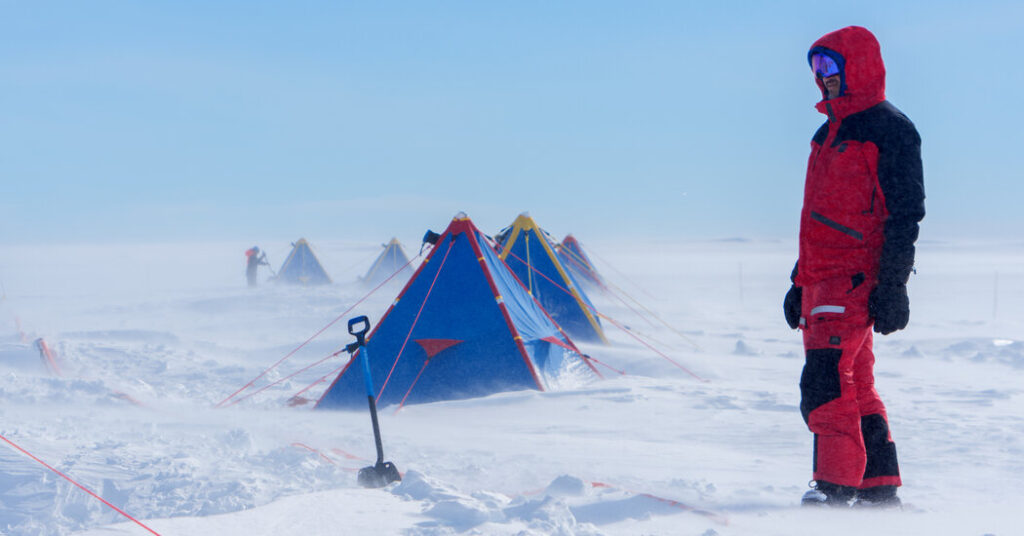
On Tuesday, a week after scientists from Britain and South Korea pitched tents on Antarctica’s remote Thwaites Glacier, they were pretty much ready to start drilling into the half-mile-deep ice.
The multiday drilling operation would be the culmination of the eight-week voyage of the icebreaker Araon. If successful, it would allow the researchers to lower instruments through the glacier into the ocean below, providing never-before-seen data on how the water is melting the ice from the bottom up, adding to global sea-level rise.
But fierce winds, like those that had been whipping for days around the researchers’ campsite, could cause their drill equipment to freeze up or become buried in snowdrifts. They would also make it difficult for the scientists to stay outside while boring the hole and installing instruments beneath the ice, in a process they expected to take more than 60 hours.
Calmer conditions were forecast for Wednesday, which was when the scientists hoped to get to work. They were fine with having to wait an extra day.
“We’ve come this far,” said Peter Davis, an oceanographer at the British Antarctic Survey. “It would be annoying if we failed at the last hurdle, just for the sake of a day.”
On Tuesday, the team’s 10 members were largely in good spirits, satisfied that their hard work had brought them to the cusp of completing their mission, against very long odds. After a week on the glacier, their clothing was grimier, the men’s facial hair bushier. Some people’s faces were lightly bronzed by snow tans.
Everyone had been shoveling a lot of snow, both to clear it from their tents and equipment, and to gather a supply of water for starting the drilling, which will use hot water to melt a hole deeper and deeper into the ice.
During a break from shoveling, Seunghwan Oh, an engineer and, at 23, the team’s youngest member, described his feelings about the experience perhaps a little too candidly.
“Save me from this hell,” he said with an uneasy laugh, one that suggested he wasn’t entirely joking. “Please, take me to the Araon.”
In such an extreme working environment, it helps to stick to a routine, said Won Sang Lee, the expedition’s chief scientist. The team works from 8 a.m. to 6 p.m., with breaks for lunch and tea. Dinner is at 6 or 7 p.m. in the mess tent, followed by a discussion of the next day’s plans before team members crawl into their sleeping tents.
Another thing that has allowed camping on Thwaites to feel more like normal life is fast satellite internet, via Starlink, which the team hadn’t used before in Antarctica.
Besides helping the scientists stay connected with loved ones, good internet access has made it easier to communicate with the crew and other researchers back on the Araon, which has been traveling to different areas in the waters around Thwaites. One of the team’s safety guides, Taff Raymond, has been sharing videos and weather data every morning from camp to help the helicopter pilots assess whether it’s safe to fly over it.
Before leaving the ship last week to camp on the glacier, Keith Makinson, an oceanographer and drilling engineer, said he worried that fast internet would make everyone antisocial, preferring to spend their down time sitting and scrolling rather than talking to each other.
That concern hadn’t been fully borne out, Dr. Makinson said Tuesday, though he acknowledged, “There are moments of silence that are not eating, when everyone’s catching up on news from home,” he said. “Not for too long.”
During a midday tea break, the scientists and engineers gathered in the unheated mess tent for a bit of chatting and a bit of scrolling.
Mr. Raymond had baked a fresh loaf in the bread machine, and the tent smelled wonderful. The team members cut up the bread and ate it with strawberry jam and slices of “Tasty cheese,” a kind of aged Cheddar from New Zealand and Australia. Mr. Raymond made a pot of black tea with snow that had been melted and boiled on a portable gas stove. Power for the bread machine and other electrical devices comes from gasoline-fueled generators.
Dr. Davis, the oceanographer, asked if I wanted a cup. I declined, saying I couldn’t possibly dip into the team’s stash when they still had so much work to do on the glacier.
“It’s fine, we’re nearly finished,” Dr. Davis said, a moment before he realized the boldness of his statement and deflated it by adding, “He says confidently.”
“One way or another, we are,” Dr. Makinson said, and he was right. The Araon has to begin its return journey to New Zealand on Feb. 7 or thereabouts, whether the drilling has succeeded by then or not.
Raymond Zhong reports on climate and environmental issues for The Times.
The post Life on an Antarctic Glacier: Tea, Cheese and Lots of Shoveling appeared first on New York Times.