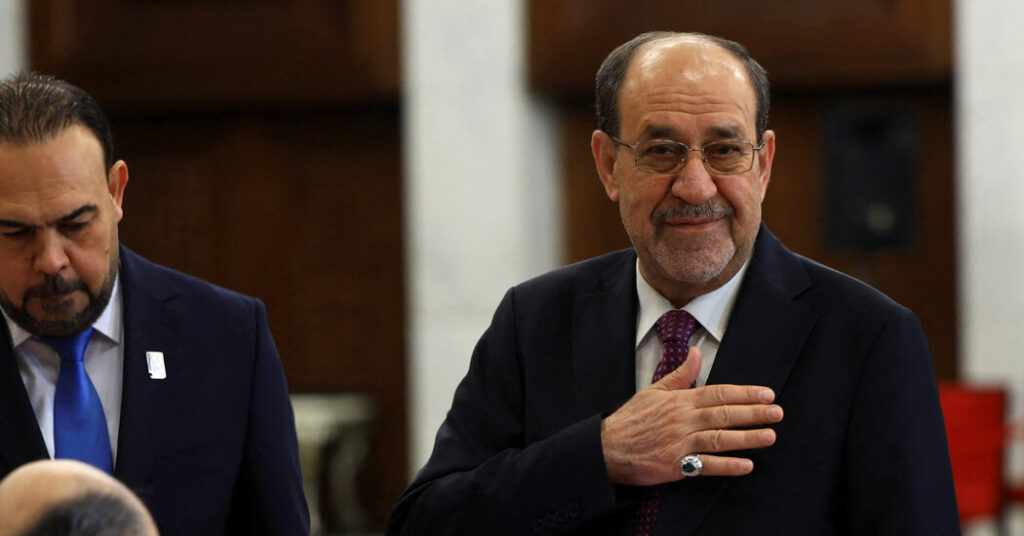
The nominee to be Iraq’s next prime minister, Nuri Kamal al-Maliki, vowed to continue pursuing the position on Wednesday, and dismissed a threat made by President Trump to withdraw U.S. support for the country if his nomination went ahead.
“We categorically reject this blatant American interference in Iraq’s internal affairs and consider it a violation of its sovereignty,” Mr. al-Maliki wrote in a post on social media, saying that Mr. Trump’s comments contravened Iraq’s democracy.
In Iraq’s elections in November, the country’s most powerful Shiite political bloc won a majority of votes, and nominated Mr. al-Maliki, a former prime minister, to lead the parliament.
Mr. Trump’s ultimatum, issued Tuesday, was the latest push by his administration to pressure Iraq into reducing the influence of its larger and more powerful neighbor, Iran, amid Washington’s escalating confrontation with Tehran.
Iraq’s current caretaker government has so far been silent on Mr. Trump’s comments.
Mr. Maliki’s relations with Washington weren’t always this bad. In fact, he was first elected prime minister in 2006 with U.S. backing. But over the course of two four-year terms, he became increasingly seen as aligned with Iran, the regional Shiite power, and was accused of fueling sectarianism with policies that favored Iraq’s Shiite majority.
Critics accuse Mr. al-Maliki of enacting sectarian policies that fueled the rise of the Sunni militant group, Islamic State. In 2014, the group seized nearly a third of Iraq, sparking a yearslong U.S.-led international military campaign to defeat the group.
On Tuesday, Mr. Trump wrote on social media that Mr. al-Maliki’s last term in office, which ended in 2014, plunged the country into “poverty and total chaos.”
“If elected, the United States of America will no longer help Iraq and, if we are not there to help, Iraq has ZERO chance of Success, Prosperity, or Freedom,” Mr. Trump added.
The former prime minister has remained a powerful player in Iraqi politics and sought a third term in Iraq’s November elections.
“It is not surprising that the Trump administration would oppose a third term for Maliki,” said Victoria J. Taylor, who led Iraq policy at the State Department during the Biden administration, and is currently at the Atlantic Council, a think tank. “It is more surprising that the United States did not try to thwart his nomination earlier in the government formation process.”
Several smaller parties within Iraq’s majority bloc, the Coordination Framework, have thrown their support behind Mr. al-Maliki and also rejected Mr. Trump’s statement as a violation of sovereignty.
The bloc is set to meet on Wednesday to decide whether it will carry on with Mr. al-Maliki’s nomination.
In his statement, Mr. al-Maliki said he would “continue to work until we reach the end, in a manner that achieves the higher interests of the Iraqi people.”
Eric Schmitt contributed reporting
The post Iraq’s Nominee for Prime Minister Rejects Trump Threats appeared first on New York Times.