Every January, the flurry of avant-garde performance festivals promises to show us “what’s next.” The avant-garde is by definition out in front, and so we assume its gaze will primarily be forward-looking. But judging by what I’ve seen in this year’s experimental crop, pioneering works are increasingly interested in drilling into our aesthetic reserves. Art always responds to previous art in some way, but I can’t remember a time when so many theatermakers explicitly revisited their sector’s creative past.
That’s a particularly fraught direction to look for Anne Gridley, whose (almost) one-woman-show “Watch Me Walk” — in the small upstairs theater at Playwrights Horizons — was a key Under the Radar offering. That festival has ended, but since Gridley’s solo is also a Soho Rep commission, its run will continue through Feb. 15.
Gridley, one of downtown theater’s tartest, wryest performers, has a long association with Soho Rep. This bantam actor was, for many years, a signature star of the audacious Nature Theater of Oklahoma, and its co-production with Soho Rep of the nearly four-hour “No Dice” (2007) was one of its most ambitious efforts. In fact, the first thing we hear in Gridley’s new piece, directed by Eric Ting, is a recording of a phone call between Gridley’s mother and Pavol Liska, one of the directors of “No Dice.” This long-ago conversation was part of the wide net Liska and his co-director, Kelly Copper, cast for content — “No Dice” used verbatim transcripts of over 100 hours of phone interviews — though Nature Theater never used that specific audio.
Audiences might need some historical context, since Gridley maintains a pained dialogue with it. “Anne has outdanced dancers that are much taller and bigger than she is,” Liska tells her mom, referring obliquely to the many explosively physical performances Gridley created with Nature Theater. “Poetics: A Ballet Brut,” a deliberately amateurish movement piece from 2008, for example, included the unforgettable sight of Gridley exhausting herself in a long, jogging-in-place dance (there was also some mimed boob-honking) while occasionally glaring at the audience like a silent movie villain.
Gridley’s greatest comic gift is her air of appalled offense — she has what I think must be the world’s only resting “are you goddamn kidding me” face. And in the 20 years since “Poetics,” the performer’s outraged impatience has remained as hilarious as ever. Her capacity for movement, however, has changed. Gridley discovered well into adulthood that she had inherited a condition from her mother and grandmother: a rare degenerative neurological disorder called hereditary spastic paraplegia. She now requires mobility aids to walk.
According to her acerbic narration, her legs feel like they’re “turning to stone,” but the narrow band of people with her type of HSP doesn’t represent enough pharmaceutical dollars to warrant investment in research. What folks do give her, though, is unsolicited advice. That’s when her gift for fury comes in handy. Oh, she should just lift her feet when she walks? “Thanks, coach,” she snarls, stabbing her walking stick into the stage.
“Watch Me Walk” takes a number of tacks: Sometimes it’s an educational cabaret about disability, with backup performers; sometimes it’s a rapid-fire account of familial loss. (The more we learn about the death, in 2017, of Gridley’s mother, the harder it becomes to hear her sweet, silly chatter with Liska.)
Ting and Gridley, therefore, take a spaghetti-against-the-wall approach, which results, inevitably, in both breakneck comedy and a certain amount of mess. The more they lean into vaudeville — she dresses as Annie (HSP is an “orphan” disease), and as a degenerating upper motor neuron — the more the show seems to be annoying the performer. But Gridley becomes a wonder again any time she’s dressed as herself and in motion. She falls, she gets up, she falls, she gets up. The production, with its Physiology 101 interludes, teaches us to understand what we’re watching when she’s walking. But our deepest delight comes, as it has for decades, when she dances.
Gridley’s archive is relatively near at hand — the call logs, the choreography she once performed, her own body. Elsewhere in the festivals, though, artists were reaching a little farther back. In a weird coincidence, midcentury lions accounted for a surprising proportion of the catalog. Did everyone agree, suddenly, that the Literary Modern needed a moment?
At Under the Radar, JoAnne Akalaitis directed an exquisitely lonely, meditative version of Samuel Beckett’s radio play “All That Fall,” from 1957, for Mabou Mines, while Sister Sylvester’s participatory installation “Drinking Brecht” at Onassis ONX (part of the Techne Homecoming program) walked us through assembling cocktails, mixed with DNA from one of Bertolt Brecht’s long-dead collaborators.
And the bizarro frolic “Time Passes,” the Goat Exchange show playing through Saturday in the Exponential Festival, takes much of its language from the second part of Virginia Woolf’s “To the Lighthouse.” The directors, Chloe Claudel and Mitchell Polonsky, constructed their oddball mash-up by confronting their Woolf with another beast entirely: the shark from “Jaws.”
In one of the season’s great surprise entrances, a big gray blob in the middle of the Target Margin warehouse space inflates, expanding, over the course of several long minutes, into a life-size Great White. (It keeps getting bigger. Do we need a bigger theater?)
Apart from this bouncy apex predator and a vacuuming robot who plays a caretaker, Claudel is the only performer. She toggles between intoning Woolf’s long, dreamy account of the slow decay of a neglected summer home and playing a cartoonish version of Ellen Brody, the police chief’s wife in “Jaws.” Ellen tries and tries to keep her anxious hubby — who is, to be clear, the shark — happy. Why are these radically different texts so weirdly comfortable together? The simultaneous sense of environmental fragility and threat in the two pieces might be one point of comparison; the corrosion of salt air and the way it quickens death is another.
But for sheer modernist bulk, even leviathan cannot compete with the other big Under the Radar holdover into the regular season, the Elevator Repair Service’s performance of James Joyce’s “Ulysses” directed by John Collins and co-directed by Scott Shepherd.
A sort of kinship exists among all these projects. “Ulysses,” when it’s at its best, makes you aware of the vulnerability of bodies — at the molecular level, like “Drinking Brecht”; at the blood-and-crunching-bone level, as in “Time Passes.”
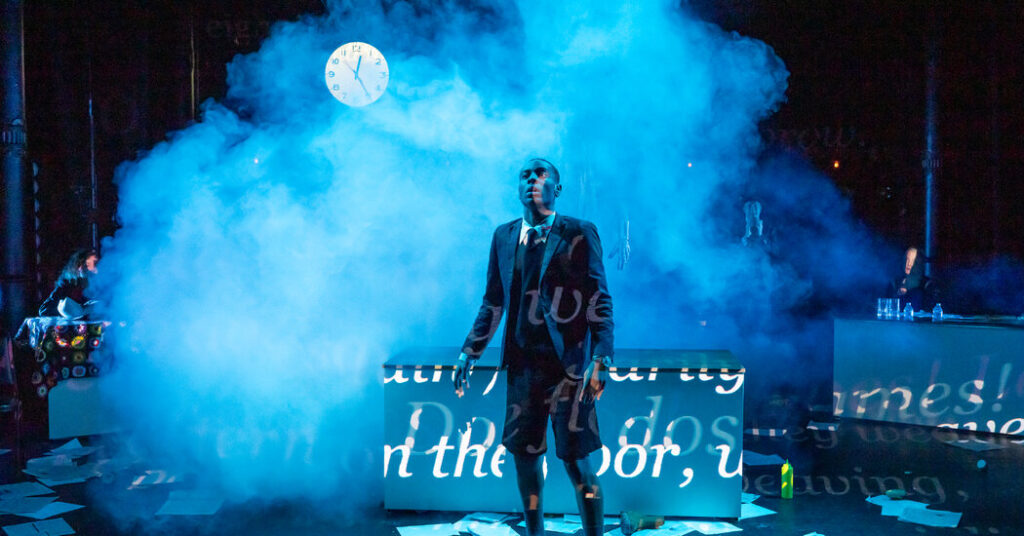
You might assume that “Ulysses” would make you think about words, instead, given that the novel has 265,000 of them. Certainly Shepherd, welcoming the audience as a jaunty narrator, assures us at the play’s outset that the company has accounted for every last jot and tittle by putting Joyce’s whole text on a teleprompter-like screen hanging behind our heads; to keep us conscious of the actors’ editing choices, the sound designer, Ben Williams, plays a “fast-forwarding” noise any time a section is skipped. (The show, at the Public Theater through March 1, is only two hours and 45 minutes, so they skip a lot.)
The company sits at a long table, arranged like auditors at a dissertation review. Actors recite Joyce’s tale of one event-filled day verbatim, melting in and out of roles. Christopher-Rashee Stevenson plays young Stephen Dedalus, a teacher fallen in among bad friends; Vin Knight plays the anxiously paternal Leopold Bloom, who encounters Dedalus as he wanders Dublin.
Everyone else seems somehow monstrous: the slithery Blazes Boylan (Shepherd), off to cuckold Bloom with his wife, Molly (Maggie Hoffman); the shrieking waitresses in a succession of restaurants; the men gorging themselves on awful food.
Abbreviated or not, “Ulysses” is still impossible to digest in a sitting. Some chapters reward the company’s headlong narrative treatment, as when Bloom masturbates at a fireworks display over a girl, Gerty (Hoffman again), who allows him to see a sliver of skin.
As Bloom’s excitement mounts, each of Joyce’s adjectives! Go! Exploding! Across the … stage. Whew. It’s wonderful. But other sequences chafe at the company’s insistence on velocity. Certain hallucinatory passages devolve into noise. The nice thing about a book is, if you want to stop and ponder, say, Joyce’s nauseating description of the way a kidney tastes, we can put the text aside and let sensation mount within us. Here we hurry on by.
The company’s strengths and the book’s tactics most coincide right at the end of the show, in the book’s final scene, a half-sighed stream-of-consciousness monologue by Molly, shifting in her unfaithful bed, thinking over the sensations of her body.
Hoffman has one of downtown’s great voices, a lazy, amused timbre that can relax into an almost Mae West-like groan. During Molly’s erotic reverie, she sounds like an instrument encountering the music it was always meant to play. Hoffman performs this scene fully clothed and almost completely hidden behind a desk onstage. For action, she sometimes gives a little wriggle under a crocheted afghan. Yet Molly somehow also seems naked, just because of the way Hoffman shapes her vowels. “Yes I said yes I will Yes,” Molly murmurs. And the whole show sinks into her, a fleshy masterpiece pushing at last into flesh.
The post Forward-Looking Theater Festivals Turn to the Past appeared first on New York Times.