The call from Michael J. Fox didn’t need any punching up. It arrived after he began watching “Shrinking,” the Apple TV comedy co-created by his former “Spin City” boss Bill Lawrence that features Harrison Ford as a therapist adjusting to life with Parkinson’s. The actor, who was diagnosed with the disease at 29, was moved by the depth and nuances he felt in the writing and performance.
“It’s so human and it was accessible for me,” he recalls thinking. “I know what that is.” And, so, he called Lawrence roughly a year ago, once he burned through episodes, to say as much. But this being Fox, he slapped it with the sort of wry delivery that long ago made him a master of comedic timing.
“Bill, why the f— am I not on the show?”
Immediately launching into laughter, Lawrence pipes in: “It’s true.”
The pair are recounting the moment during a recent video call — Fox beaming in from his home in New York; Lawrence from his office on the Warner Bros. lot in Burbank— to promote the guest role for Fox that spun from that conversation.
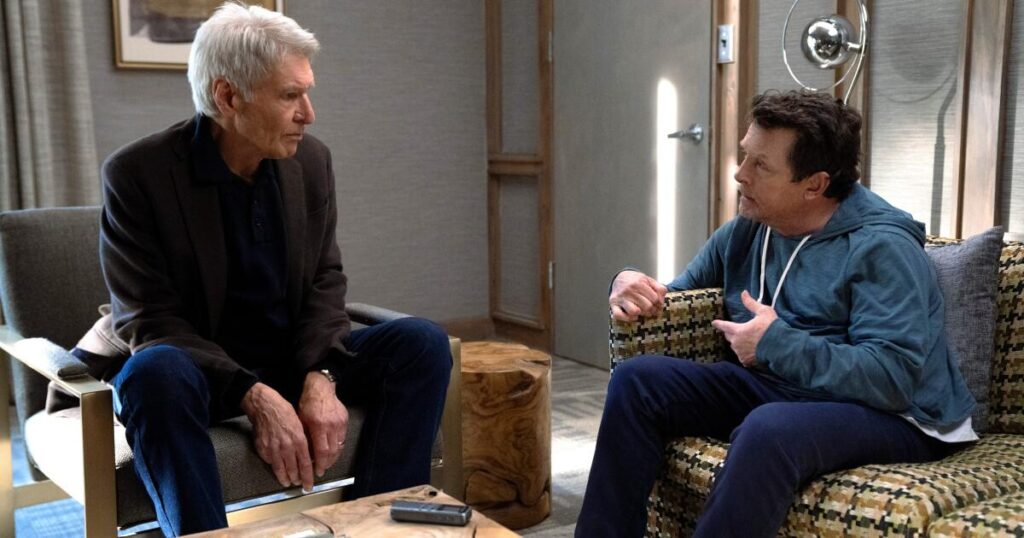
In Season 3, premiering Wednesday with two episodes, Ford’s character, Paul, after noticing a progression of his Parkinson’s symptoms, schedules a doctor’s visit. While waiting to be seen, he encounters Gerry (Fox), a fellow patient with Parkinson’s who, like Fox, hasn’t lost his humor. (The series has been renewed for a fourth season.) It reunites Fox and Lawrence, who first worked together on “Spin City” through the show’s fourth season, after which Fox departed to manage his health. The pair last worked together in 2004 when the actor guest starred on Lawrence’s medical comedy “Scrubs.” Here are edited excerpts from the conversation.
You get the call from Michael that sets this in motion. But had it been in your mind, Bill, having Michael stroll through “Shrinking” at some point?
Lawrence: I’m a sucker because every time Mike retires from acting, I believe him. [laughs] I hate to get deep on you, but I referenced Mike a bunch because one of the things when you do what I do, you always hope, especially when you’re a fan, that people turn out to be the way you imagine them in your head. With Mike, I got spoiled young, and he turned out to be the person I wished he would be. As every guy in his late 50s who waxes poetic about the way things used to be, any time I get the opportunity to do that again, I’m going to take it.
To Bill’s point, Michael, in 2020 you announced your most recent retirement from acting in your book, “No Time Like the Future,” saying that your symptoms were making it difficult to be on set or memorize lines at the time. How was it to arrive at that decision?
Fox: It was non-emotional and kind of OK. I was doing … “The Good Fight” — I confused it with Kiefer [Sutherland’s] show [“Designated Survivor”] because both shows, I had similar issues. They’re both very legal. I’d have to read screeds of legalese. I couldn’t get it. When I did “The Good Fight,” I had just seen one of my favorite movies, “Once Upon a Time in Hollywood,” and there was a great scene where Leo [DiCaprio] goes back in his room and just lays into himself in the mirror and just goes insane and drinking and crying at his lack of ability to memorize lines and I found myself, similarly, in front of a mirror and I went: Meh!
[A collective laugh erupts]
“I can’t do it. I can’t do this anymore.” So, let’s just get this puppy done as best I can and … move on with my life. So that’s what I did. I flashed back to back in the early aughts when you were doing “Scrubs” and you called me up and asked me if I would do something. I thought, “Well, I retired.” I had retired from “Spin City” and I didn’t really want to do anything, and I did the show and I loved it and [had] all these great offers for things — I discovered this new niche, which is do characters that had some kind of flaw and taking my Parksinsonian issues and translate that into cancer on “Boston Legal” and a form of Parkinsonism on “The Good Wife.” But I saw Billy’s show, and I just thought, it’s fantastic. The depth of character, the quality of relationships, the language — it’s just a beautiful show. And I thought, just do that for its own sake. I don’t have an agenda. Don’t have to be coming back into acting or anything. It’ll be fun. And there’s Harrison Ford, which is insane.
How did you arrive at the Gerry character, Bill, and using him as a figure to illustrate the progression of Paul’s symptoms.
Lawrence: The show is set up that Mike could have said, “I want to come on as a cameo and I can play Mike Fox” because it’s a doctor in L.A. But the first thing he said was, “I want to play a character,” which is so much cooler for a writing team.
Brett Goldstein, who created the show with me, his father has Parkinson’s. My grandfather had Parkinson’s. My dad has Lewy bodies with Parkinson’s. And Mike has been a force in my life for a long time. [Two] things that always plagued us in the show: One, is authenticity; the second one is, just because of our own experience, wanting to have a hopefulness and not have something feel maudlin and have it feel inspiring. Nobody in my family has ever — and Mike is another great, inspirational example — treated Parkinson’s like a death sentence or like something that you need to walk around in the shadows the whole time. We never knew we’d be able to kind of elevate the show to the level we did; once you put Mike on it, it has kind of a new level of authenticity.
What was it like being on that set? Much of your screen time, Michael, is with Harrison, so give me your best Harrison story.
Fox: The thing with Harrison is he just was so lovely. I didn’t know what to expect, we certainly have a lot of mutual friends and acquaintances and people who we work with, Bob Z. [Zemeckis] and Steven Spielberg. I wasn’t nervous, but I knew he’d be cool. But I didn’t know he’d be as cool as he was and sweet to me. You saw this, Bill, he was tender.
Lawrence: He was moved by the whole thing, man.
Fox: Then we started to act. He found something in the character, and in my character, and he just launched into it. I was like, “No wonder this guy’s one of the biggest stars in the world.”
The encounter between Paul and Gerry results in the slogan that carries through the season, “F— Parkinson’s.” Michael, did you arrive at an empowering slogan like that to fuel your own journey?
Fox: I have a million. I drive my kids crazy with my lessons. I like to say: Let’s deal with what is. It might be what was, what could be. Parkinson’s will really mess with you; it screws with your memory, so you can’t remember how screwed up you are. … It’s all about stepping in the light and figuring out what’s next on the agenda. I’m much more worried about Canada and Greenland than I am about Parkinson’s. I get a lot of confidence and positivity and sense of purpose from feeling part of this community.
This whole thing, some might say, truncated my career; maybe in one aspect, but it made it more dynamic in other aspects and more laden with possibility. At the core of it, I’m still just an actor. I’m the happiest sitting on a set with Harrison Ford, making people laugh.
When you look back at the decision to leave “Spin City,” what was your outlook — your mindset about your future and mortality — then versus now? We see how Paul decides he’d rather, as he puts it, “suck the marrow of what’s left of this amazing life” than wallow.
Fox: I was thinking about my kids. My kids are 24, two 30s (twins), and 37 — so they’re done. They’re cooked. I don’t have to worry about them anymore. When I went into retirement, I wanted time with them. I spent that time with them and they grew up, and I was with them all those years. Now I’m 64 years old, my wife and I have an empty nest, so I’m happy to dip my toe back in more. But it’s not the beginning of any campaign to reestablish my career.
Lawrence: Having been there, I was always blown away, when somebody announces their retirement, you expect them to shuffle off into the ether. Mike was almost immediately as busy as he had ever been.
Fox: I had the foundation stuff to do. If I hadn’t been busy with it, it would have been really difficult. [In 2000, he founded the Michael J. Fox Foundation for Parkinson’s Research, aimed at finding treatments and a cure for the disease.]
Lawrence: I hadn’t been for a while, [but] I went to one of the foundation’s events and the culture is pervasively hopeful and optimistic. And getting to be around these people that are day-to-day involved with all this stuff, and some living with it, is so inspiring and made me feel like we were all on the right path as far as you tell stories about this.
To expand on the community aspect of this, Michael’s character returns later in the season and connects with Paul about their experiences. Why was that important to show?
Lawrence: Mike already made the point here, just randomly on this interview — it doesn’t matter if you empathize and you’re around it. I don’t know what it’s like to live with Parkinson’s. The only person that really gets it is somebody else that lives with it. For a character in a show to have a community of somebody else dealing with the exact same things, it becomes a two-way street. It was such a good thing for us writing-wise. We even made a joke about it. There’s another character in one of the scenes that those guys did that feels out of place because all he’s got is prostate cancer. I think he says, “I have mostly issues with peeing.” And Mike riffs, “I have issues with peeing.” On a storytelling level, to have a peer group that actually is going through what you’ve gone through — on an authenticity level, I would have never done the story because Harrison was already very nervous about playing somebody with a condition, so then to go, “You’re gonna get with this other person who’s also faking it,” I don’t think it would have sat well.
Fox: He’s so exquisite. The way he plays it is so beautiful. It’s so subtle.
Lawrence: He [Ford] makes our medical advisors send him videos. He studies. He’s really obsessed about it. He looks at takes afterwards to see if he’s moving correctly. The guy’s a gift on this stuff.
Part of Paul’s journey is grappling with what his identity is if he’s not doing the work that he loves. How does your work as an actor keep you feeling like yourself, or give you a sense of purpose? But also, who is the Michael you’ve come to discover outside of that?
Fox: You find another version of yourself that you weren’t looking for, one you wouldn’t know to go looking for. It just lands in your doorstep and you either try to get around or you go through it. I just try to go through it. I’m not the biggest mystery in the world. There’s a lot that I learned from the struggles. I won’t lie to you, some of the times that were really frustrating — I don’t fall too much anymore; I fell a lot for a while. I’m not doing that anymore. But sometimes I’ll slide down a wall and get to a place on the floor and I can’t get up and I think about that lady in that television commercial —”I’ve fallen and I can’t get up.” It’s a real thing, you can’t get up. I’ll wait for somebody to stroll by, if I’m in my house. That can be a tragic thing, but that just is what it is. In terms of this part, when I need to access that stuff, I haven’t blocked it. I haven’t been in denial about it. I haven’t lied to myself about it. I can give Bill something that people don’t understand and progress the story and maybe enlighten people.
This season we see how Paul struggles with his legacy, what it means and who will carry it on. Michael, is that something you give a lot of thought to?
Fox: I’ll be dead. … My late father-in-law wrote a book once called “Die Broke.” The theory being spend all your money now. I don’t mean just money. Your gift, your nectar. Spend it all now, and spend it on your kids, on people you love. I don’t think about legacy. Certainly, the foundation will be around and our work will continue. It’d be nice to have it done before I die, but I don’t know if that will happen. We’re certainly getting closer. Legacy is other people’s business; my business is to live my best life, do the best I can, the best work I can, seize opportunities like working with Billy and Harrison and continue to write my story until the pin drops.
The post Michael J. Fox was so moved by ‘Shrinking,’ he asked his former ‘Spin City’ boss for a part appeared first on Los Angeles Times.