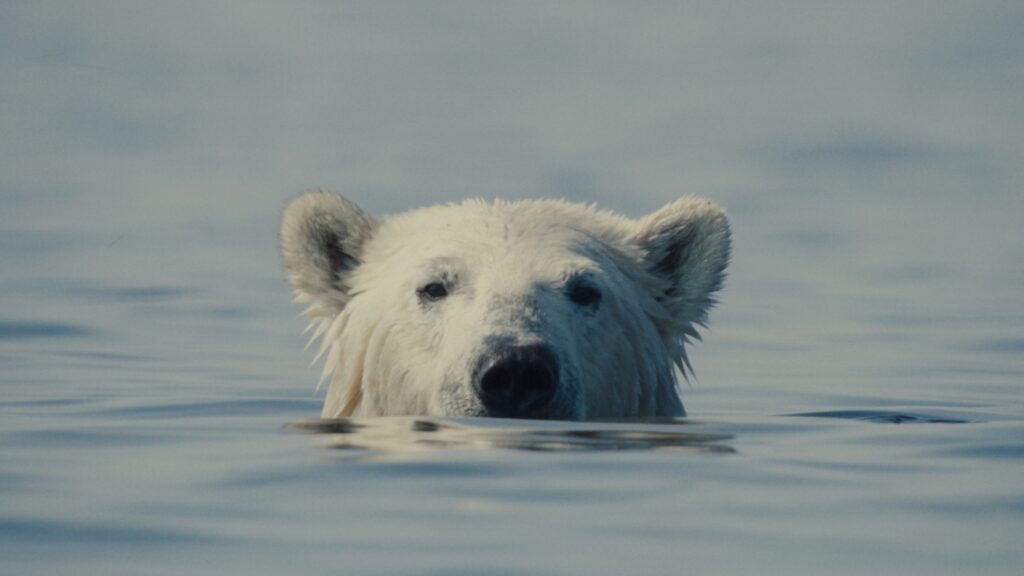
PARK CITY, Utah — In the snowy subarctic wilds of northern Manitoba, the Inuit have a word for polar bears who’ve lost their fear of being around humans: avinnaarjuk, or “nuisance bear.”
That’s a rather sweet name for a hypercarnivorous, unpredictable apex predator that can weigh 1,500 pounds and outrun or outswim any human. But the documentary “Nuisance Bear,” which premiered at the Sundance Film Festival, thrusts us so thoroughly into the bears’ perspective that it turns the whole notion of who is predator and who is prey completely on its head.
This is no typical nature documentary. It’s an edge-of-your-seat thriller from A24 that plays out like “The Fugitive,” as the bears are chased by humans who want to capture or kill them. Then, as we switch to the perspective of the Inuit fighting off the growing horde of polar bears invading their streets, it starts to feel, thrillingly, like a zombie movie. It produced the kind of audience reactions usually reserved for midnight horror films, with the entire theater shouting commands to the screen or cheering in unison. (It’s still seeking distribution.)
Canadian directors Jack Weisman and Gabriela Osio Vanden essentially have been making this movie since 2015. That’s when they first started taking their cameras to Churchill, Manitoba, a town that used to house a military base, with a mixed Inuit and White population of roughly 870 people. It’s known, at least in ecotourism marketing, as the “Polar Bear Capital of the World.”
The Sundance film is an extension of a wordless, widely viewed 14-minute documentary short from 2022. While more than half of the feature’s 86 minutes are spent immersed with bears, it also adds the perspectives of two human communities with opposite views on how to combat what they see as a growing polar bear menace.
In Churchill, polar bear tourism is the economic lifeblood, and a vigilant “bear patrol” guards over the town’s border with big trucks, helicopters and tranquilizer guns. In Arviat, an Inuit community 160 miles to the north, the population is being beset by “Churchill” nuisance bears who are helicoptered out of town and into forests abutting Inuit land. All they can do is bring their children in before dark and hope the Canadian government eases bans so they can hunt polar bears like they used to.
In their director’s statement, the filmmakers said they wanted to use the plight of nuisance bears to raise larger questions about Western ideas of conservation. Are the ways in which we’re trying to protect bears, such as through wildlife photography expeditions and bear patrols to protect town borders, actually desensitizing them to humans in a way that puts them in far more danger?
From the start, there’s no question of whom audiences are supposed to root for. The bear’s-eye footage is so immersive, you could practically do dental work given how much detail you can see of their teeth. It’s the closest most us will get to a polar bear in our lifetimes. Half the experience of watching the movie is wondering how they got those shots. (A camera mounted to the front of a truck with elaborate stabilizers and controls inside the cabin, it turns out.)
It’s impossible not to fall for the bears pretty much from the opening shots: a mama sleeping with two fuzzy cubs, a young male taking a languid swim. From there, we’re following the so-called troublemakers, who can’t help it that Churchill was built right in the middle of their migratory path, or that humans dump all kinds of tasty things in landfills that are way easier to feast on than having to go out there and kill a seal. Much of this footage plays out wordlessly, with natural sound or with a heart-bruising score from “The White Lotus” composer Cristóbal Tapia de Veer.
But then we learn about the town’s conservation-minded “bear jail,” which locks up problem bears, gets them tagged and then helicopters them to wild forestland, which is essentially dropping them off for the Inuit to deal with. Any bear breaking into properties or showing up in town is, essentially, a fugitive. Every time they’re doing normal bear things, it’s like an entire SWAT team descends. We see bears being corralled by trucks, chased off with a barrage of flares and hunted down by helicopters bearing wildlife agents brandishing tranquilizer guns that look like AK-47s. It’s a lot. The film essentially puts the audience on the side of the “criminals,” who we’re also pretty convinced are the good guys.
The audience at the premiere was so rapt that, 18 minutes in, when a bear dramatically and successfully manages to escape a trap and come away with the seal-meat bait, too, the theater exploded with cheers and applause.
And when the inevitable happens, and the movie’s “lead” bear gets caught, flown miles and miles while dangling midair below a helicopter in a net, then tagged and marked with green paint like a badge of infamy, it’s wrenching.
“Bro, I straight-up cried at the helicopter part,” one audience member said while leaving the theater.
The shift to the Inuit perspective in the second half makes you question everything that came before it.
The tone shifts, ominously. We watch townspeople scurry indoors with their children as a polar bear steps onto their streets — a prowling shadow appearing from a swirl of nighttime snow. The polar bears aren’t going extinct, the Inuit insist; their population is actually increasing, and they know this because they keep seeing more and more in town, including one that killed a man in 2018.
The bears are adapting, the film’s narrator, Inuit elder Mike Tunalaaq Gibbons, says in the film. They’re losing their hearing from human noise, but their other senses are sharpening. They’re getting bolder.
The solution isn’t obvious, but it seems it will arise only from a shift in perspective. What’s causing these polar bears to continually enter human spaces? What’s it like to be an Indigenous community fighting for survival in a harsh environment, with none of the technology or financial resources of the Westernized community that keeps dropping troublemaking polar bears off on your doorstep?
Early on, Gibbons delivers a haunting line that lingers long after the credits roll.
“The tourists come because they want to see a bear,” he says. They believe they’re heading for extinction and want to see them in the wild while they’re still around.
“Inuit never say, ‘I want to see a bear,’” he continues. “If you do, one might show up when you don’t expect it.”
The post This riveting polar bear documentary plays out like ‘The Fugitive’ appeared first on Washington Post.