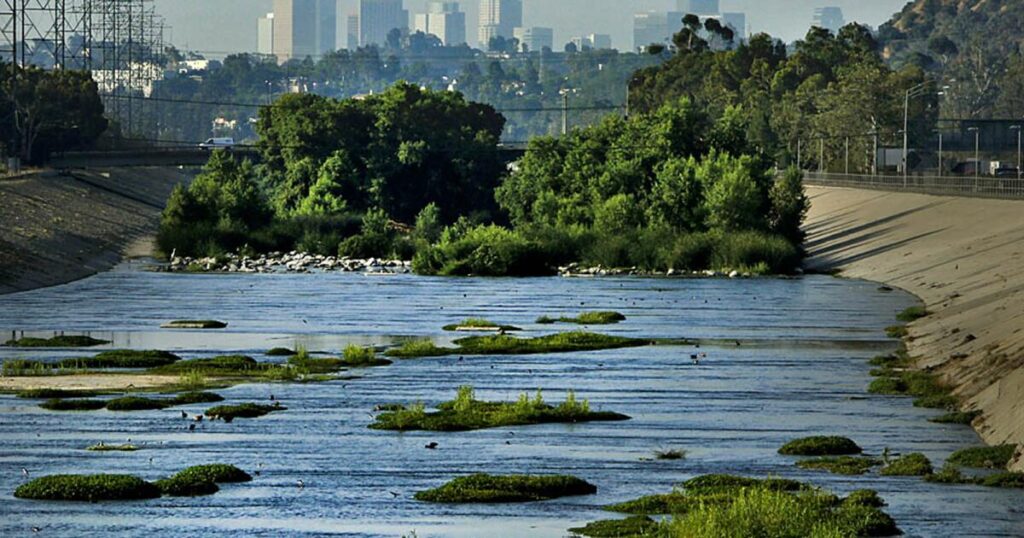
At the end of last year, Los Angeles County adopted a new target to remove and replace 1,600 acres of pavement with green infrastructure including trees, plants and rain gardens by 2045 as part of its ongoing Sustainability Plan. In doing so, the county aims to join a growing number of cities worldwide that are ditching pavement to respond to ecological vulnerabilities.
While depaving efforts in places like Chicago and Portland, Ore., have largely been driven by residents and nonprofit groups, L.A.’s plan marks the first explicit depaving target from a major U.S. public agency, signaling an emerging shift in how policymakers are rethinking infrastructure.
Depaving, the act of removing asphalt and concrete in places where hardscape isn’t needed, comes with the goal to create more space for vegetation, trees and soil that provide useful benefits like cooling and shade. Urban planners are increasingly turning to depaving as an adaptation strategy as extreme weather exposes the limits of aging civic infrastructure.
For more than a century, pavement offered American cities convenient solutions to pressing civic issues. In Los Angeles, the dusty and uneven dirt roads of the 1800s were paved over to make transit more efficient. Later, civil engineers applied concrete more broadly, using it to suppress weeds that would otherwise need to be trimmed, cover up contaminated soil that would be costly to clean and reduce maintenance costs for cash-strapped municipalities.
After a catastrophic flood in 1938 killed more than 100 people, the U.S. Army Corps of Engineers encased the Los Angeles River in concrete, turning a once dynamic ecosystem into an orderly, obedient channel. The floodwaters receded, but the living ecosystems that once thrived there vanished. The California Coastal Conservancy estimates that nearly all of the Los Angeles River’s original wetlands and 90%-95% of its riparian habitat have disappeared as a result of over-paving. Along with them went the natural workforce — the plants and soils that absorbed water across wide floodplains, regulated temperature, filtered pollution and nurtured biodiversity with sophistication.
Now, cities across California are grappling with the long-term consequences of infrastructure decisions made decades ago under short-term budget constraints. Recent years have brought record-breaking heat waves to Los Angeles, with concrete radiating lethal temperatures. Research indicates that over the last decade, extreme heat has killed more Californians than wildfires. When it does rain, pavement prevents water from soaking into the ground, increasing flash flooding while limiting groundwater recharge that could buffer future droughts. Residents of neighborhoods that lack crucial trees and shade, like South Los Angeles and the northeast San Fernando Valley, face greater risks of depression, and cardiovascular and respiratory illness. Quality of life suffers because the living things that cool, protect and nourish people struggle to survive where the ground is sealed shut.
The county plans to start toward its ultimate goal with an assessment of small depaving project opportunities in neighborhoods where tree canopy is lacking. Sustaining the beneficial vegetation that grows in its place is another challenge. To truly succeed, policymakers will have to reconsider how nature is valued, and invest in the ongoing maintenance required to keep natural infrastructure alive and healthy, not just the initial planting.
The financial tradeoffs of concrete versus natural infrastructure can be misleading. At first glance, concrete seems economical because it only requires upfront capital investment with relatively low ongoing maintenance costs. But over time, it generates costly side effects that cities pay for through emergency response, disaster recovery and public health impacts.
Natural infrastructure, by comparison, seems expensive to keep on the public payroll because trees, wetlands and rain gardens are not inert, material assets; they are a living workforce. These natural elements perform countless services including filtering water and cooling the air, but they also need ongoing care: pruning, watering and protection from harm, just as human employees need annual salaries, benefits and paid time off.
The benefits of nature tend to increase over time as plants mature, delivering compounding returns like cooler streets, cleaner water and healthier communities. However, without ongoing care, nature can’t deliver its benefits, and the costs just resurface later as severe storms, floods and heat waves that are much more expensive for cities to manage.
The creation of a depaving target invites a new way of thinking about how urban infrastructure can be understood: as a mix of living systems and built surfaces that each have a vital role to play in making cities safe and livable. The next step is to consider how this perspective might inform public budgets, accounting for the valuable work that nature performs every day.
Only time will tell if L.A. reaches its depaving goal, but if one of the most paved places in the world can begin to free itself from concrete, others can too. If nature could earn a living wage and receive the long-term stewardship it deserves, what could Los Angeles, and the places that follow, become?
Devon Provo is a Los Angeles-based urban planner and senior manager of planning & program alignment at Accelerate Resilience L.A.
The post L.A. is ripping up 1,600 acres of pavement — but is it too little, too late? appeared first on Los Angeles Times.