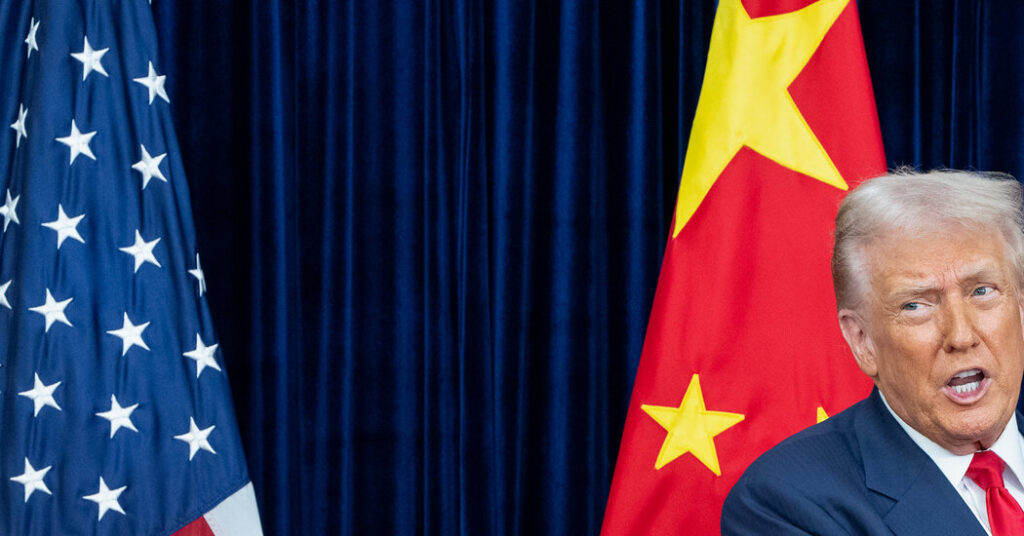
President Trump’s second-term approach to China is full of contradictions. One minute, he is threatening tariffs on Beijing and bolstering Taiwan’s military; the next, he’s lavishly praising Chinese President Xi Jinping and easing high-tech trade restrictions. His critics say this scattershot policy is incoherent. But in foreign affairs, inconsistency is not necessarily incompetence. Mr. Trump has used unpredictability to good effect in the past, including in relations with Beijing. The question is what he is after now.
Mr. Trump is unmistakably drawn to powerful autocrats. He admires — perhaps even envies — Mr. Xi’s brutal treatment of domestic foes and his repression of press opposition. Mr. Trump has reversed bipartisan restrictions on the flow of the most advanced semiconductor technology and artificial intelligence chips to China, undercutting one of the few areas of clear American advantage in the contest for global technological leadership. And he has resurrected, jarringly, the “G2” framing of the U.S.-China relationship, suggesting a shared approach to global trends and responsibilities.
By contrast, in a challenge to Beijing, the Trump administration announced in December one of the largest U.S. arms sales to Taiwan in history, replete with items like precision munitions and drones that have proved effective in the brutal killing fields of the Ukraine war. And he has attempted to maneuver out from under the Sword of Damocles that China holds over the United States in the form of its monopolies of critical minerals and rare-earth magnets.
The administration’s published documents and its senior figures’ statements provide little help in resolving these contradictions. Certain references to China appear to have been hastily edited out of Mr. Trump’s National Security Strategy. When administration figures do, on rare occasions, venture some version of a China strategy, they fall back on bromides like “Our policy is a policy of American power with America first at its core.”
All of this ambiguity can cut one of two ways. It may help Mr. Trump to negotiate with Mr. Xi over long-term American interests when the two meet later this year. If Mr. Trump is just maneuvering for his short-term political and personal interests, however, the damage to the United States will be lasting. As the administration prepares for those meetings, it is crucial that it takes the first, strategic path. Even if it does, the approach carries risks.
“Strategic ambiguity” has a tortured history in the U.S.-China relationship. It refers to the longstanding and intentional uncertainty over whether the United States would come to Taiwan’s aid militarily in the event of an attack by China on the island. This ambiguity has allowed Washington to balance engaging Beijing and preserving links with Taiwan, simultaneously warning both of them not to rock the boat.
The Trump team has taken strategic ambiguity to a profound new level. There is now a much larger uncertainty over whether, when the chips are down, the president will side with China’s authoritarians or align with America’s traditional opposition to adversaries seeking to dominate the Indo-Pacific. Strategic ambiguity in the Taiwan Strait context has been an imperfect but workable vehicle for deterring provocation and preserving peace and stability. There is anxiety now, however, that strategic ambiguity applied in the larger U.S.-China context might lead to accommodation, even appeasement, of an increasingly ambitious China.
Mr. Trump’s strategic ambiguity has certain advantages. First, it keeps China off balance about Washington’s ultimate intentions. Mr. Xi has managed Mr. Trump more effectively in his second term than in his first, treating the U.S. president personally with great respect while responding to every blunderbuss tariff threat with a precision countermove that exploits American vulnerabilities. Yet Beijing remains uncertain and worried about what Mr. Trump might do under duress. Mr. Xi is confident that the correlation of global forces favors Beijing in a longer-term contest with the U.S. but is still deeply wary of Mr. Trump’s ability to surprise and suddenly shift course in the near term.
Strategic ambiguity has certain domestic political advantages for Mr. Trump as well. China policy is one of the few areas where Republicans in Congress have found a tremulous voice to criticize the administration, reproaching its softer moves toward Beijing. Ambiguity keeps them hoping for a turn back to hard-line moves.
The Trump administration’s big tent on China includes some top officials who are bent on securing commercial deals and others who believe that China poses an existential threat to America. The president’s strategic ambiguity accommodates these conflicting positions and agendas, albeit while triggering brutal bureaucratic infighting, by suggesting that it is merely a clever way to get to the ultimate destination of a hard, or a soft, relationship with China.
For all of its advantages, however, ambiguity toward China carries more risks than rewards. U.S. strategy in the Indo-Pacific in the 21st century has rightly focused on building allied solidarity and military capacity through shared diplomatic approaches and combined technological prowess. Ambiguity doesn’t help that. The Trump administration’s harsh tariffs on America’s traditional partners may be manageable, but a true G2 world, dominated by the U.S. and China, would be untenable for America’s allies in the region.
Mr. Trump’s mixed messages already have partners from Tokyo to New Delhi scouring his utterances and actions for signs that Washington can still be counted on. Countries such as Japan and India want badly to be reassured and are seeking to sway Mr. Trump. Yet at some point, allies will make stark decisions about their security — including potentially pursuing nuclear weapons or alliances with other countries.
At home, Mr. Trump’s ambiguity has helped to fracture the last true area of bipartisan consensus in American foreign policy: a tough, competitive framework for relations with China that has prevailed for the past decade. Now some corporate Republicans, largely from the investment world, along with liberal-minded academics and think-tankers, have defected in favor of a softer, more collaborative approach akin to the one that was dominant in the 1990s heyday of U.S.-China engagement.
Whether Mr. Trump’s ambiguous approach is worth the risk ultimately depends on his goals. Those will become clearer this year. Mr. Trump and Mr. Xi are set to meet, potentially, on several occasions before year’s end, and administration advisers frequently refer to the prospect of a “comprehensive and ambitious” set of outcomes during the president’s expected visit to China in April.
The U.S. side has signaled that it badly wants short-term wins on exports of agricultural products and curbs on the flow of fentanyl, to address domestic political needs. China appears to be angling for bigger game, seeking access to advanced technologies while weakening Taiwan’s democratic leadership. Big U.S. concessions on Taiwan and technology in exchange for nominal Chinese purchases of legumes and restrictions on drug flows would be a manifestly bad deal. That could pave the way for Chinese hegemony in the western Pacific, with the U.S. ceding control over crucial global trade routes and leaving its allies vulnerable to coercion by, and eventually forced capitulation to, Beijing.
It is not an exaggeration to say that the course of the 21st century may depend on whether Mr. Trump’s ambiguity is strategic or merely tactical. If Mr. Trump is playing a long game in hopes of improving America’s increasingly weak military and economic hand, then his ambiguity may well prove to be a cunning strategic gambit to keep the United States ahead of its primary global competitor. If he is instead just shoring up his political position at home while appeasing China, the costs for Americans now and in the coming decades could be catastrophic.
Kurt Campbell served as the deputy secretary of state from February 2024 to January 2025. He previously was the Indo-Pacific coordinator at the National Security Council in the Biden administration.
The Times is committed to publishing a diversity of letters to the editor. We’d like to hear what you think about this or any of our articles. Here are some tips. And here’s our email: [email protected].
Follow the New York Times Opinion section on Facebook, Instagram, TikTok, Bluesky, WhatsApp and Threads.
The post Trump’s China Policy Is Incoherent. That May Be the Point. appeared first on New York Times.