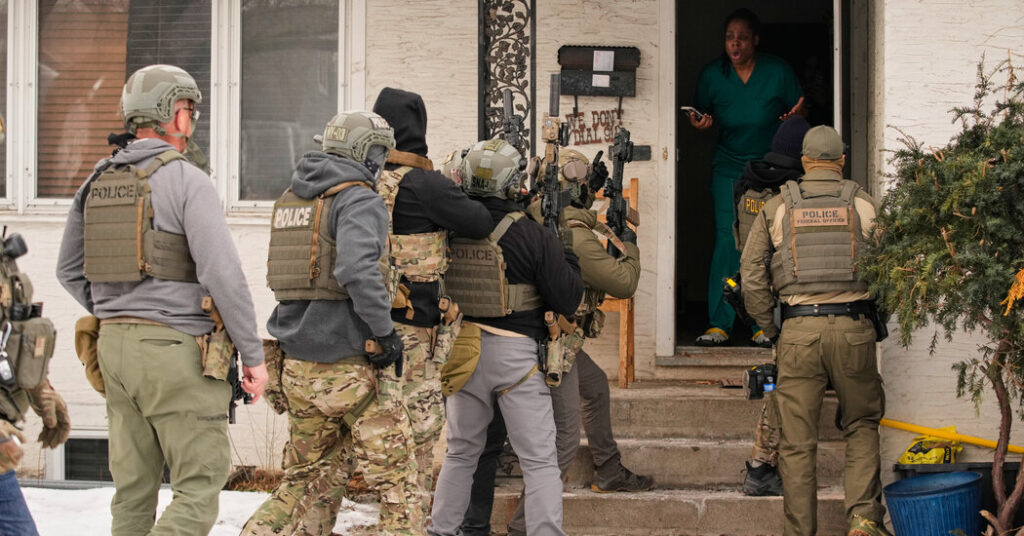
Images of the immigration crackdowns in Minneapolis and across the United States have been likened to those from the country’s wars in Iraq and Afghanistan. The helmets, camouflage and tactical gear all look straight from the battlefield.
Nowhere is that more apparent than in a single photo taken on Jan. 11 by John Locher of The Associated Press. It captures a line of federal agents on the doorstep of a woman’s home, rifles in hand.
Upon closer inspection, the agents’ equipment tells its own story. Their gear is the physical manifestation of decades of war, fine-tuned and perfected for close-quarters killing over myriad operations in faraway lands but now wielded in broad daylight in American cities. This type of equipment is often reserved for SWAT and hostage rescue units.
Suppressors, like the ones on the end of these rifles, have migrated from soldiers to law enforcement officers and civilians. They have proliferated because of the added safety benefits of reducing brain trauma and hearing damage when shooting indoors.
The production of firearm suppressors, or silencers, climbed by more than 9,000 percent from 2000 to 2021, according to data from the federal Bureau of Alcohol, Tobacco, Firearms and Explosives. The suppressor highlighted above is made by HUXWRX Safety Co. In recent years, the company was awarded a multimillion-dollar contract to supply the F.B.I. with its suppressors.
Just behind the muzzle toward the front of the rifle are two modular advanced weapons lasers, commonly referred to as MAWLs, made by B.E. Meyers & Co., Inc. The laser is considered top of its class and is described in the company’s literature as “the superior solution for any low light/no light combat environment.”
In Iraq and Afghanistan and elsewhere, the U.S. military’s dominance on the battlefield was aided by advanced night-vision equipment and thermal-imaging technology. Troops used infrared aiming lasers that evolved from clunky-looking boxes on the end of their rifles to streamlined and ergonomic tools that cost more than $3,000.
At least two of the rifles have modernized black rails mounted around their barrels, which allow accessories to attach more easily. These are Daniel Defense MFR M-LOK rails.
For the M4 — the military equivalent of the AR-15 — U.S. Special Operations Command has championed the M-LOK, or modular lock, for its lighter weight and sturdiness when securing devices like lasers, flashlights and grips. Daniel Defense receivers and barrels are used across the U.S. military.
Also pictured in the photos is a smattering of tactical gear plucked from the battlefield. The tan and camouflage “dump pouches” on the agents’ belts are used to store expended ammunition magazines (though they often just hold snacks and water bottles).
Clasped on one agent’s weapon is a rifle combat magwell, a piece of plastic that helps widen the aperture for an ammunition magazine so the firearm is easier to reload when adrenaline overpowers fine-motor skills during a firefight.
The civilian standing in the doorway, at the receiving end of a swarm of well-armed federal agents, was Teyana Gibson Brown. Her husband, Garrison Gibson, who is from Liberia, was arrested during the raid.
In a video taken from inside the house and posted on Instagram and other social media sites, Ms. Brown yells for the agents to put down their guns. “There’s kids in this house,” Ms. Brown said. “Show the warrant first.”
A federal judge ordered Mr. Gibson’s release four days later, ruling that the agents violated his Fourth Amendment rights against unlawful search and seizure.
Annotations by James Thomas and Gray Beltran. Video production by Jackeline Luna and Zach Wasser.
Thomas Gibbons-Neff is a national correspondent for The Times, covering gun culture and policy.
The post The Height of Close-Combat Weaponry Is on This Woman’s Doorstep appeared first on New York Times.