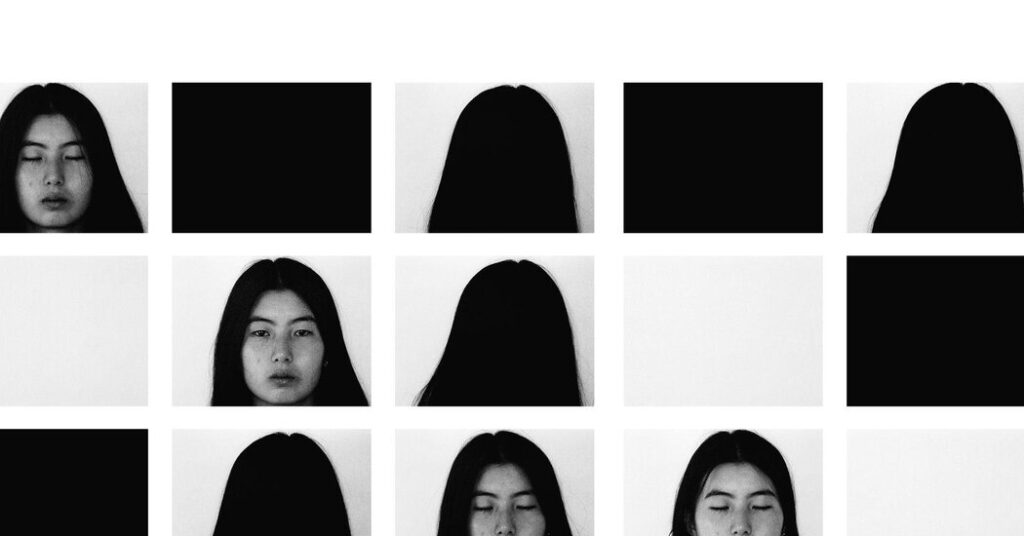
To the names Eva Hesse, Francesca Woodman, Ana Mendieta, Sylvia Plath — visionary women all who died too young and became canonized in the process — add the genre-defying Korean American artist Theresa Hak Kyung Cha. Her experimental novel, “Dictee” — a radical, fragmented autobiography that reflects on the effects of displacement, the slipperiness of language and the precarity of memory — was published days after her shocking murder in 1982, at age 31. It propelled her to cult status among artists, writers and scholars, a position that she has never really left.
Until relatively recently, her fans’ first — and sometimes only — encounter with her work was through “Dictee” and other writings, since her films, performances, mail art and other forays into artmaking were often ephemeral or difficult to access. Exhibitions over the four decades since her death — among them a 1993 Whitney Museum exhibition curated by Lawrence Rinder, the presentation of 14 of her films in the 2022 Whitney Biennial, a retrospective at the Hessel Museum of Art at Bard College the same year, and her recent inclusion in the exhibition “Echo Delay Reverb” through Feb. 15 at the Palais de Tokyo in Paris — have offered glimpses into the breadth of her interdisciplinary practice.
Now, “Multiple Offerings,” a new show at the Berkeley Art Museum and Pacific Film Archive (BAMPFA), running through April 19, will serve up the most complete picture to date of the artist’s prolific practice, realized over the course of a barely decade-long career. It’s fitting that the show is at U.C. Berkeley, a place where Cha studied (she received four degrees in her time there) and worked (as an usher in the theater and art handler at the museum), and where her archives have been housed since 1992.
On display is some of her earliest student work — she began as a ceramist — as well as moving image work, objects and ephemera from her performances, and a generous selection from her archives. It will also include a reconstruction of one of her most important installations, “Exilée” (1980), made in the wake of her first visit to Korea after immigrating to the United States at age 11 with her family. Like many of her works, it layers moving images, text and spoken word.
Importantly, the exhibition includes the work of artists, both her contemporaries and those who came to her later and have played crucial roles in keeping her legacy alive. “The impetus to do this show really came from conversations with contemporary artists,” Margot Norton, chief curator at BAMPFA, said.
One is Cecilia Vicuña, the Chilean poet, artist, activist and filmmaker who arrived in New York in 1980, around the same time as Cha. Given that they were both interested in “displaced people from different wars and tragedies,” as Vicuña recalled in an interview, people encouraged the two to meet. A few days before the planned rendezvous, she heard through the SoHo grapevine that Cha had been brutally murdered. (A security guard at the Puck Building in SoHo named Joey Sanza had raped and killed her; it took three trials over five years before he was convicted of the crime.)
The missed encounter still haunts her. “My relationship with Theresa consists in me admiring and longing for the friendship that could have been,” she told me. Vicuña has returned multiple times to Cha’s memory in the years since, including a sound work for the 2020 Gwangju Biennial made in collaboration with the Colombian pianist-composer Ricardo Gallo. “I decided it was time to have Theresa come back to South Korea.”
Victoria Sung, who curated “Multiple Offerings” with the assistance of Tausif Noor, described the “long tendrils of interconnection” on view. “For some artists, it’s really about how Cha is thinking through memory, loss of language, the impact of colonization,” she said. “For others it’s how she is constantly overlapping forms, whether it’s thinking about moving image through performance or performance through text.”
The presence of multiple voices in this show is true to Cha’s desire to invite her audience to take part in creating the work’s meaning. In “Audience Distant Relative” (1977-78), an unbound artist book accompanied by a sound recording of her voice, Cha imagined her relationship to viewers as a longed for, but imperfect, communication: “seen only heard only through someone else’s description.”
The artist’s eldest brother, John Cha, summed up the shifting interpretations of Cha’s work over the years. “First it was the SoHo avant-garde. And then after a while, people made her a feminist. Asian American academicians and artists came in and said, well, she’s a feminist, but she’s an Asian American feminist. And then after that, another crowd came and said ‘Well, there’s so much reference to Korean culture in her work,’ so she became a Korean feminist artist.”
When it was first published, “Dictee” was received by many as a revelation. “It had nothing to do with the New York vibe, or the California vibe. It was just kind of cosmic,” said her friend and former classmate Reese Williams, whose Tanam Press first published the book. (It has been reissued multiple times since, most recently by the University of California Press in 2022.) Written in English, French and Korean, and interspersed with family photos, found images, diagrams and handwritten notes, it draws upon her own autobiography, as well as the stories of her mother and that of a second woman, a freedom fighter, whose lives were shaped by the 35-year Japanese occupation of Korea in the first half of the 20th century.
Its form was influenced by her close reading of French poststructuralist thought and film theory. It is also marked by her fascination with language and translation — not surprising for a child arriving in the U.S. from Korea, where the national language had been banned during the Japanese occupation. “As a foreigner, learning a new language extended beyond its basic function of communication,” she wrote in a 1979 artist statement, becoming “a consciously imposed detachment.”
Renée Green picked up a copy of Cha’s book shortly after its publication, intrigued by the black and white photograph on the cover, an image of a row of boulders in a pebbly field. “It related to landscape, but you didn’t know what it was,” she recalled. “It could be a moonscape. It didn’t have a location marker, but it resonated with other forms, like Earthworks.”
When invited to participate in the 1997 Gwangju Biennial, Green made a single-channel video, “Partially Buried Continued,” a reflection on artistic and familial genealogies. It brought Cha’s work into dialogue with the land artist Robert Smithson, as well as with slide photographs taken by Green’s father while he served in the Korean War.
While an undergraduate at Brown University in the late 1980s grappling with semiotics and film theory, L. Franklin Gilliam, another artist in the exhibition, discovered Cha’s 1981 book volume “APPARATUS,” which juxtaposed theoretical writings — by Roland Barthes, Jean-Luc Godard and Dziga Vertov among others — with Cha’s own visual essay. “I was just so moved to find someone who was struggling with film theory but at the same time felt as if it belonged to them,” Gilliam said.
Cha’s impact on Gilliam is apparent in the latter’s 1992 film, “Now Pretend,” which weaves together found and shot footage to deconstruct racial and gender stereotypes, and features images of a figure holding up words — us/them,” “subject/object,” “good hair/bad hair” — stenciled on strips of paper. They are a direct reference to Cha’s penchant for materializing language in her performances and films using words printed on fabric and other supports, as in her 1975 performance “Aveugle Voix.”
“It was such a beautiful and tactile way to think about language,” Gilliam said.
For Cici Wu, also in the show, Cha’s experiences as an immigrant, her life marked by movement, felt like a point of connection. “My work also has to do with leaving and returning,” she said. But so did Cha’s deep understanding of the medium of film.
Wu’s research in the BAMPFA archives a decade ago led her to Cha’s last, unrealized project, “White Dust from Mongolia” (1980) in which the artist intended to return to the place her mother was born and raised during the Japanese occupation. Wu’s “Upon Leaving the White Dust” (2017/2018), included in the exhibition, is an oblique reimagination of what Cha’s work could have been. Wu created a device that recorded the light that emanated during a rare screening of the 30 minutes of footage Cha and her brother James had shot during a trip to Manchuria. “It was a way to steal the film via light, to abstract it into pure brightness,” Wu said. Wu’s light projection is paired with sculptural objects relating to Cha’s extensive storyboards for her planned film.
“She was thinking about how light and film could be a medium to convey the interior space of memory,” Wu said.
The tragic end of Cha’s life has often colored viewers’ first encounters with her art, sometimes leading them to overlook crucial aspects of the work, such as her often very funny, and even playful, treatment of language.
This has especially been the case in the wake of the publication of Cathy Park Hong’s 2020 book “Minor Feelings: An Asian American Reckoning,” which introduced Cha to a wide readership. Her chapter on Cha begins with a detailed, almost forensic, account of her rape and murder.
The curators of “Multiple Offerings” are acutely aware of this. “We’re really interested in centering her art, her life, her making,” Sung said.
“She wasn’t thinking about her own death when making her work, so we really want to stay grounded in the present of her making.”
A piece by the New York and Seoul-based artist Jessie Chun, “시: concrete poem, stanza (for all the uninherited and inherited time travelers that hum through the slivers),” a ritualistic offering that pays homage to her artistic matriarchs, her maternal grandmother and Cha, will also be on view. Chun said she was struck by how many avenues there were to enter Cha’s work. “It is really culturally specific to a Korean experience, but then she expands it, and it becomes this other kind of poetics that everyone can access,” she said. “I think there’s a lot of generosity there.”
The post A Cult Figure, Silenced Too Soon, Resurfaces appeared first on New York Times.