It might not be obvious, but it has been a bit of a challenge to keep the lights on in the eastern part of the United States this week.
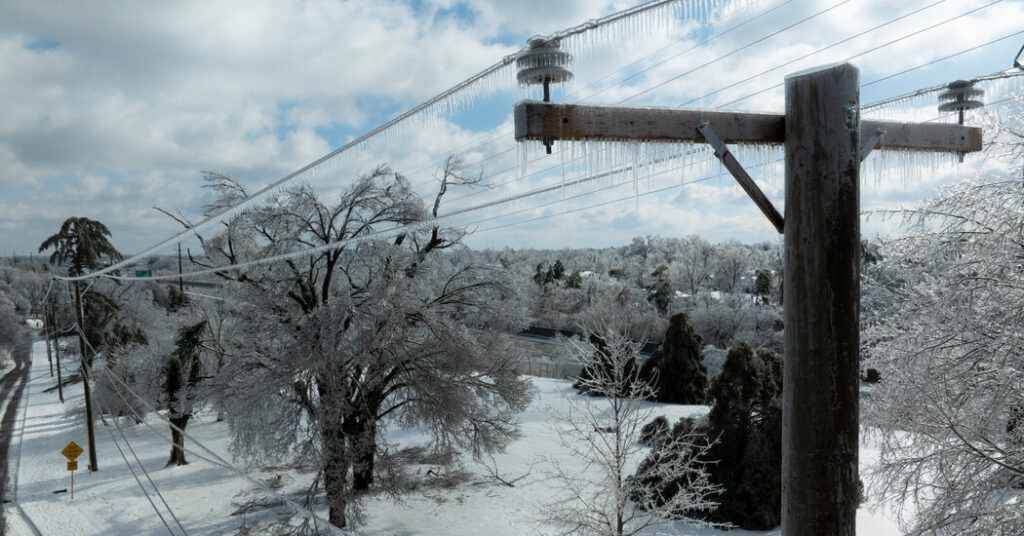
The people responsible for the country’s electricity grid have been working overtime, asking for more government help than usual and maxing out some power plants. They have thankfully avoided disaster so far — and while more than a million Americans lost power in the past week, those outages were mostly caused by snow and ice breaking poles and wires, not by demand exceeding supply.
Winter is an increasingly brittle moment for the grid and for our energy infrastructure, and it’s time for politicians, utilities and the public to wake up. The United States needs more energy to get through the cold snaps of the future. The question is where it will come from — and whether it will raise or lower climate-heating emissions.
Let’s start with the basics. America’s energy system is most tested by summer heat waves and winter cold snaps.
On the most sweltering days of the year, air-conditioners roar and the local grid stretches to deliver as much electricity as it can. Summertime demand tends to peak in the late afternoon and evening, as Americans come home, make dinner, turn on the TV and crank up the air-conditioning.
These moments test the grid now — and will keep straining it into the future. But wind, solar and batteries could help ease some of these issues in the future.
The winter poses a different kind of challenge.
The peak of wintertime electricity demand comes twice a day: in the evenings, when Americans get home and run their appliances; and in the morning, around the time they wake up. In the wee dark hours of January and February, millions of Americans get out of bed, turn on the lights, make breakfast or shower and — crucially — turn up the thermostat or switch on electric space heaters. And that means they burn more natural gas: Although electric heat pumps and resistance heaters are in a rising share of homes, natural gas is still the No. 1 home heating fuel in the country. The grid also gobbles up as much gas as it can get because gas power plants are what grid operators crank up or down to meet momentary demand.
In essence, that means that the gas pipeline network is under double strain in the winter — it must send gas to homes for furnaces and boilers, and it must send gas to power plants to be combusted for electricity generation. (Often, gas infrastructure — which isn’t always winterized — is able to move less gas during these moments, too.)
This surge in demand naturally drives up the price of natural gas — and in places such as New York and New England, it can cause shortages or price increases that lead power plants to turn to burning oil and diesel fuel instead. Gas plants can also fail in the winter, worsening the supply crunch. At one point last weekend, New England appeared to be one of the world’s leading consumers of oil for electricity generation.
As more Americans buy electric vehicles and transition from using gas furnaces to heat pumps, wintertime power use will rise. More data centers, factories and economic growth will push up demand even further for all seasons. A decade from now, Americans in New England could regularly use more electricity during the winter’s coldest moments than they do during the summer’s hottest afternoons.
Helping Americans switch to electric heat pumps can reduce the energy load — and the emissions — caused by heating our homes. Heat pumps are more efficient than gas furnaces, even when they’re powered by a fossil-fuel-heavy grid. Unfortunately, President Trump and Republicans in Congress recently cut tax credits that helped Americans buy heat pumps and insulate their homes as part of a Republican tax law. These incentives, which were originally meant to last into the 2030s, expired at the end of December.
Other resources — such as nuclear energy and onshore and offshore wind — could eventually help relieve wintertime strains on the grid. Unfortunately, Mr. Trump has sought to block the offshore wind projects that could bring the most immediate relief to the Mid-Atlantic and New England. Eventually, geothermal power and long-term energy storage can be ramped up or down as the grid demands it, much like gas power plants can today. New large-scale transmission projects, which connect regional grids to their neighbors, could also help stabilize the power system.
But right now we rely too much on fossil fuels such as natural gas, diesel and propane in winter — and we won’t have many viable alternatives for a long time.
In the years to come, the Democrats who tend to lead the northeastern states that face the biggest winter energy concerns will need a pragmatic approach that takes climate change and affordability into account. They haven’t always helped themselves on this front: New York’s natural gas consumption (and its greenhouse gas emissions) has increased since the state shut down the Indian Point nuclear power plant several years ago, a decision made by Andrew Cuomo, who was then the state’s governor, and supported by Robert F. Kennedy Jr., who was then an environmental activist.
A more pragmatic approach would focus first on increasing the efficiency of homes: We should try to make these peak demand moments as small as possible without hurting people’s quality of life by encouraging residential batteries, more insulation and more integration with the grid.
But only so much magic can happen on the demand side — ultimately, the northeastern grid will need more electricity supply. And while we should build many more solar farms and batteries, they will not single-handedly get us through a multiweek cold snap like the one the Mid-Atlantic is experiencing now.
In the absence of alternatives, grid operators will burn fossil fuels to avoid blackouts and brownouts. Some fossil fuels are better than others: For example, it’s better to burn natural gas sent through a pipeline from Pennsylvania or Texas than liquefied natural gas shipped in from abroad. And either form of natural gas is likely far better than diesel fuel and oil.
There are other options: Nuclear power plants can provide zero-carbon electricity 24 hours a day, regardless of the weather outside or the temperature inside. Gov. Kathy Hochul of New York has laudably called for building five gigawatts of new nuclear capacity in the state. Could she band together with others in New England to build even more?
In the 1970s, France responded to the oil crisis by building dozens of new nuclear power plants — and because it built them all at the same time, it got good at building them cheaply, quickly and safely. If northeastern lawmakers want cheaper electricity, lower emissions and less oil and gas combustion, then they should consider a similar path.
Robinson Meyer is a contributing Opinion writer and the founding executive editor of Heatmap, a media company focused on climate change.
The Times is committed to publishing a diversity of letters to the editor. We’d like to hear what you think about this or any of our articles. Here are some tips. And here’s our email: [email protected].
Follow the New York Times Opinion section on Facebook, Instagram, TikTok, Bluesky, WhatsApp and Threads.
The post It’s Very Cold. Just Wait for the Grid to Fail. appeared first on New York Times.