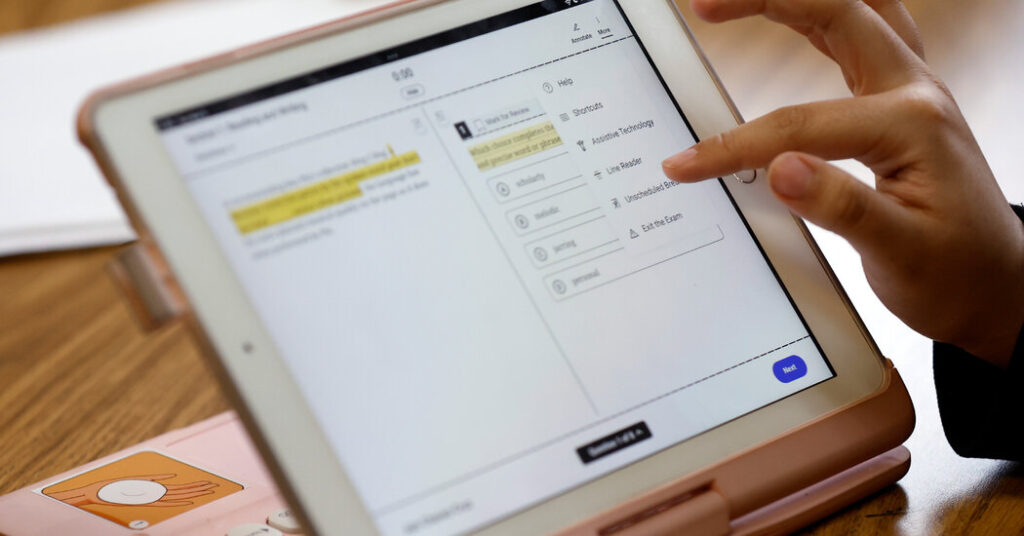
Three years ago, after nearly a century of testing on paper, the College Board rolled out a new digital SAT.
Students who had long relied on No. 2 pencils to take the exam would instead use their laptops. One advantage, the College Board said, was a reduced chance of cheating, in part because delivering the test online meant the questions would vary for each student.
Now, however, worries are growing that the College Board’s security isn’t fail safe. Fueling the concerns are what appear to be copies of recently administered digital SAT questions that have been posted on the internet — on social media sites as well as websites primarily housed in China.
The SAT leaks dominated the conversation in November at an international education conference in Seville, Spain, according to Angel B. Peréz, the head of the National Association for College Admission Counseling.
“It was the talk of cocktail parties at the international high school conference,” Dr. Peréz said in an interview. “I had a few counselors come up to me to say, ‘we are very concerned.’”
The College Board was alerted to the cheating efforts by an SAT tutor, according to emails obtained by The New York Times. “This is not a matter of one compromised form. It is a multiyear breach of active test material, accessible on a global scale,” the tutor wrote to the College Board in November, according to the emails.
The tutor, who works with students at a prestigious European boarding school, asked the Times not to be identified, fearing harm to his students and school. But after reviewing leaked questions, he said he concluded that at least some of them were authentic.
The SAT is administered seven to eight times a year, and the College Board says its network includes 1,700 testing sites in 187 countries. Students take the test at an SAT-approved site, but they are permitted to use their own laptops. While some colleges, including the Ivy League, made standardized admissions tests optional during the pandemic, many top schools have since reinstated a requirement that applicants submit a standardized test score.
One of the sites — bluebook.plus, an apparent knockoff of the official College Board platform, Bluebook, used to administer the actual test — posts what it says are practice tests that students can pay to access. But some of the questions appear to be real, possibly providing questions that ultimately may appear on a student’s actual exam.
In November, bluebook.plus, which appears from domain name searches to be based in China, had 875,000 visitors, according to an analysis by the web traffic site Similarweb.
The bluebook.plus site did not respond to an emailed request for comment.
Concerns about the security of the digital SAT follow breaches involving other digital tests, including the Law School Admissions Test and Graduate Record Examination.
The College Board said in written statements that SAT cheating is rare, affecting only a fraction of 1 percent of its test scores, and noted that overall test scores have remained steady after the transition to digital tests. “However, some students will always be tempted to cheat on high-stakes assessment, and bad actors are persistent. We stay hypervigilant,” it wrote.
The College Board also acknowledged that, “in certain international markets, bad actors have long made concerted efforts to access and share test content (as well as fabricate content) in order to take advantage of anxious students and parents.”
The organization has taken steps to make cheating on the digital test more difficult. The exam is adaptive, meaning that test-takers who perform well early in the exam receive harder questions as they go along. And the College Board says the tests are drawn from a pool of “several hundred thousand” test items.
In addition to having human proctors present during testing, the SAT’s Bluebook platform requires that other apps on a student’s computer be turned off.
But the organization acknowledged that it was aware of “screenshots that purport to have been taken while testing is in progress” as well as “hardware and software-based efforts to evade our security system.”
A variety of coding and SAT “prep” websites discuss ways to bypass Bluebook security. One way is to use a plug-in that seems like a mouse, but is, in fact, a video capture device. Another is a program called a “sandbox, an isolated virtual environment that can work without detection within a computer. Users in various forums, as well as advertisements, also discuss the remote takeover of a student’s computer by an off-site proxy test taker, operating much like an office IT expert.
Test experts caution that many of these ads are scams.
Cheating on standardized tests is not new. In the Varsity Blues college admissions scheme, wealthy parents paid test site administrators to allow others to take tests for their children, give them answers or change answers after testing was complete. Other SAT leaks over the years have included the theft of paper tests.
Rob Franek, editor in chief of Princeton Review, a publishing and test preparation company, said there has been cheating “since these tests were invented,” adding, “certainly, the digital versions were not spared.”
Allegations of SAT cheating follow breaches in digital LSAT and GRE tests used by dozens of prestigious law and graduate programs to screen applicants. In those cases, the tests were taken remotely, not in test centers like the SAT.
Several graduate business schools, including those at the Ohio State University and the University of Minnesota, rescinded admissions offers in 2024 following allegations of GRE cheating by students in Ghana and Nigeria who had taken the tests at home, according to the online publication Poets & Quants, which writes about business schools.
In August, the Law School Admission Council, which administers the LSAT, suspended testing in China, the only place that tests were administered remotely. (The SAT is no longer administered in China because of government restrictions in that country. Instead, students travel to Hong Kong, Macau, or South Korea to take the test.)
In announcing the LSAT suspension, Susan L. Krinsky, executive vice president of the organization, sounded an alarm about the growth of test cheating. Her organization, she said, had become “increasingly concerned about organized efforts by individuals and companies in mainland China to promote test misconduct.”
She added: “This type of activity is not limited to the LSAT; these enterprises purport to offer cheating services for virtually every standardized test.”
LSAT cheating was exposed when a Chinese law student in the United States raised alarms after seeing cheating services advertised on RedNote, a Chinese social media platform. The student, using the pseudonym “Travis,” later discussed LSAT security problems on a podcast hosted by Mike Spivey, an LSAT admissions consultant.
Rachel Schoenig, a former head of security for the ACT, the second-largest undergraduate admissions test, said the web is filled with ads from companies selling hardware and software, purportedly to help students cheat.
“Some are scams,” she wrote in an email. But, she added, “The reality is that no system is foolproof.”
Ms. Schoenig, now chief executive of Cornerstone Strategies, an industry consultant, described efforts to ensure test security and the counter-efforts by cheaters as “always a bit of a cat-and-mouse game.”
The fact that students are permitted to use their own laptops is one weak link that several experts flagged.
There is evidence that digital test security problems are spreading beyond standardized admissions tests, with companies operating online that offer to take college exams for students, for a fee.
Cornell Law School has notified students that it is investigating a testing breach during a contracts exam in December. The school learned of the problem because a paid test taker — intending to advertise his services — posted screen shots of the exam online shortly after gaining remote access to a student’s laptop.
A spokeswoman for Cornell confirmed that its law school had investigated an “isolated incident of alleged testing misconduct,” adding that the school would not comment on disciplinary cases.
The content of the SAT exam is not public, but the tutor who notified the College Board said he was able to authenticate some of the questions students flagged to him. One way was to compare old SAT questions that were retired last year, which the College Board has since published online, with questions posted earlier on cheating sites when those retired questions were still being used on the SAT.
For example, an advanced math question, part of a March 2025 international exam that was posted online and shared with the European tutor by a student, was virtually identical to a question the College Board removed from its question bank in August.
When presented with the similarities, the College Board said it would not comment on any test content.
In some cases, metadata showed that questions were posted online almost instantaneously after the test — creating the possibility of “time zone cheating,” in which test takers in a later time zone can gain access to the test questions before their test begins.
Test questions also have been sold on Telegram, a Dubai-based platform, and posted on Scribd, a subscription digital repository of data. Students have also circulated questions among themselves on Google docs, the European tutor said. Many of the tests have been removed from Scribd, apparently at the College Board’s request. A spokesman for Scribd, based in San Francisco, said the company responds to valid requests to remove copyrighted material.
But the College Board has been unable to fight bluebook.plus, according to an email exchange with the College Board that the tutor shared.
“We did go through the legal process to request a takedown, but as is often the case with international sites, we didn’t get a response,” wrote a College Board security official, Michael Thiel, responding to the tutor.
Mr. Thiel added: “Some of what’s posted may be real, some isn’t, but none of these sites have all the SAT questions.”
Stephanie Saul reports on colleges and universities, with a recent focus on the dramatic changes in college admissions and the debate around diversity, equity and inclusion in higher education.
The post How the Online SAT May Be Vulnerable to Cheating appeared first on New York Times.