Already, 2026 is proving to be a challenging year for global hunger. Last year, the global development sector faced enormous upheavals, with the United States and other donor countries slashing aid budgets even as low-income countries struggled with debt burdens. Steep aid cuts have exacerbated existing food security crises—whether from Russia’s war with Ukraine disrupting international food supplies or farmers losing tens of billions of dollars due to climate change. Nearly one in 12 people worldwide suffers from hunger, while one-third of the world’s population cannot afford a healthy diet. If aid cuts continue at this pace, preliminary research shows that 14 million people could die in the coming years, 4.5 million of them children. A huge number of those deaths will be because those kids don’t have access to food.
Yet amidst this discouraging backdrop, those who work on hunger, food and nutrition security, and climate are rallying around a promising solution: school meals. It’s a solution increasingly funded by countries in Africa, Asia, and Latin America, reducing reliance on outside aid. After a year that proved we can’t depend solely on traditional donors and models to feed the world’s hungry, low and middle-income countries are stepping up with strong leadership. School meals programs are increasingly an area of focus—they are already feeding 466 million children globally and, with country-focused investment and support, could reach 100 million more by the end of the decade.
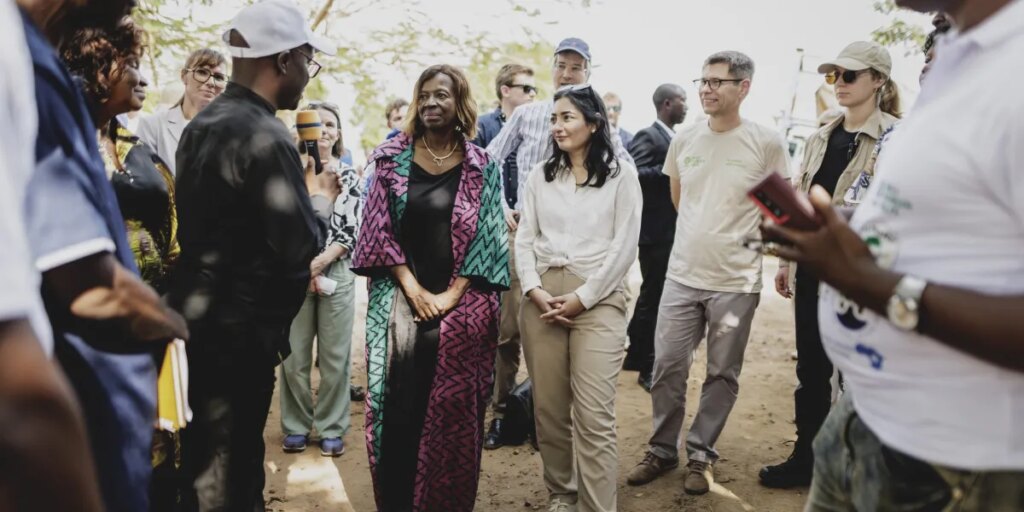
In response to the many governments seeking to harness the power of school meals for their populations, earlier this month, our organizations (Germany’s Federal Ministry for Economic Cooperation and Development, The Rockefeller Foundation, and the Novo Nordisk Foundation) worked with the leading agency in school meals, the World Food Programme, to launch the School Meals Accelerator. This first-of-its-kind initiative, launched in Berlin as part of the School Meals Coalition, makes an initial commitment of more than $80 million to give targeted support to countries advancing school meals programs.
Collectively, our organizations have decades of experience working to address child malnutrition, global poverty, and humanitarian crises. We have seen the same problems persist: economic instability, environmental disasters, political turmoil – all exacerbating hunger and poverty in a self-perpetuating cycle. Remarkably, school meals have proven a solution that can be truly transformative in the face of these challenges, improving health and education while helping withstand environmental and economic shocks. By providing vulnerable children with at least one reliable meal each day, school meals serve as the world’s most extensive social safety net. The value of this safety net was made clear during the Covid-19 pandemic, when millions of children could no longer depend on a consistent meal. Now, it’s a major policy priority for more than 110 countries, who are increasingly standing up national school meals programs—and paying for it themselves. Global funding for school meals doubled from 2020 to 2024, and 99% of that comes from domestic budgets, not donors.
But the biggest reason school meals have so much momentum is their ripple effects. In addition to feeding kids, the meals help keep students in school. especially girls, and set a strong foundation of good health that pays dividends later on. Then, there are the benefits outside the schoolhouse: school meals can turn public spending into predictable demand for farmers, jobs for local cooks and small businesses, and more local, sustainable food chains. This gives countries an opportunity to use procurement to create large-scale change in their agricultural sectors and food ecosystems. For instance, Brazil requires that a portion of school meal ingredients be sourced from local family farmers, which has led to as much as a 106% increase in farmer incomes. Globally, every $1 invested in school meals yields up to $35 in economic returns. Finally, as climate challenges grow, school meals can build local capacity, which can help communities endure droughts, floods, wars, and other crises.
So it’s clear why school meals are becoming more popular: quite simply, they work. Yet the challenges are formidable. These programs are technically sophisticated: feeding approximately 30 percent of the population one meal a day can be expensive and complex. Many governments have expressed the need for more staff, expertise, and resources to run their school meals programs and to conduct monitoring and evaluation. The meals themselves need to be planned to ensure they’re nutritious, diverse, and low-cost. There’s also the challenge of procuring ingredients consistently and affordably—which, if done strategically, can also be an opportunity for farmers and food systems.
To help governments tackle some of these challenges, our organizations developed the School Meals Accelerator. This initiative does not fund the meals themselves; rather, it will provide expertise, information-sharing, and other resources, based on countries’ needs, to make programs more effective and financially sustainable.
For example, the Accelerator might work with partners to help a country train administrative staff to design budgets or digitize systems to ensure food safety. Another country could receive advice for local farmers on ensuring vegetables arrive fresh at schools despite hot weather. Or the Accelerator could bring in organizations to supply better ovens that reduce health risks for cooks. Ultimately, the goal is to give targeted support through partners, build local capacity so countries can independently sustain these programs.
By responding to countries’ push for self-sufficiency, the School Meals Accelerator represents a new approach to development that can withstand the challenges of the current aid climate. In contrast to the more top-down food aid approach to 20th century aid (think, for instance, of grain or vegetable oil shipments to developing countries), this new effort focuses on countries that are already taking the lead on their own programs. Today, with traditional international institutions under strain, the School Meals Accelerator relies on the power of partnership to ensure that, regardless of geopolitical shifts, countries can continue improving their programs and keep them in place for generations.
The momentum behind school meals would be extraordinary at any time—let alone today, when the political winds seem to be blowing against supporting vulnerable people. Each of our organizations has confidently chosen to invest in sustainable school meals because the investment is not just for kids, but also for local farmers, economies, and the planet. We hope our commitment will encourage others to follow suit. With more partners at the table working to make national school meals programs an established global norm, we can ensure that someday soon, no child goes to bed hungry.
The opinions expressed in Fortune.com commentary pieces are solely the views of their authors and do not necessarily reflect the opinions and beliefs of Fortune.
The post How to fight child hunger in a time of foreign aid cuts appeared first on Fortune.