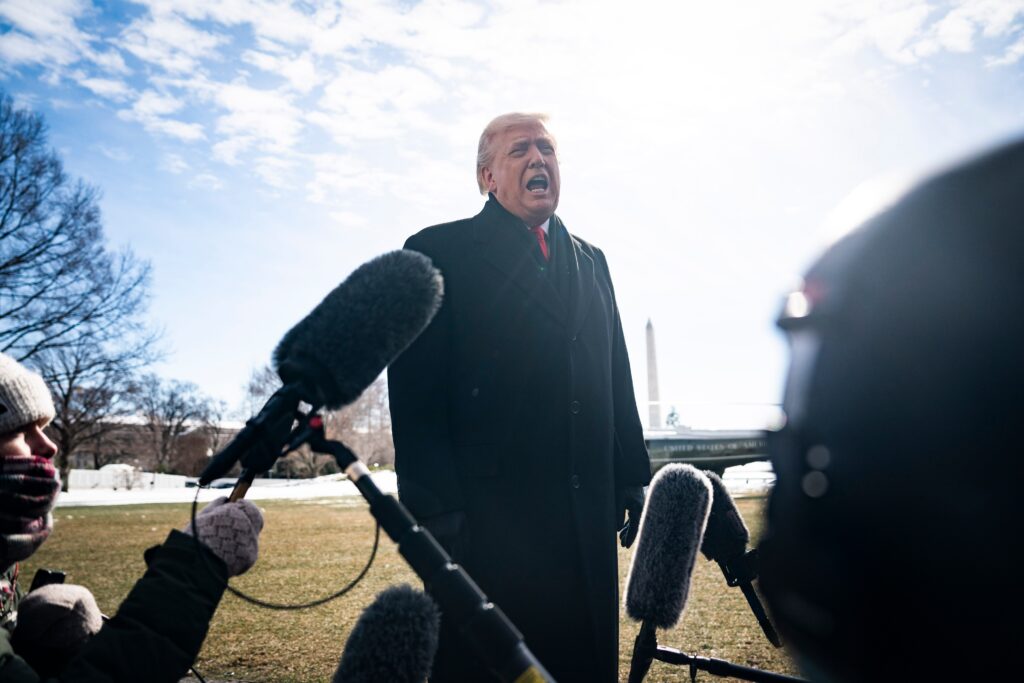
President Donald Trump’s partial retreat on immigration enforcement in Minneapolis is a mess of his own making. His approach to immigration long has been one of denigration, bluster and extravagant promises. But heavy-handed tactics and two killings in Minnesota have generated a predictable public backlash. What next for the president?
The killing of Alex Pretti on Saturday, coming just two weeks after the shooting death of Renée Good, represents a crisis moment for Trump’s immigration policy. The tentative steps he has taken to de-escalate may offer him some breathing room. But will he learn from the mistakes that have brought him to this moment? History suggests no, because it would require a fundamental rethinking of his immigration policy.
Trump has shown no limits on the issue of immigration. He used the issue to win the 2016 election and again the 2024 election. Attacking immigrants, particularly those here illegally, was his not-so-secret sauce. Economic issues aided his comeback in 2024, but frustration over immigration was also a major driver.
President Joe Biden’s immigration policy — he allowed a huge influx of undocumented immigrants through a porous southern border — provided Trump with the conditions he needed in the campaign to exploit the always volatile issue. In the campaign, Vice President Kamala Harris couldn’t find a way to undo the political damage the president she served had caused.
The influx of undocumented immigrants under Biden was more than enough for Trump to seize upon. But to stoke public fears, he lied about what happened, claiming with no evidence for example that other countries had emptied out their prisons and sent inmates to the United States. Sealing the border and carrying out the largest mass deportation in history were the first two promises in the Republican platform in 2024, coming even before a pledge to deal with inflation.
Trump promised to rid the country of violent undocumented immigrants, those with criminal convictions who nonetheless were still here. But he went further. His agents would seek to deport anyone who had crossed the border illegally, whether they had lived here peacefully for years or even decades. That part of the policy was unworkable from the start; now it has been Trump’s undoing.
His call to tighten the border enjoyed strong public support. His call for deportations of violent criminals also has had the public behind him. But how many Americans anticipated the tactics that he would authorize to carry out these promises — the virtual storming of selected American cities by Immigration and Customs Enforcement (ICE) agents, armed and masked.
Trump did not learn from other presidents. President Barack Obama carried out significant deportations, so many that he drew criticism from immigrant activists and many on the left. But Obama did not terrorize cities with displays of massive force that have been authorized by Trump. There are ways to enforce the law and ways not to.
Trump can claim success in tightening the border. Illegal crossings are at record lows. But his deportation policy is another matter. Over the past year, Trump’s enforcement has shifted from arresting and deporting undocumented immigrants with criminal records to rounding up immigrants with no criminal records. From promising to ridding the country of the “worst of the worst,” the administration has sought simply to meet unrealistic deportation targets.
To meet quotas established by Stephen Miller, the White House deputy chief of staff, enforcement became random and often violent, sweeping up noncriminal undocumented immigrants. A Wall Street Journal editorial Monday, citing the Cato Institute, noted that since October, “73% taken into ICE custody had no criminal conviction and only 5% had a violent criminal conviction.”
That is a dramatic reversal compared with early in 2025. “The Trump Administration’s rhetoric about deporting criminals doesn’t match its current much broader policy of mass deportation,” the Journal editorial said.
The officials entrusted with overseeing the roundup and deportation of immigrants present in the United States illegally learned the wrong lessons from the president they serve. Trump has never been tethered to the truth, so it may not be a surprise that Homeland Security Secretary Kristi L. Noem spoke without any facts, smearing Pretti when visual evidence showed something different.
Gregory Bovino, the Border Patrol official who was in charge in Minneapolis, was forced to admit in court that he had lied about a tear-gassing incident last fall in Chicago. He said he threw a tear-gas canister after a rock was thrown at him. In fact, he threw the canister first before a rock was thrown in response. Now Bovino has been replaced by border czar Tom Homan, who reportedly has a tenuous-at-best relationship with Noem.
The tragedy in Minneapolis comes at a time when Trump has shifted on other policies. He backed away from threats to use force to take control of Greenland. He claimed he has a workable deal, but details remain sketchy. He denigrated the contribution of soldiers from the United Kingdom serving in Afghanistan, then, facing a ferocious pushback, posted a groveling response on social media.
He is also trying to convince skeptical Americans that his economic stewardship is paying dividends. Trump pledged quick action to bring down prices, another promise he has not met.
But immigration is now front and center as a challenge. Even some Republican lawmakers have been spooked enough by the killing of Pretti to begin to speak out, calling for de-escalation and a change in strategy. These calls have been tentative; GOP lawmakers are still hesitant to criticize the president directly. But it’s notable, given how rare it has been for Republican elected officials to break with Trump.
A New York Times-Siena University poll released last week showed that 61 percent of Americans said that the tactics used by ICE had gone too far, including 71 percent of independents (though just 19 percent of Republicans). Almost 6 in 10 (58 percent) said they disapprove of Trump’s handling of immigration, though 50 percent said they approve of the general policy to deport immigrants living here illegally.
That poll was taken before Pretti’s killing. It’s likely any poll taken this week would show even more dissatisfaction with the tactics of ICE and with the president’s leadership. Trump’s political antenna tell him he has a problem on his hands. But he has long believed that admissions of mistakes or signs of weakness represents a losing strategy. Better to tough it out and hope the crisis will pass.
Maybe that will be his approach now. In any given week, attention can swing rapidly from one seeming crisis to another. There will be events to take attention away from Minneapolis, and it’s probable that Homan will bring about a reduction in the ICE footprint there. But for Trump, the issue that has been at the heart of his political appeal is dragging him down.
The post Trump is dealing with an immigration mess of his own making appeared first on Washington Post.