In October, when Matthieu Blazy unveiled his debut Chanel collection, the model that closed the show, Awar Odhiang, did so with a huge grin, throwing her arms up in the air in celebration. Her personality was so infectious, it not only made the audience grin in response, it became a meme unto itself, and made her a superstar almost overnight.
Then, in December, when Mr. Blazy brought his freshman Métiers d’Art collection to the New York City subway, he tapped another relative unknown, Bhavitha Mandava, to open the show, making her the first Indian model to get that gig and — again — vaulting her and her own story into the public eye.
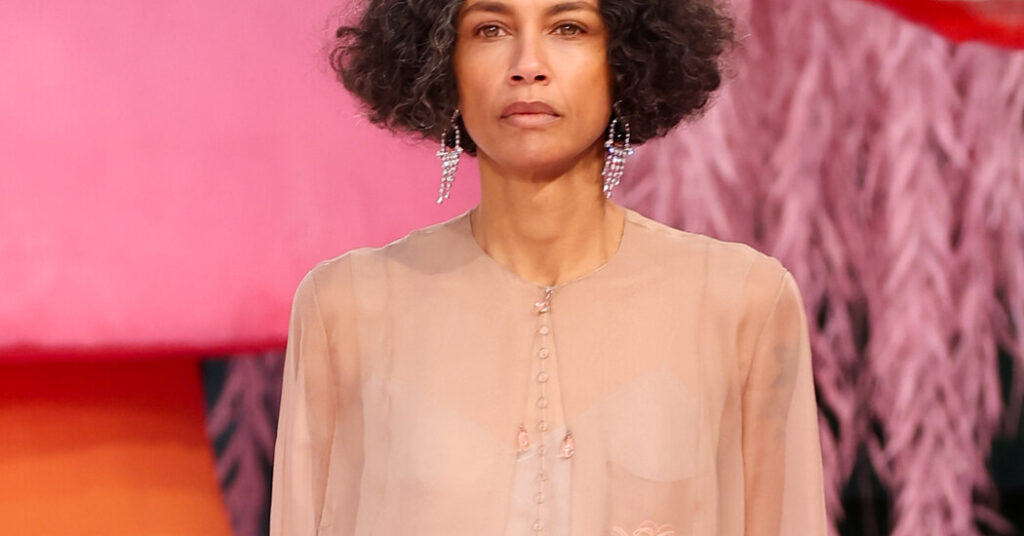
So on Tuesday when the first model stepped onto the Chanel runway for Mr. Blazy’s first couture show, and she was a 40-something grown-up named Stephanie Cavalli, it wasn’t a fluke. It was the final part of a mission statement: about whom Mr. Blazy’s Chanel is for and what he is trying to do with the brand.
Namely, free it from old strictures. Coco Chanel was, after all, the designer who liberated women from the corset. Mr. Blazy is simply taking that heritage and making it his own. In all sorts of ways.
First, he untethered himself from the idea that a runway should be full of grim, automaton-like teenagers. Older models, “bring a completely different dimension to the clothes,” Mr. Blazy said backstage after the show. “They have life; they’ve seen the world.” (Not every model in the show was a mature woman, but there were enough to make it clear they weren’t tokens.)
Then he untethered himself from the morass of Chanel iconography: the camellias and the double Cs and bows and ropes of pearls.
And then the collection really took flight. Partly because, despite the fact Mr. Blazy set the show in a fairy-tale-pink forest speckled with Wonderland-size magic mushrooms, he named birds as an inspiration. Think airy, rather than trippy.
Thus, while he may have begun with the usual parade of daywear suiting, the clothes were rendered not in the typical bouclé, but entirely in layers of transparent mousseline, like a breeze around the body. The gold chain that Chanel famously added to the inner hems of her jackets to help them hang straight migrated to the outside, dangling tiny seed pearls. Embroidered toadstools and feathers climbed side seams.
There was even a pair of bluejeans and a white tank top, both in mousseline as weightless as a cloud. (Making one kind of material look like another has become something of Mr. Blazy’s signature.)
More feathers showed up embedded in 3-D faux tweed (actually composed of tiny silk knots) coats and cocktail suits; undulating from the hems of sleeveless sheaths; curving around the arms in a cape; and beaded into a flapper dress. Even the last look, a wedding dress, worn by Ms. Mandava, was not a traditional wedding dress at all, but an oversize tunic and skirt (with pockets) covered in hundreds of glinting feathers made from mother-of-pearl. Amid it all were what he called “ravens” — little black dresses — because, well, that’s life.
And though Mr. Blazy has an inexplicable affinity for a skirt hemmed just below the knee, a frumpy length that tends to drag the eye down and that Chanel herself often favored in her later years, there’s a generosity to his approach that works as a lightener.
Indeed, rather than elide the idea that couture is a made-to-order business based on the unique, Mr. Blazy embraced it, asking his models to provide a personal story or memory he could have represented inside the garments they wore: a child’s date of birth, someone’s initials, a quote from a love letter.
It was a reminder that what makes this kind of fashion special is, sure, the work involved, which is often eye-boggling (one dress involved tweed that seemed to melt magically into beading that seemed to melt into avian plumage). But even more so, it’s the connection the clothes have to the person within. That’s an idea often lost amid the spectacle that couture now represents.
And the approach, like the ages represented on the runway, aims to allow the women watching to “recognize themselves in something they see,” Mr. Blazy said. Whether they would ever wear it, or not.
Vanessa Friedman has been the fashion director and chief fashion critic for The Times since 2014.
The post Chanel Celebrates Grown-Up Women appeared first on New York Times.