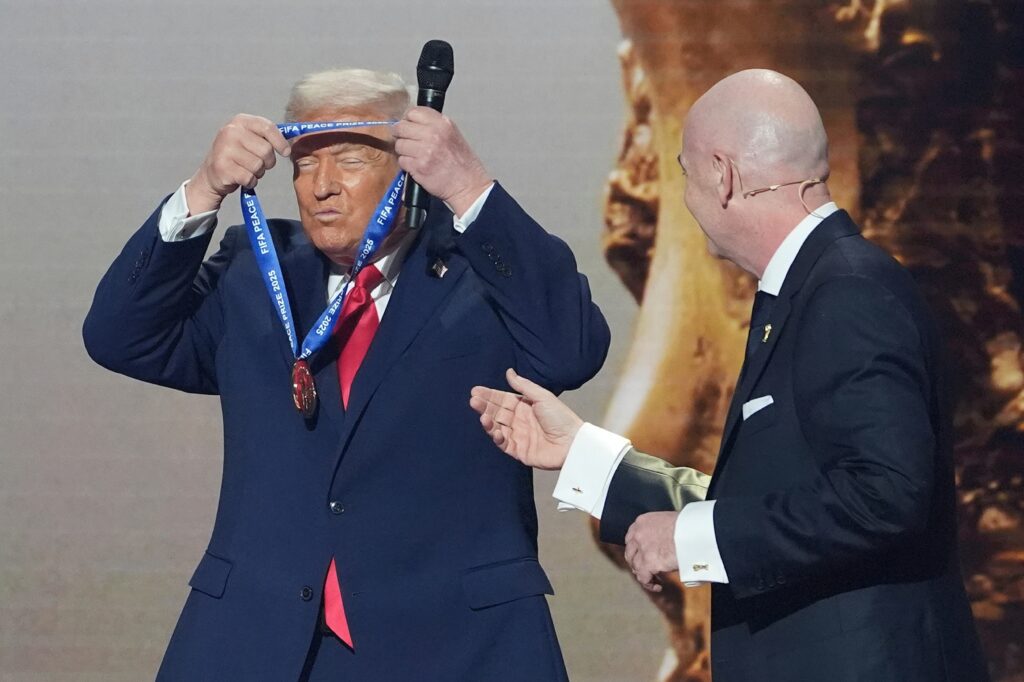
This summer’s World Cup is inextricably tied to President Donald Trump. He has for months cast the soccer tournament — to be held in cities across Canada, Mexico and the United States — as part of his legacy. FIFA, the sport’s governing body, has returned his embrace: Its president, Gianni Infantino, handed Trump a newly invented “peace prize” during a ceremony in December.
“We want to see hope, we want to see unity, we want to see a future,” Infantino said then, in a display widely mocked as fawning by soccer fans and pundits. “This is what we want to see from a leader and you definitely deserve the first FIFA Peace Prize.”
Whatever the strangeness of FIFA doling out such an award, which Trump accepted as due vindication for his peacemaking efforts over the past year as he sought the Nobel Peace Prize, the gesture signaled the extent to which Trump’s personality and presidency would loom over the world’s most popular sporting tournament.
It also dovetailed with increasing concerns surrounding the administration of the tournament in the United States, with foreign soccer fans already perturbed by the astronomical cost of tickets (with a small share going for $60 and many going for thousands of dollars), difficulties in getting U.S. visas, as well as invasive surveillance measures introduced by the Trump administration, including vetting of the social media accounts of new arrivals. Though the World Cup is being hosted by all three major countries of North America, most games will be in the U.S.
Those concerns only intensified in January, after Trump’s raid to seize Venezuelan President Nicolás Maduro and demands to obtain Greenland, an autonomous territory of Denmark. Many European onlookers have been horrified by the scenes of U.S. federal law enforcement cracking down on dissent in the streets of Minneapolis and killing U.S. citizens.
In Europe, there’s a growing clamor from some corners to boycott the World Cup — and questioning of the fitness of the U.S. to host the tournament. A petition circulated by popular Dutch broadcaster Teun van de Keuken that calls on the Netherlands to withdraw from the tournament has garnered more than 140,000 signatures. “We do not want our footballers, through their performances at the tournament, to implicitly support the policy of violent terrorism pursued by President Donald Trump against innocent immigrants, whether or not they hold a U.S. passport,” the petition says.
Van de Keuken’s ire is not unique. Leftist French lawmaker Éric Coquerel urged a boycott, expressing outrage over the idea of playing “in a country who attacks its ‘neighbors,’ threatens to invade Greenland,” and “destroys international law.” In an interview with Le Monde, Claude Le Roy, a prominent French soccer coach who has managed a number of African national teams, pointed to Trump’s gutting of humanitarian aid to African countries as justification for Trump not “deserving” the prestige of the World Cup.
A motion signed by more than two dozen left-leaning lawmakers in Britain’s parliament this month called on FIFA to mandate the exclusion of the U.S. national team from the tournament along similar grounds to its barring of Russia, arguing that the Trump administration’s “conduct undermines the rules-based international order.” Separately, Simon Hoare, a Conservative lawmaker, argued during a speech in the House of Commons last week that a withdrawal of Britain’s home nations — England, Scotland and, if it qualifies, Wales — from the World Cup would serve to “embarrass” Trump, whom he described as a “thin-skinned” leader with “an ego.”
At the peak of Trump’s most recent threats over Greenland, Jürgen Hardt, a center-right German parliamentarian from Chancellor Friederich Merz’s ruling party, suggested a German boycott would be a “last resort,” but a measure that could bring Trump “to his senses.” A survey in Germany’s leading tabloid Bild found that about 47 percent of the German public approved a boycott in the event of Greenland’s annexation.
Oke Göttlich, one of the vice presidents of Germany’s ruling soccer body, urged a conversation about a boycott, likening the current considerations to those made by some Western governments during the 1980s when faced with the Soviet Union’s invasion of Afghanistan. “What were the justifications for the boycotts of the Olympic Games in the 1980s?” Göttlich told the Hamburger Morgenpost. “By my reckoning, the potential threat is greater now than it was then. We need to have this discussion.”
But it’s unlikely this discussion will go far. Top French and German sporting officials have shrugged off the possibility of a boycott. The last two World Cups were held amid huge controversy: Russia, the 2018 host, had consolidated its grip over illegally annexed Crimea, while Qatar, in 2022, faced severe scrutiny over its human rights record and treatment of its legion of migrant workers. But no country engaged in a full-fledged boycott in either instance. The vast love of the sport shared by many tends to win out over any moral hesitation.
Before the events of the past month, the main source of disquiet surrounding the World Cup in the United States was the Trump administration’s perceived anti-immigration crackdown. There’s uncertainty about the ability of visiting fans and even players and staff from certain countries — ranging from Haiti to Iran — being able to attend the tournament. Dozens of countries are subject to indefinite pauses to visa processing. FIFA authorities and the White House have said special arrangements will be made for visa applications by those holding purchased tickets. But while Russia and Qatar rolled out the red carpet for visitors, there’s not much of a welcoming climate in the United States months away from the tournament’s kickoff.
At a launch event last week for the World Cup in Davos, Switzerland, Infantino hailed the “party” and “celebration” to come in the United States. He acknowledged that he had been “hammered” by critics over high ticket prices, but gleefully predicted that every match in the tournament will be sold out and that American resellers would make even more money selling off tickets they secure through FIFA’s byzantine purchasing process.
He also scoffed at European protests over Qatar’s World Cup, mocking the British in particular. “When the ball started rolling and the magic started we had virtually no incidents,” Infantino said, describing the orderly scenes in Doha. “For the first time in history also, no Brit was arrested during a World Cup. Imagine! This is something really, really special.”
Within FIFA, reports suggest there’s growing embarrassment with Infantino’s embrace of Trump, as well as the oil-rich monarchs of the Gulf. Mark Pieth, a Swiss attorney who specializes in white-collar crime and once chaired an independent governance committee associated with FIFA, urged a boycott as a protest of the Trump administration.
“What we are seeing domestically — the marginalization of political opponents, abuses by immigration services, etc. — hardly encourages fans to go there,” Pieth told Swiss daily Tages-Anzeiger. “For fans, just one piece of advice: avoid the United States! You’ll get a better view on television anyway. Upon arrival, fans should expect that if they don’t behave properly with the authorities, they will be immediately sent home. If they’re lucky.”
Sepp Blatter, the scandal-hit figure whom Infantino succeeded, piped up on social media. “I think Mark Pieth is right to question this World Cup,” he wrote.
Sign up to receive WorldView, a free, thrice-weekly email newsletter from the international desk of The Washington Post.
The post Clamor is growing in Europe to boycott Trump’s World Cup appeared first on Washington Post.