President Trump on Tuesday warned that the United States would “no longer help Iraq” if Nuri Kamal al-Maliki returned as Iraq’s prime minister, a new intervention in another country’s politics that came after Washington signaled it would seek to limit Iranian influence in Iraq’s next government.
Just over the last few days, Mr. Trump has threatened Canada over doing business with China and vowed to raise tariffs on South Korea because of delays in fulfilling a trade deal with the United States. Last week, Mr. Trump walked back a pledge to raise tariffs on European countries that were resisting his efforts to take over Greenland.
But Iraq, where Prime Minister Mohammed Shia al-Sudani fell short of a decisive victory in elections last November, is far more vulnerable to American threats. The United States controls Iraq’s oil revenues because they flow through the New York Federal Reserve.
“No Iraqi prime minister is viable if the Americans say, ‘We’re going to hate this guy from Minute 1,’” said Michael Knights, an Iraq specialist at Horizon Engage, a strategic consulting firm in New York.
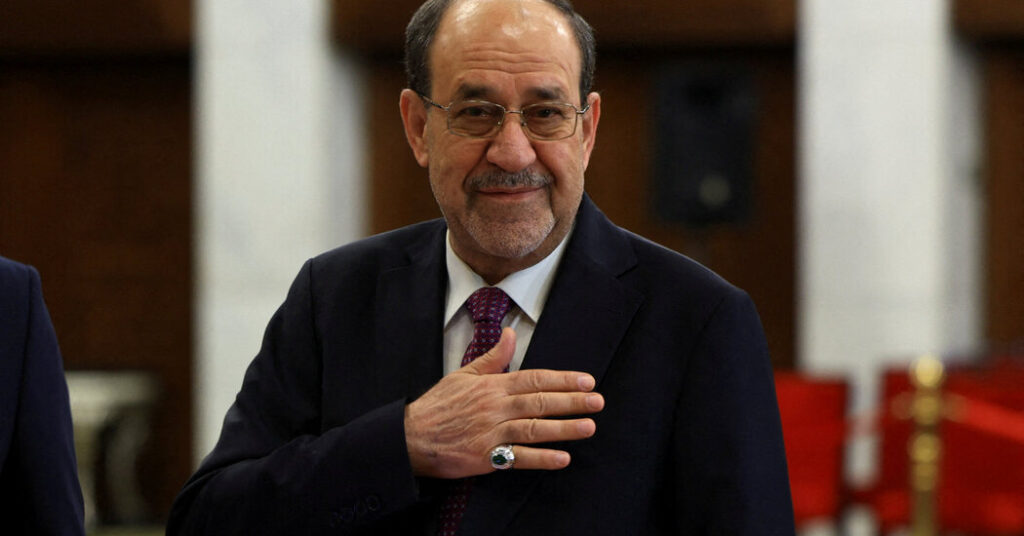
Mr. Maliki was nominated to the prime minister post by the main Shiite Muslim bloc in the Iraqi Parliament on Saturday. He was backed by the United States when he first became prime minister in 2006 but was blamed in his second term, from 2010 to 2014, for sectarian policies that fueled the rise of the Islamic State, a Sunni extremist group. Iraq, like Iran, is a majority Shiite nation.
“Last time Maliki was in power, the Country descended into poverty and total chaos,” Mr. Trump posted on his Truth Social platform on Tuesday. “Because of his insane policies and ideologies, if elected, the United States of America will no longer help Iraq and, if we are not there to help, Iraq has ZERO chance of Success, Prosperity, or Freedom.”
Mr. Trump’s broadside against Mr. Maliki came after months of building U.S. pressure against Iranian influence in Iraq. Iraq’s leaders have long had to walk a tightrope between the United States on one hand and Iran, their powerful neighbor, on the other. Iran has ties to many leading figures in Iraq’s Shiite majority, including Mr. Maliki.
“A government controlled by Iran cannot successfully put Iraq’s own interests first,” the State Department said after Secretary of State Marco Rubio spoke with Mr. Sudani, the current prime minister of Iraq, in a phone call on Sunday.
Mr. Trump did not mention Iran in his Truth Social post, leaving his exact motivations unclear. Mr. Knights said that while Mr. Maliki empowered Iran-linked militias in his second term as prime minister, his actions in recent years did not stand out as particularly pro-Iranian compared with other major Shiite figures in Iraq.
But Representative Joe Wilson, Republican of South Carolina, reinforced the administration’s anti-Iran message in a social media post a few hours after Mr. Trump’s missive on Tuesday. He said that Iraq needed to “fully disarm and dismantle all Iranian aligned militia groups” within 12 months and remove Iranian advisers, operatives and agents from the country.
“Iranian influence in Iraq will no longer be tolerated,” Mr. Wilson wrote. “The era in which outside actors imposed prime ministers on Iraq is over.”
Anton Troianovski writes about American foreign policy and national security for The Times from Washington. He was previously a foreign correspondent based in Moscow and Berlin.
The post Trump Threatens to Pull U.S. Help From Iraq if Former Leader Returns appeared first on New York Times.