Please note: We ask that adults respect the intent of our Student Opinion questions and refrain from posting here. While there are many other places on nytimes.com for adults to have their say, this is the only forum that explicitly invites the voices of young people. Please be sure to observe The Times’s commenting guidelines in your response.
On Saturday, federal agents in Minneapolis fatally shot Alex Pretti, a 37-year-old registered nurse and U.S. citizen. He is the second person to be shot and killed in the city during protests against the Trump administration’s ramped-up immigration enforcement effort. Earlier this month, an Immigration and Customs Enforcement agent killed Renee Good, another U.S. citizen.
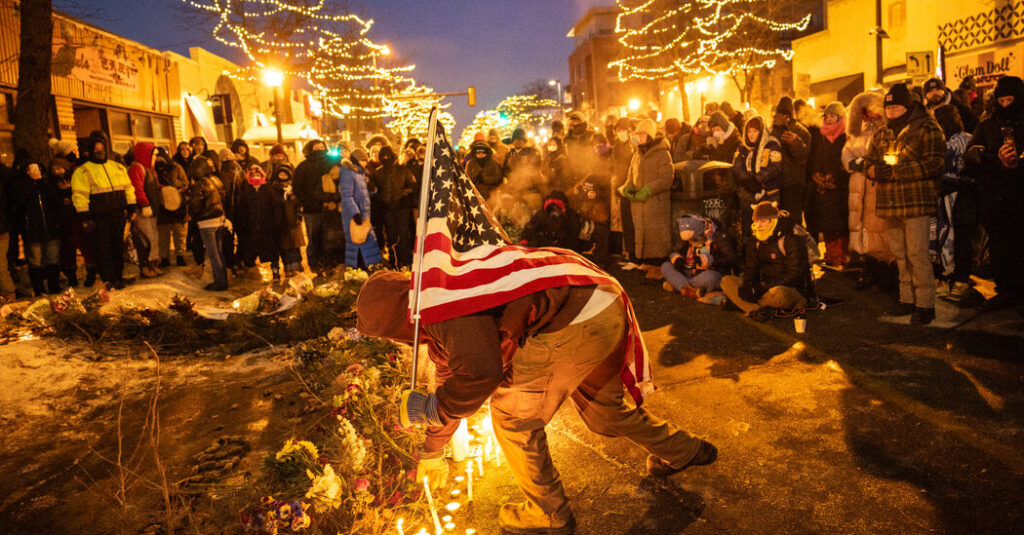
For many, the killings have been shocking. After the fatal shooting of Ms. Good, thousands of protesters flooded the streets of the Minneapolis-St. Paul area to demand that federal immigration agents end their weekslong crackdown. Mr. Pretti’s death prompted more protests in Minneapolis and other parts of the country last weekend.
Have you been paying attention to what is unfolding in Minneapolis? What have you seen and heard about the shootings, the immigration crackdown and the protests?
In the wake of these events, what are you thinking and feeling about America — about what it stands for and where it is heading?
In “A Shocked Nation Watches Minneapolis Killings: ‘Something Needs to Change,’” Dan Barry interviewed people across the country to understand the nation’s mood right now. He writes:
The wintry whiteout that swept across half the United States over the weekend could not erase what the country had just seen unfold in Minneapolis. No amount of snow could block out the images: furious protesters clashing with masked officers, clouds of tear gas wafting through neighborhoods — and for the second time in three weeks, video of an American citizen being shot dead by a federal agent.
And for the second time in three weeks, the Trump administration’s account of a deadly shooting contradicted what many in the country believe they saw. Federal officials described both victims as “domestic terrorists” intent on harming federal agents; critics of the administration, and many others, said such a description was belied by the video evidence.
Scenes from the violent unrest in Minneapolis played on a loop throughout the weekend, overshadowing the extreme weather and two N.F.L. playoff games. The images conveyed the unmistakable sense of consequence, of a watershed moment, prompting reflections about what the nation stands for, and where it is heading. Minneapolis seemed close, no matter where one lived.
Mr. Barry explains what happened in Minneapolis:
The weekend’s turn of events in Minnesota began with a campaign promise. Since returning to office a year ago, President Trump has sought to make good on his vow to rid the country of undocumented immigrants he describes as criminals.
Agents for U.S. Immigration and Customs Enforcement have carried out sweeps in a succession of Democrat-controlled cities, all the while being dogged by protesters. Critics have denounced the operations as cruel, often unconstitutional, fraught with mistaken or improper detentions — even un-American.
In December, ICE turned to the Minneapolis-St. Paul area with a focus on its large Somali community. The Trump administration has blamed an ongoing fraud scandal in Minnesota, involving billions of dollars in federal funding, on the state’s Somali immigrants, whom Mr. Trump demonized as “garbage” in comments widely denounced as bigoted.
Then, on Jan. 7, an ICE agent fired three times into an S.U.V. as it was pulling away from a confrontation, killing the 37-year-old driver, Renee Good. Federal officials have maintained that the agent acted in self-defense, while state and local officials have disputed that account of the fatal moment, which was filmed from several angles.
Tensions continued to escalate all month, with furious protests, arrests and the shooting and wounding of a Venezuelan man by an immigration officer.
Then: Saturday.
Mr. Pretti, a nurse at a Veterans Affairs hospital with no criminal record, was using his cellphone to record a protest when he stepped between a woman and an immigration agent who was pepper spraying her. As he, too, was hit with pepper spray, several agents threw him to the ground and, in the ensuing scrum, saw that he had a gun, which he never drew and was legally carrying.
They opened fire, in a brutal scene that was witnessed, recorded and quickly shared.
As the inclement weather brought much of the country to a standstill, many people could not help but see the disturbing video, hear the Trump administration’s rushed justifications — including the unsubstantiated claim by Gregory Bovino, a senior Border Patrol official, that Mr. Pretti had been out to “massacre law enforcement” — and ruminate.
Mr. Barry ends with an exchange between a married couple who disagreed about what the shootings mean for America:
And at an upscale mall in West Des Moines, Iowa, where the temperature was in the single digits, a married couple, Jennifer Stitz and Don Caves, finished their food-court meal on Sunday evening while trying to find common ground on Minnesota and the country. Mr. Caves’s 18-year-old son, Carsten, sat nearby, playing a game on a tablet.
Mr. Caves, a high school Bible teacher, and Ms. Stitz, an accountant, both voted for Mr. Trump in 2024. But as they discussed the shooting deaths in Minneapolis, their viewpoints diverged.
Mr. Caves, 62, said that the shootings were “absolutely terrible,” but he maintained that Ms. Good and Mr. Pretti had put themselves in harm’s way.
“I just don’t understand why people would interfere in other people doing their job, especially law enforcement,” Mr. Caves said. “Get out of their way. They’ve got guns.”
He said he supported peaceful protest, but added: “Don’t get in the way between point A and point B, the good guys going and getting the bad guys. And that’s the situation that our officers have been facing.”
Ms. Stitz, 54, listened quietly — and then disagreed.
She said she was troubled by both deaths in Minneapolis. Mr. Pretti, she said, had “every right” to carry a gun, and ICE agents could have simply let Ms. Good drive away and then trace her through her license plate. Both victims, she said, had the right to protest.
“This is not China or a communist country where, you know, you get killed for protesting,” Ms. Stitz said. She added: “Something needs to change, is what I feel.”
Students, read the entire article and then tell us:
-
What are you feeling about America at the moment, considering the Trump administration’s aggressive immigration crackdown, mass protests across the country and the killings of two U.S. citizens by federal agents?
-
What images have you seen coming out of Minneapolis that have made an impression on you? Did you see those events unfold on social media, in the news or with your own eyes? What do these images say to you about where America is right now?
-
Have you discussed what is happening with your community — whether with your family, with your friends, in your classroom or in other groups you’re a part of? What have those conversations been like? What has stuck with you?
-
What questions do you have about what is happening in Minnesota? What questions do you have about the Trump administration’s immigration enforcement efforts in general?
-
Mr. Barry writes that the Trump administration’s accounts of the deadly shootings “contradicted what many in the country believe they saw.” He continued: “Federal officials described both victims as ‘domestic terrorists’ intent on harming federal agents; critics of the administration, and many others, said such a description was belied by the video evidence.” What is your reaction to the Trump administration’s characterization of the shootings?
-
What would you like to see happen next? How should President Trump and the federal government respond? What about Minnesota officials? What should ordinary Americans do, in Minnesota and around the country?
-
Mr. Barry writes that many Americans are reflecting on “what the nation stands for, and where it is heading.” What, in your opinion, are the values that America stands for? Do you believe the country is living up to those beliefs right now? What, if anything, do you think needs to change?
-
Is this a turning point for America, as the article suggests? What fears do you have about the future of the country? What gives you hope?
Students 13 and older in the United States and Britain, and 16 and older elsewhere, are invited to comment. All comments are moderated by the Learning Network staff, but please keep in mind that once your comment is accepted, it will be made public and may appear in print.
Find more Student Opinion questions here. Teachers, check out this guide to learn how you can incorporate these prompts into your classroom.
Natalie Proulx is an editor at The Learning Network, a Times free teaching resource.
The post After a Second Killing in Minneapolis, How Are You Feeling About Where America Is Heading? appeared first on New York Times.