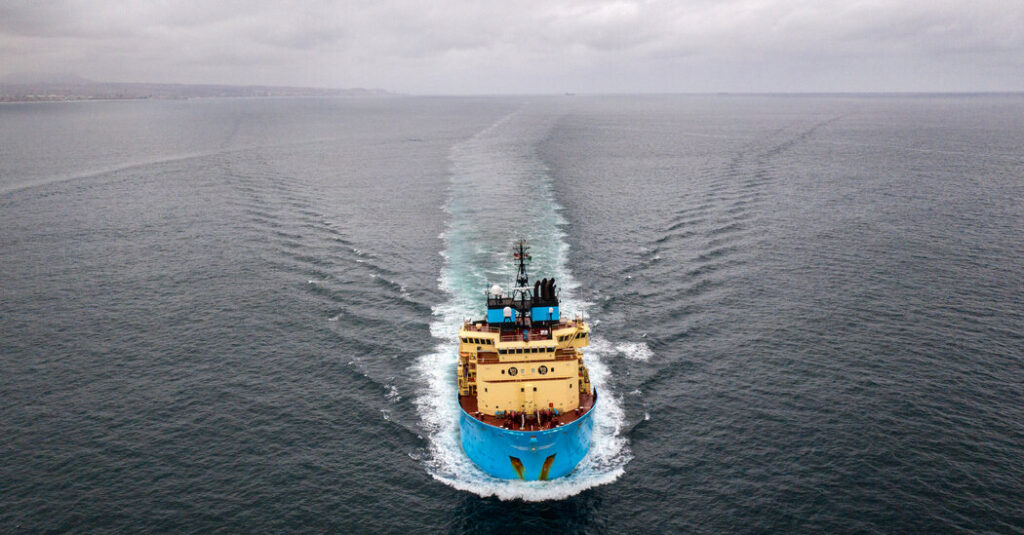
The National Oceanic and Atmospheric Administration is shifting from science to prospecting as it surveys a region of the Pacific Ocean to help private companies find mineral deposits buried on the ocean floor.
Deep-sea mining holds the promise of harvesting vast quantities of potato-sized nodules that contain manganese, cobalt, nickel and copper used in high-tech equipment like electric vehicle batteries and weapon systems. Commercial seabed mining has not yet started and conservation groups and scientists warn it could significantly damage marine environments.
But the Trump administration is fast-tracking the nascent industry and has urged NOAA to prioritize processing the first commercial seabed mining permits. On Thursday, the agency announced a survey that, beginning next month, will map the seafloor near American Samoa to find minerals for industry.
“What an exciting time to know that within the next few years, under this administration, there will be companies pulling deep sea nodules out of the ocean and bringing them to the U.S.,” said Erik Noble, a NOAA deputy assistant secretary who oversees deep sea minerals, at an industry conference in Washington.
The survey will take place in an area of 30,000 square miles being considered for mining that is adjacent to the Rose Atoll Marine National Monument, a pristine coral habitat that supports hundreds of marine species, as well as protected sea turtle nesting grounds.
Separately, the Trump administration said Tuesday that it wanted to open waters off the Alaska coast for commercial mining for the first time. The region being considered is a huge area stretching from lucrative fishing grounds in the Gulf of Alaska to the Arctic waters of the Chukchi Sea.
The Bureau of Offshore Energy Management, the agency responsible for the leases, said it would begin taking public comments at the end of this week about the mining proposal.
“Alaska’s offshore holds strategic potential for the minerals that drive American industry, defense and next-generation technologies,” said the bureau’s acting director, Matt Giacona, a former director at the Offshore Industries Association, an oil industry group. “This Request for Information is a practical first step to gauge interest and identify areas where development could make sense for jobs, investment and national supply chains.”
NOAA is a sprawling agency responsible for weather forecasts, climate research, ocean exploration, fisheries management and coastal navigation surveys. Its surveys in American and international waters are used by scientists to document new marine habitats as well as by commercial fishing interests and energy companies looking for potential drilling sites.
In previous administrations, NOAA ocean voyages and surveys had science at the forefront, according to ocean scientists and former agency officials. Under the Trump administration, the focus has shifted to helping industry.
Between 2015 and 2017, NOAA scientists conducted 187 dives with robot submarines to explore the undersea world around Hawaii and several U.S. Pacific territories. They discovered hundreds of new species of corals, sponges and other marine life, and mapped previously unknown subsea mountains, canyons and hydrothermal vents.
The project, known as Capstone, was one of the largest ocean exploration efforts ever conducted by the federal government.
On Thursday, NOAA awarded a $20 million contract to NV5, a Florida-based engineering firm, for the survey of the seafloor near American Samoa. The work will “inform NOAA, other federal agencies and interested parties of the critical mineral deposits and relative prospectivity of the surveyed area,” the announcement said.
Impossible Metals, a deep sea mining start-up based in San Jose, Calif., has been asking the Trump administration to map U.S. federal waters, Oliver Gunasekara, the chief executive of Impossible Metals, said in an email.
Unlike other companies, Impossible Metals says it would gather nodules using remotely operated claws designed to limit harm to marine life.
Last April, the company requested a lease from the Trump administration to mine the waters around American Samoa. Within two weeks, the Bureau of Offshore Energy Management announced it was beginning the process to consider the request. By initiating the leasing process, Mr. Gunasekara said, the company drew attention to the region that has “long been under-mapped.” “We helped accelerate a set of steps that ultimately benefits everyone, because the data that NOAA generates will be public and improve the quality of decision making,” Mr. Gunasekara wrote in an email.
Brian Kennedy, a deep sea ecologist and one of the leaders of the Capstone project, has also explored the seafloor of the Gulf of Mexico, where conflicts have arisen between oil companies looking for drilling sites and scientists uncovering new underwater habitats.
“We were largely looking for areas that are protected from mining,” Dr. Kennedy said. “But all the data was public and there was no control over how it was used after it was published.”
Dr. Kennedy said the proposed permit area around American Samoa contained at least 30 underwater mountains that attract fish, sponges and corals, and might hold deposits of minerals.
In addition to the value of seafloor minerals, marine experts note that more than 1,000 compounds found in animals living in the deep seas have shown anticancer, antiviral, antifungal or anti-inflammatory activity in medical assays. The Food and Drug Administration has approved 17 drugs derived from marine organisms, according to a database compiled by the Midwestern University Department of Marine Pharmacology.
Some scientists say deep-sea mining would damage ecosystems that are slow to recover and full of undiscovered species. Dozens of countries and territories have taken stances against seabed mining, including American Samoa, which has an ongoing moratorium prohibiting the industry. At a recent hearing on Capitol Hill, lawmakers from Pacific island territories expressed their environmental concerns.
“The ocean is not just the backbone of our local economy, it is sacred,” said Aumua Amata Coleman Radewagen, a Republican representative from American Samoa. Residents are opposed to seabed mining, she said. “We have yet to be convinced that the benefits will outweigh the costs of this occurring so close to our beloved waters.”
Sachi Kitajima Mulkey covers climate and the environment for The Times.
The post A Shift for NOAA’s Surveys: From Science to Mining appeared first on New York Times.