Your Mileage May Vary is an advice column offering you a unique framework for thinking through your moral dilemmas. It’s based on value pluralism — the idea that each of us has multiple values that are equally valid but that often conflict with each other. To submit a question, fill out this anonymous form. Here’s this week’s question from a reader, condensed and edited for clarity:
I feel increasingly alarmed by what’s happening politically in America. And yet, even in light of everything in Minnesota, some of my friends seem very apolitical. Instead of talking about ways to get involved, they’re going on with business as usual — hosting dinner parties, posting random stuff on social media, etc. Maybe they think they’re not the target so this isn’t urgent for them personally. Or maybe they’re just busy with their own families and jobs and don’t know if it’s their role to get involved in a political fight.
My strong intuition is that we’re all obligated to play some role in this. But I don’t know how to convey that to them or how to articulate exactly what that role should be. How can I convince them that we’re past the point of “business as usual” and talk to them about what they owe the rest of the country?
Dear Politically Active,
What you’re really grasping for here is a framework — a way to think about what our duty is under authoritarianism, and a way to understand why not everyone is seeing that duty clearly.
So I want to introduce you to a man named Ernst Fraenkel. A German Jewish political scientist and labor lawyer, Fraenkel was a keen observer of the Nazi political system. As he watched Hitler’s rise to power in the 1930s, he wrote a manuscript about what he was noticing on the ground in Germany. Then he moved to the US and, in 1941, he published his book under the title The Dual State.
Thankfully, we are not currently facing a situation as grave as Nazism: Today’s America is not 1940s Germany. Yet Fraenkel’s analysis, which is enjoying a mini resurgence, offers us some helpful tools for getting our heads around the authoritarianism we see unfolding in the US right now.
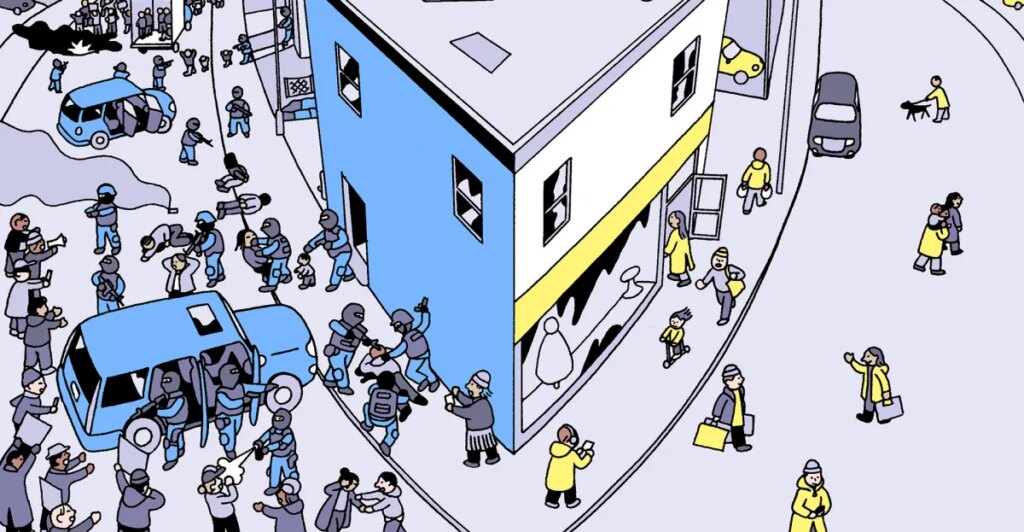
Here’s his main insight: Life under authoritarianism is actually, for the most part, weirdly normal. It’s often even, well, boring. The average person can go about their day as usual. You take your kids to school, you head to the office, and yes, you even host dinner parties. You live in the realm that Fraenkel referred to as “the normative state,” and from within that realm, it’s easy to think that if you just keep your head down and avoid making waves, you’ll be perfectly fine, thank you very much.
But Fraenkel’s book is called The Dual State for a reason. This first state, the business-as-usual one, actually exists to lull you into a sense of complacency such that you don’t realize that another state is also operating in parallel with it. That second state, which Fraenkel calls “the prerogative state,” only becomes visible to you when you do something that the powers that be don’t like. Then suddenly you’re in a realm where the rule of law does not exist, where citizens can be killed with impunity, where you — even you, who thought you were invulnerable — can become a target.
The dark genius of this setup is that most people don’t realize that the prerogative state is active until it’s too late. They only wake up when the knock comes on their very own door — or when the door is forcefully broken down.
“The Dual State lives by veiling its true nature,” Fraenkel wrote.
That’s why it’s not surprising to me that your friends have been politically inactive. If they think of themselves as “not the target” — if they’re citizens, if they’re white, if they don’t speak with the “wrong” accent or express the “wrong” political views in public — it’s extremely easy for them to think everything is mostly normal, because the whole political apparatus is designed to make them think exactly that.
But, of course, you’re right. Everything is not normal.
And so, I would argue, the first obligation we all have is an epistemic one: It’s to know what kind of reality we are actually inhabiting. All other obligations will then flow from that knowledge. Because once we discern that we are living in a dual state, it becomes obvious that compliance won’t save us, and that some kind of action is called for.
For you, the tricky question is: How do you get someone to realize that they’re in a dual state, when its darker half has not yet touched their life personally?
To start with, you can give them a frame, and Fraenkel’s explanation of the dual state is the most helpful one I’ve found. But you can also make it more powerful by placing a particular picture inside the frame — a concrete illustration of the dual state dynamic.
And here is where you might want to talk about Renee Nicole Good.
The 37-year-old who was shot to death by ICE was not armed. She simply sat idling in her car and observing an ICE operation. And she was a white woman. And a citizen. By all accounts, not someone you’d expect to be targeted.
She was killed anyway, and that makes her, tragically, an illustration of Fraenkel’s insight: Authoritarianism feels a lot like normal, predictable life — until it doesn’t. There’s a hidden tripwire you can step on, but you often don’t realize you’ve stepped on it until you find yourself with a gun in your face.
The Russian American journalist M. Gessen made this point in a recent New York Times column, which argues that it’s precisely the unpredictability that we’re seeing in Minneapolis that reveals that state terror — something like Fraenkel’s prerogative state — is happening in the US, not just run-of-the-mill repression.
“The randomness is the difference between a regime based on terror and a regime that is plainly repressive,” Gessen writes. “Even in brutally repressive regimes, including those of the Soviet colonies in Eastern Europe, one knew where the boundaries of acceptable behavior lay… A regime based on terror, on the other hand, deploys violence precisely to reinforce the message that anyone can be subjected to it.”
In other words, if it happened to Good, it can happen to more or less anyone.
By talking about Good in the context of Fraenkel’s analysis, you can try to bring this home to your friends.
And if that fails? Try what I call “the grandkid test.”
Have a question you want me to answer in the next Your Mileage May Vary column?
Feel free to email me at [email protected] or fill out this anonymous form. Newsletter subscribers will get my column before anyone else does and their questions will be prioritized for future editions. Sign up here.
I grew up in a Jewish community that focused heavily on Holocaust education; many of our grandparents were Holocaust survivors. And I remember that my peers and I used to always ask ourselves: If we were non-Jewish Germans in 1940s Germany, how would we have acted? Would we have hidden Jews in our attics? Would we have stood up to the Nazis? Or would we have complied in hopes of saving our own skin?
Again and again, we came back to this: We hope that we would have acted as the brave people in our grandparents’ generation acted. We hope that we would have done something that would make our grandkids proud.
You can present this thought experiment to your friends. Tell them that one day their grandkids may ask them what they did in the wake of Minnesota, or under this administration more broadly. Will they be able to answer in a way that makes that young, upturned face beam?
To pass the grandkid test, people don’t necessarily need to put their bodies in the street in Minneapolis. Everyone exists at a different risk level, and we shouldn’t expect a noncitizen or someone who is undocumented, say, to put themselves at risk to the same degree as someone with more privilege.
For some, taking action will mean attending a peaceful protest in their own city; for others, it might mean making donations so that Minnesotans can afford safety equipment, dash cams, or legal aid; for others still, it might mean bringing groceries to a family that feels extra vulnerable and is afraid to leave the house.
But the grandkid test is a powerful way to bring home the realization that taking some kind of action is in everyone’s best interest — not because of an abstract moral obligation, but because it’s in moments like these that we choose what kind of people we will be, and what kind of legacy we’ll leave behind for the next generations to follow.
The post Your friends are still acting like everything is normal in America. What do you do? appeared first on Vox.