Investigators from the National Transportation Safety Board faulted the Federal Aviation Administration for discounting safety warnings and mismanaging the control tower at Ronald Reagan National Airport for years, creating systemic risks that led to last year’s midair collision between a military helicopter and commercial jet, killing 67.
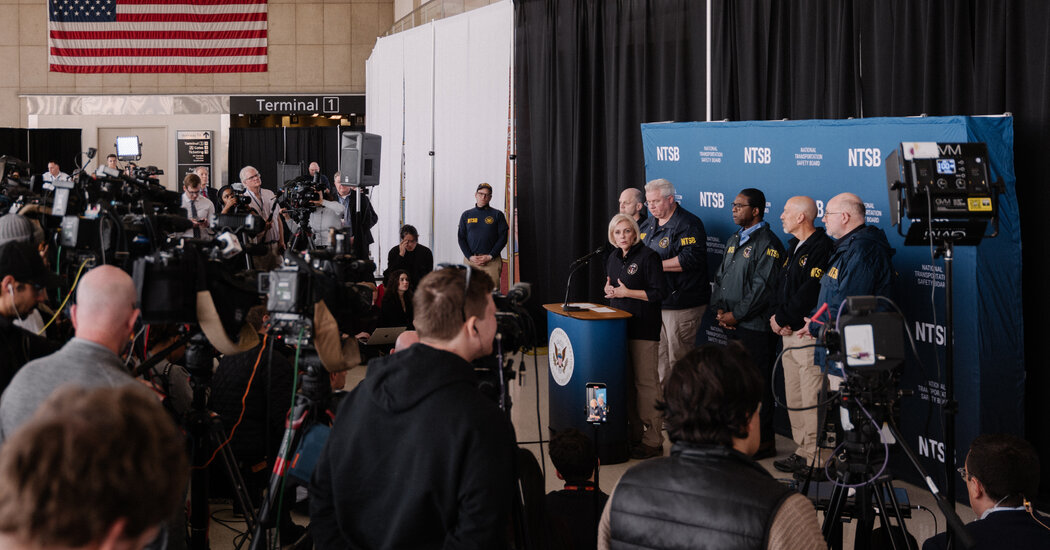
The N.T.S.B. is expected to issue its findings on Tuesday on the probable cause of the crash near Washington after a yearlong investigation, and issue recommendations to avoid similar crashes in the future. While board members are not expected to render their verdict until later in the day, opening presentations from investigative staff revealed a pattern of failures at the F.A.A. — and the frustrations of board members with the agency’s inaction.
“A multitude of errors led to this tragedy,” Michael Graham, an N.T.S.B. board member, said early in the hearing, adding: “Any individual shortcomings were set up for failure by the systems around them.”
N.T.S.B. staff investigators said an intersection between the route the Army Black Hawk helicopter flew along the Potomac River and the landing path of American Airlines Flight 5342 had never been designed to ensure adequate separation between two aircraft and was never adequately vetted. That led air traffic controllers to rely too much on pilots themselves to avoid each other.
The N.T.S.B. determined that the F.A.A. failed to train controllers on the hazard of allowing pilots to use a common but risky practice called visual separation to navigate the busy airspace around National Airport, adding that controllers should have followed up with warnings that the two aircraft were at risk of a collision.
“They were not adequately prepared to do the jobs they were assigned to do,” Brian Soper, who leads the N.T.S.B.’s air traffic control investigations.
The F.A.A. ignored appeals from controllers to reduce National Airport’s traffic, N.T.S.B. staff testified, even as its main runway became the single busiest in the United States. Staff investigators described how the F.A.A. installed, but never activated, a traffic management system that could have helped controllers handle traffic better on busy nights, like the night of the collision, Jan. 29.
N.T.S.B. staff investigators questioned why the F.A.A. relaxed the restrictions on having a controller manage helicopter and airplane traffic simultaneously, noting that the positions did not have to be combined Jan 29.
And they excoriated the F.A.A. for downgrading National Airport’s facility rating, a measure that determines the experience level required for controllers to work there. That change in 2018 and commensurate pay cut made it more difficult for the tower to attract experienced personnel capable of handling Washington’s busy airspace, the N.T.S.B. staff said, especially given the city’s high cost of living.
“This tower is essentially treated as a training facility,” Jennifer Homendy, the N.T.S.B. chairwoman, said. “It is a pass-through, they can’t attract people here, which is a problem.”
The investigators’ findings were punctuated by a series of animated videos that showed how the skies over the airport would have appeared to the pilots of the helicopter and the jet, and the controllers in the tower.
The animation suggested that the instructor pilot in the helicopter, who was evaluating a less experienced pilot on a training flight, lost sight of the passenger jet as the two aircraft approached each other. The jet came back into his view only a second or two before impact, the video indicated.
A visual reconstruction of the view from the tower showed the helicopter and jet on a collision course, but one only visible through a small sliver of the windows between a large monitor and its suspension rack.
As the animations played, dozens of spectators, including family members of victims of the crash, watched from the N.T.S.B.’s spacious boardroom. It was utterly silent.
The N.T.S.B.’s findings and recommendations are the culmination of an inquiry into the deadliest aviation incident on U.S. soil in 24 years. The crash touched off public demands for improvements to aviation safety. Many of those have not materialized.
During a series of investigative hearings held by the N.T.S.B. last summer, a number of harrowing details emerged about how systematic failures — as well as possible pilot errors — contributed to the collision.
Transcribed interviews released as part of the investigation illustrated how frequently military pilots would fly helicopters under incoming planes to avoid collisions — and how many of the Black Hawks operating around the airport either did not turn on or did not have functional advanced tracking technology when they flew through the area’s congested airspace.
On Tuesday morning, N.T.S.B. staff investigators laid out their assessment of how those factors contributed to the collision. But it will be up to the N.T.S.B. board to vote on a verdict and any recommended changes.
During the course of the morning, the N.T.S.B. staff issued a number of recommendations to the F.A.A. in areas like route design and controller training. But the Trump administration and Congress will determine whether to implement them.
The F.A.A. has already limited what aircraft can fly through the airspace surrounding National Airport. It has also reconfigured helicopter routes in the area in response to urgent recommendations that the N.T.S.B. issued last March.
The agency also has been making significant investments to modernize the country’s aging air traffic control system. A funding bill pending before the Senate would pump billions more dollars into the F.A.A. to help with hiring more controllers, but the legislation could falter amid a political standoff over funding for immigration enforcement.
Karoun Demirjian is a breaking news reporter for The Times.
The post Safety Board Heaps Blame on F.A.A. Over Potomac Plane-Helicopter Crash appeared first on New York Times.