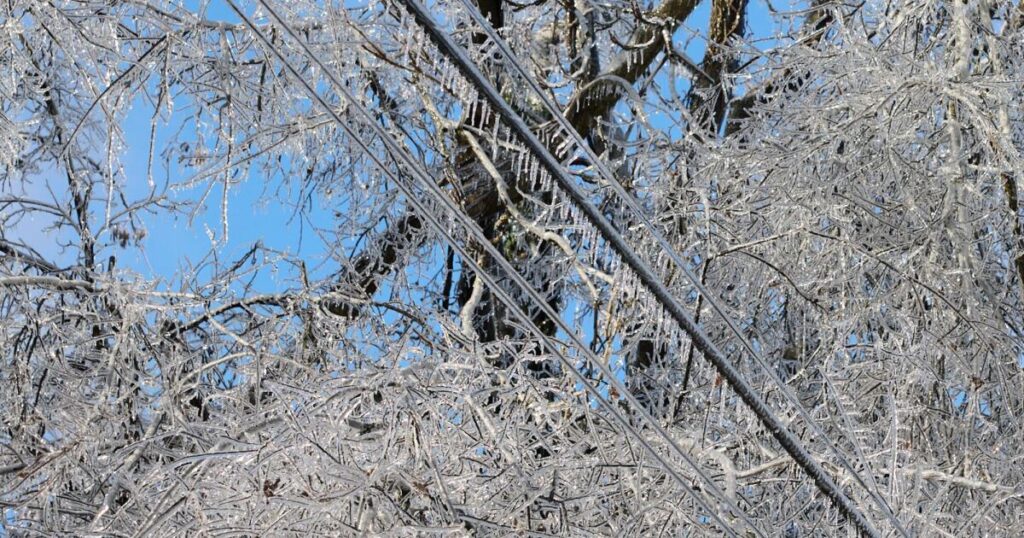
The day after a major winter storm swept across the U.S., hundreds of thousands of homes and businesses remained without electricity, and the prospect of more outages loomed amid frigid temperatures. One early estimate suggested the storm could result in $24 billion in total economic losses.
But a new analysis by RMI, a clean energy nonprofit, suggests that the current methods for counting the damages from power outages mean we are likely undercounting its impact — and those of similar storms — by a significant margin.
The report finds that current insurance metrics focus too narrowly on physical property damage while ignoring the “non-linear compounding losses” that occur when the grid stays down, such as food and medicine spoilage, as well as transportation disruptions that can extend well beyond the outage area. Traditional estimating tools like the Value of Lost Load (VoLL) fail to capture the reality of a multi-hour blackout beyond a given time window or narrow geography, the authors say.
“The methodologies that go into power outage data in particular are often based on survey data, taken after the storms at a specific point in time, and often, as a result, underestimate the kind of systems-wide impacts that occurred,” said co-author Elizabeth Harnett, a research and impact expert at RMI’s Center for Climate-Aligned Finance.
This gap may be massive: In the aftermath of Hurricanes Sandy and Harvey, one study found that business interruption losses were 800% to 900% higher than actual property damages. Even if business interruptions added just 30% to 50% to direct totals, the RMI authors noted, it would imply at least an additional $35 billion per year that are not captured in US disaster-loss calculations.
The RMI authors suggest two other tools that are based on VoLL but with refinements. One, developed by the Lawrence Berkeley National Laboratory (LBNL), looks at outage costs by customer class — such as residential, commercial and industrial — and is well suited for estimating localized and shorter-term events. The other, developed by LBNL and the University of Southern California, combines behavioral survey data with a computer model to assess economy-wide “disequilibrium” effects such as evacuation, supply-chain disruption, and recovery costs.
The authors also point to a need to develop new, forward-looking methods less reliant on historical data and survey responses.
The costs of winter weather in the US are mounting: According to reinsurer Swiss Re, annual insured losses from winter storms averaged $7 billion from 2021 to 2025, more than triple the average from 2011 to 2020. Ultimately, failing to accurately price the chaos of a blackout prevents the very investments that could stop it — investments in resilience.
“If we were better able to put a higher price on the impact,” Harnett said, “doing grid hardening or fortifying roofs against these kind of storms, or improving transport resilience, would be much more likely to be invested in both at an individual level, at a community level, but also by local governments.”
Kaufman writes for Bloomberg.
The post Why power outages do more economic damage than we think appeared first on Los Angeles Times.