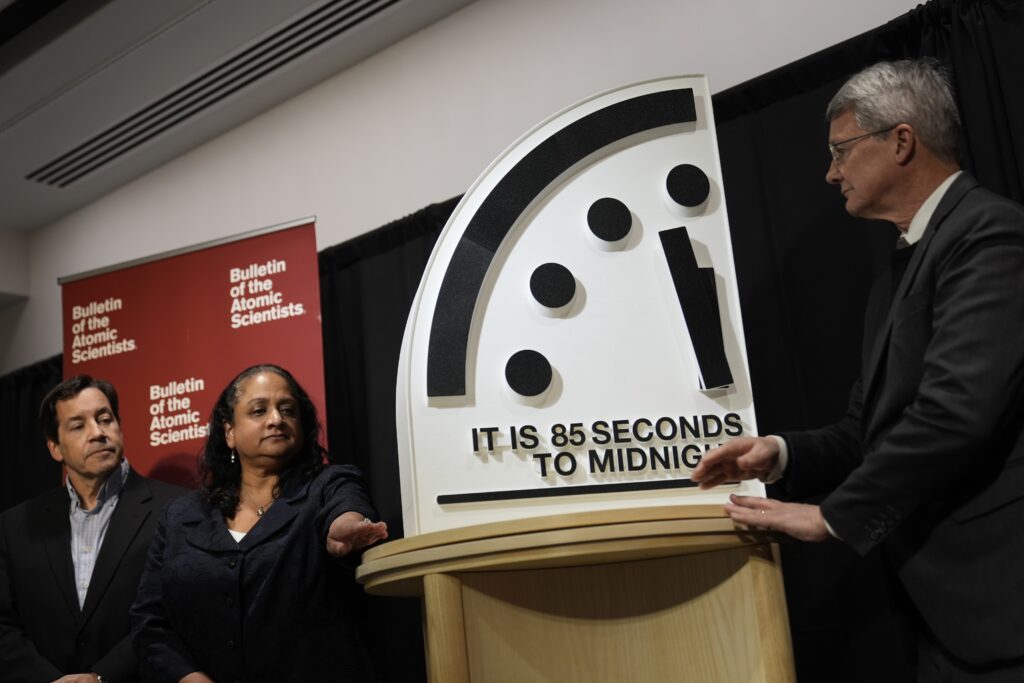
The world is closer than ever to the end, according to those behind the Doomsday Clock, which is set 85 seconds to “midnight” for 2026.
Members of the Bulletin of the Atomic Scientists said Tuesday that they were moving the minute hand of their metaphorical clock forward by four seconds, as the risks related to nuclear weapons, climate change, artificial intelligence, autocracy, biological technologies and other threats of humanity’s own making continue to grow.
“Our leaders need to do better. We need to do better,” Daniel Holz, a University of Chicago physics professor who chairs the bulletin’s science and security board, said during a news conference announcing the new time.
Historically, the bulletin, founded by Manhattan Project veterans behind the first atomic bombs, focused on the availability of nuclear weapons to assess how close Earth is to apocalypse. The clock was set at seven minutes to midnight when it debuted in 1947. The furthest marker was 17 minutes to midnight in 1991, after the fall of the Berlin Wall and the end of the Cold War.
But in recent years, the nonprofit has included other existential threats in its evaluation. And the clock, meant to serve as a warning to policymakers, has ticked forward.
Among the top concerns this year is climate change, which is intensifying storms and floods globally. The panel lamented the lack of progress in reducing greenhouse gas emissions under the Paris climate accord.
The ability of artificial intelligence to fuel misinformation and allow autocratic rulers to remain in power also weighed heavily on the panel, as did the environmental cost of running the servers behind the technology.
“We’re witnessing something more dangerous: the fusion of state power with the tech oligarchy,” said Maria Ressa, a Nobel Peace Prize-winning journalist who has faced off for years with authorities in the Philippines. “The men who control the platforms that shape what billions believe have merged with the men who control governments and militaries.”
The long-standing risk of nuclear annihilation still loomed large for the panel, with a nuclear arms treaty between the United States and Russia set to expire and President Donald Trump preparing to restart nuclear weapons tests for the first time since 1992. And novel biological threats, such as the emergence of new pathogens similar to the coronavirus, as well as lab-made cells that could be deadly to other life on Earth, also factored into the decision.
Trump’s first year back in office, which saw staff and budget cuts across environmental, public health and other scientific agencies, also added to the risks, according to the bulletin.
“He’s been attacking the tools and technologies that can help us manage climate change, attacking science and academia, the very people who will help us find these solutions,” said Alexandra Bell, the bulletin’s president and CEO. “So obviously, actions of this administration have affected the clock, but the Doomsday Clock is about global risks.”
Critics of the clock have questioned the usefulness of winding and unwinding a metaphorical timepiece. In a 2015 essay, a University of Oxford researcher wrote that the work was more of a reflection of the “strong feeling of urgency” among those who run it rather than a gauge of “actual risk.”
Bell said the point of the Doomsday Clock is not to forecast the future but to serve as wake-up call for those in power now.
“It’s important to remember that the clock does not predict the future,” she said. “It illuminates our current reality. The clock has turned back before, and it can again.”
The post These scientists say the world is closer than ever to ‘doomsday’ appeared first on Washington Post.