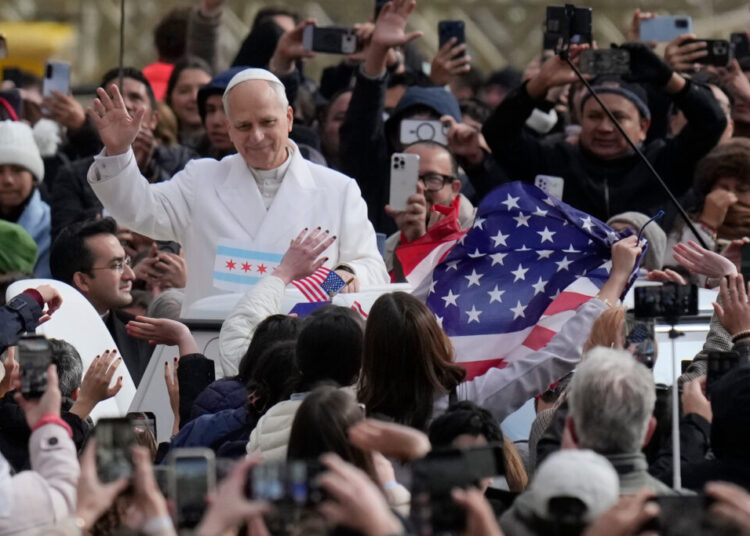
In December, a 9,000-word essay about white male millennials shot across the internet.
The author, a ticket scalper and frustrated screenwriter, marshaled interviews and data to describe how the professional trajectories of members of his generation had been crushed by what he called the institutionalization of diversity, equity and inclusion mandates, a “profound shift in how power and prestige were distributed.”
Vice President JD Vance reposted the piece, saying it “describes the evils of D.E.I. and its consequences.” Elon Musk responded, calling D.E.I. “a great wrong.”
The essay also caught the attention of Andrea Lucas, the chair of the Equal Employment Opportunity Commission, the agency, born of the Civil Rights Act, that enforces laws against employment discrimination.
“Are you a white male who has experienced discrimination at work based on your race or sex? You may have a claim to recover money under federal civil rights laws,” Ms. Lucas said in a video posted on Dec. 17 on social media. From her desk at E.O.C.C. headquarters, she referred viewers to the commission’s primer on “D.E.I.-related discrimination.”
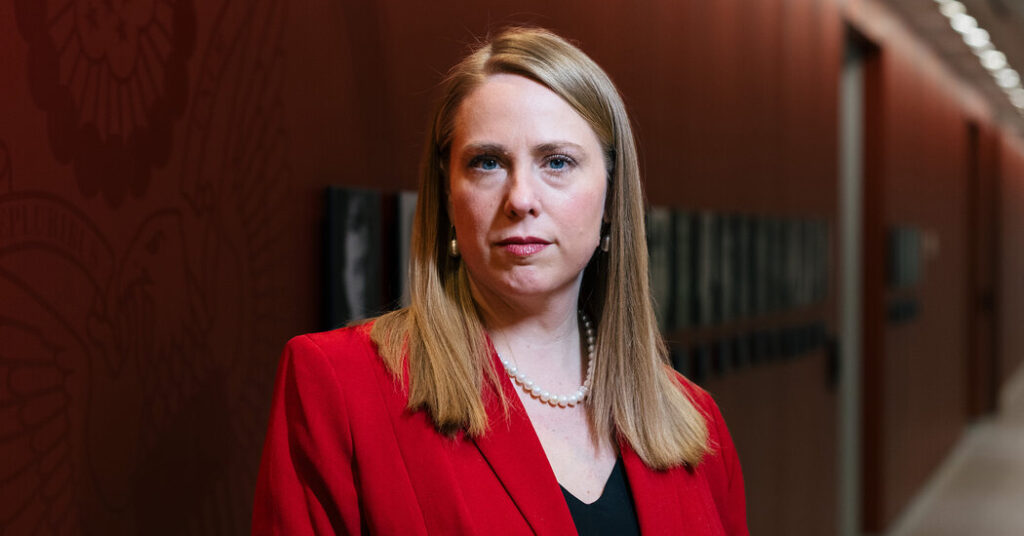
The video, which recalled the television commercials of personal injury law firms, generated volleys of shock, outrage and gratitude online. To Ms. Lucas, 40, it was an urgent public service announcement, central to her mission as an agent of President Trump’s executive authority and part of a robust response to what she described as the excesses of the left.
In an interview, she said she was determined to undo the consequences of five years of “aggressive focus by D.E.I. activists” that reserved the protections of the country’s civil rights infrastructure for certain groups.
“I think the agency is the tip of the spear for implementing a really ambitious civil rights agenda,” Ms. Lucas said. “I think that that mission is to restore a focus on equality as opposed to equity. It’s going back to the concept of equal treatment as opposed to equal outcomes.”
Critics of Ms. Lucas, including former commissioners of the E.E.O.C., say she is distorting the intent of the Civil Rights Act, paying lip service to equal treatment while using her position to write MAGA grievances into federal law. They noted that as she has solicited complaints from white men — historically a small share of complainants to the E.E.O.C. — the commission has dismissed cases that would defend transgender employees and job applicants with criminal records.
Charlotte Burrows, Ms. Lucas’s predecessor as chair who was fired by Mr. Trump last January, said, “Federal civil rights laws protect everyone, and the E.E.O.C. has a duty to engage in fair and evenhanded law enforcement.”
She and others said Ms. Lucas’s message in the December video was that white Americans would receive preferential consideration under the Trump administration. “That’s the opposite of equal opportunity,” Ms. Burrows said.
In her first year, Ms. Lucas has taken steps to undo the work of her predecessors, particularly regarding contentious issues like gender. Her work is likely to accelerate now that the commission has three members, required for a quorum, with a 2-to-1 Republican majority.
At a meeting on Jan. 22, the commission voted — over the objections of the sole Democrat — to rescind guidance for employers about workplace harassment. Issued in 2024 after 10 years of debate, the guidance detailed prohibitions against harassment, including on the basis of sexual orientation and gender identity.
“She has closed the door of the E.E.O.C. to groups that are disfavored by the president,” said Josh Boxerman, who handles civil rights work at the National Employment Law Project, a workers rights group. “That is extraordinary. And it is radical and harmful.”
Changed Priorities
Anybody who wants to sue a private employer under civil rights law must file a complaint with the commission. The E.E.O.C. received more than 88,000 such complaints in 2024, the last year for which data is publicly available. The commission is legally mandated to look into all of them, but only a sliver develop into full investigations. The commission, and particularly the chair, has great discretion over what cases to pursue, particularly because staff and resources are stretched thin.
In the past, the commission “saw our work as protecting the rights, often, of the most vulnerable workers, who really needed the government’s help,” said Jenny Yang, who worked at the E.E.O.C. from 2013 to 2018, including three years as chair.
“What we are seeing now is a real politicization of the priorities of the agency, and a disregard for the law,” Ms. Yang said.
Ms. Lucas joined the commission in 2020, when its work was being complicated by the Covid pandemic and the racial reckoning that followed the murder of George Floyd. The commission, along with employers across the country, grappled with vaccine mandates, diversity and inclusion practices, questions about gender-specific bathrooms and charges of deep-seated racism across entire industries.
“That period of time, primarily during the Biden administration, but even heading into it, was a period of a wave of discrimination that was motivated or framed as D.E.I.,” Ms. Lucas said. “Everyone collectively lost their minds for a period of time.”
Backlash followed, a sentiment Mr. Trump harnessed in the 2024 election. Among his first moves after returning to office last January was issuing executive orders that dismantled D.E.I. programs in the federal government. On Jan. 20, 2025, he nominated Ms. Lucas to serve as the E.E.O.C.’s acting chair. A week later, he fired two of the Democratic commissioners, Ms. Burrows and Jocelyn Samuels.
Ms. Samuels filed a lawsuit challenging her firing, which is on hold while the Supreme Court considers a similar case at the Federal Trade Commission, another independent agency Mr. Trump has sought to bring under the reach of executive authority.
The commission and the Justice Department, Ms. Samuels said, are neglecting their legal duty to protect workers equally, adding that Ms. Lucas is making changes that are procedurally suspect and damaging to workers who bear the greatest burden of discrimination in America.
“It has been heartbreaking and infuriating, in equal measure,” Ms. Samuels said.
For most of 2025, Ms. Lucas was the interim head of an agency that had only one other member, Kalpana Kotagal, a Democrat, lacking the quorum required to pursue major rule changes or litigation.
Ms. Lucas worked around those constraints. In March, she wrote to 20 law firms seeking details about their D.E.I. practices. The commission partnered with the Justice Department and the Department of Labor in a campaign to root out “national-origin discrimination,” such as apparent preferences for foreign skilled workers holding H-1B visas over American workers.
“It’s a little bit of a backwater. But Andrea has done an effective job of making the E.E.O.C., and the chair of the E.E.O.C., an important policymaking position,” said Jason C. Schwartz, a co-chair of the labor and employment group at the law firm Gibson Dunn, where he worked with Ms. Lucas. He called her “really smart, really strong.”
The commission also took action against universities, including reaching an agreement in which Columbia University would pay $21 million to resolve complaints of civil rights violations against its Jewish employees after the Israel-Hamas war started in 2023.
The University of Pennsylvania rebuked the E.E.O.C., in a court filing this month, refusing to supply information about its Jewish employees in connection with an investigation into antisemitism at the university.
In April, Mr. Trump issued an executive order taking aim at a pillar of civil rights law: disparate-impact liability, a legal principle holding that an employment practice is discriminatory if it creates unequal outcomes among different groups, even unintentionally. Mr. Trump directed government agencies to stop enforcing it.
The move, denounced by civil rights and employment groups, had swift consequences at the commission. Within weeks, it moved to dismiss a civil rights lawsuit it had brought a year earlier against Sheetz, the convenience store chain, over its practice of screening out applicants with criminal convictions. The commission had previously found that the practice disproportionately affected applicants of color and violated the Civil Rights Act.
Last October, the E.E.O.C. moved to dismiss seven cases it had brought in 2024 on behalf of transgender and gender-nonconforming people, in accordance with a new agency policy that it would not enforce workplace harassment claims brought on the basis of gender identity.
In her Senate confirmation hearing last summer, Ms. Lucas was clear about her priorities: pursuing cases related to religious and national-origin discrimination, rooting out D.E.I. initiatives and ending what she sees as the improper elevation of “gender identity” over biological sex. She disavowed statements she had made referring to the E.E.O.C. as an independent agency.
“I’ve been very clear: The agency is not an independent agency,” she said in the interview. “It’s an executive branch agency. The will of the people elected the president and I’m going to execute it.”
On the Agenda
With the Senate’s confirmation in October of Brittany Bull Panuccio, a Republican nominated by Mr. Trump to the E.E.O.C., the commission’s work is likely to accelerate in volume and ambition.
“We are very concerned that it will continue that path of wide-ranging rescissions and rollbacks of hard-won and thoughtfully considered worker protections,” said Mr. Boxerman of the National Employment Law Project.
“She has made it clear that longstanding agency policy, judicial precedent — these things matter less than fulfilling the Trump agenda,” he added.
Ms. Lucas sees her role as an expression of Mr. Trump’s executive authority, but it is also clear that she has given a lot of thought to issues of fairness and justice.
“If your answer to solve prior discrimination is present discrimination, I think that’s a really ugly view of the world,” Ms. Lucas said in the interview. “That’s not the vision that I want for my children. It’s not the vision that I think goes back to the concept of people being created equal. And I just really fundamentally disagree with it.”
“Historically, Republicans have been very uncomfortable to talk about race, uncomfortable to deal with this issue,” Ms. Lucas said. “But from my perspective, we have to deal with these topics.”
Rebecca Davis O’Brien covers labor and the work force for The Times.
The post Employment Commission Chair Recasts Workplace Discrimination in Trump’s Image appeared first on New York Times.