In 2020, Brad Smith, Microsoft’s president, outlined an ambitious plan to conserve water at the company’s growing fleet of data centers that power the internet. He pledged to cut use, support wetland restoration projects and deploy new water-saving technologies.
“Water is essential to life,” Mr. Smith said.
Then came the artificial intelligence boom, which caused a construction spree for even more data centers to develop and deploy the technology. Now Microsoft is privately projecting its water use will surge.
By just how much is a moving target.
Internal forecasts that Microsoft made last year, which were obtained by The New York Times, show the company expected its annual water needs for roughly 100 data center complexes worldwide to more than triple this decade to 28 billion liters in 2030. That compares with 7.9 billion liters in 2020 and 10.4 billion liters in 2024.
After The Times contacted Microsoft, the company said it had updated its projections to reflect new water-saving techniques, including a new data center design and better information from facilities that it leases. It now expects to use about 18 billion liters of water in 2030, up 150 percent from 2020. The new forecast does not include more than $50 billion in data center deals that the company signed last year.
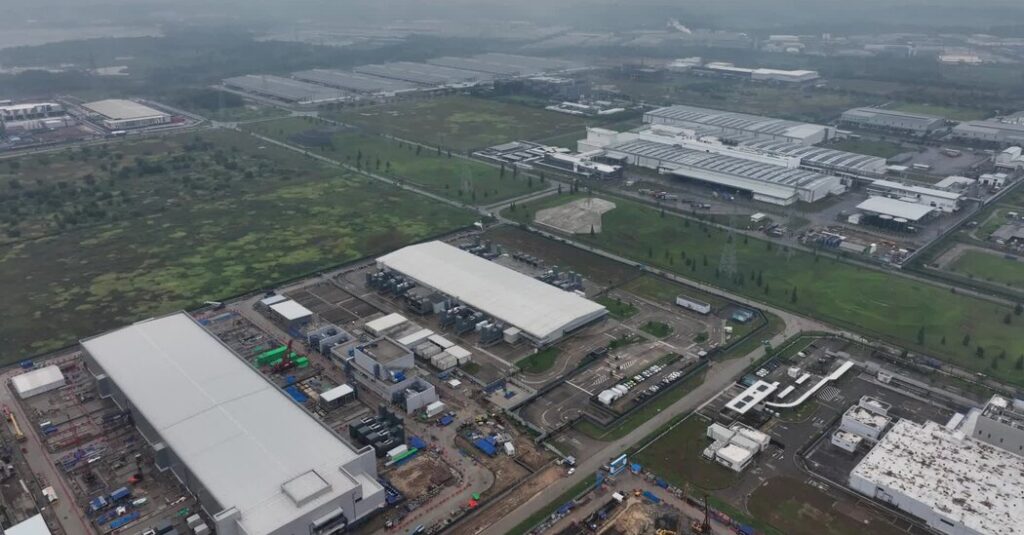
Microsoft’s water usage was expected to be particularly significant in areas already facing water crises. Near Jakarta, Indonesia, a metropolis sinking into the Java Sea partly because of drained aquifers, Microsoft last year estimated its water use there would more than quadruple to 1.9 billion liters in 2030, up from 380 million liters this year. The company has since revised that figure to 664 million liters in 2030 and said it no longer has 2026 estimates for any location.
In the Phoenix area, which is navigating two decades of drought, Microsoft predicted last year that water withdrawals would reach 3.3 billion liters by 2030, more than any other place, up from an estimated 2.9 billion liters this year. The company reduced that estimate to 2 billion liters in 2030 as it runs the facilities at higher temperatures, meaning it needs less water for cooling.
Even as Microsoft’s estimates fluctuate, overall water use for the company and across the industry is going one way: up. The rise of A.I. has transformed tech giants into resource-intensive industrial businesses, making it more difficult for them to balance lofty sustainability promises with growing computing demands. A lack of reporting requirements further complicates any assessment of the A.I. industry’s true environmental impact.
Microsoft, Google and others had long prided themselves on a light physical footprint, delivering software through code rather than factories. But the A.I. race has forced them to build or lease physical infrastructure to power tech development at a pace reminiscent of the Industrial Revolution. To serve their computing needs, global data center capacity is expected to double by 2030, according to JLL, a commercial real estate firm.
The shift was abrupt. When Mr. Smith made the water pledge in 2020, ChatGPT did not exist. The chatbot arrived two years later, igniting a frenzy of data center construction as Microsoft, Google and OpenAI battled to dominate A.I. With that came more demand for water to keep hot computers in the data centers cool.
In the United States, which accounts for more than half the global data center capacity, the A.I. boom has led researchers to estimate that water needs will grow to 150 billion to 275 billion liters by 2028 from about 60 billion liters in 2022 — potentially a nearly fivefold increase in six years.
Water has become a flashpoint for other tech giants too. Amazon recently abandoned a planned Arizona complex over water concerns, local officials said. Google in 2024 withdrew plans for one in Chile. Residents have also blamed a Meta data center in Georgia for harming supplies of drinking water.
Few disclosure rules exist for data center water use, allowing companies to choose what to make public and to create their own reporting methodologies. Microsoft said its latest forecast was based on improved information, though it acknowledged the figures omit deals with new data center providers called “neoclouds.” The company did not address some questions, including why its water projections fell in locations like Jakarta.
Microsoft’s forecasts last year included almost all of its data centers, covering those it owns and leases. The company runs more than 400 data centers worldwide, which it breaks down into about 100 regional clusters.
Microsoft said it was on track to meet the goals outlined by Mr. Smith and that overall water usage would eventually fall as it becomes more efficient and deploys new technologies. It said it works with local utilities to ensure its water needs do not strain supplies in nearby communities, including investing in public infrastructure.
“We remain committed to reducing the amount of water we use, replenishing water sources and are continuously looking for opportunities to do more,” Melanie Nakagawa, Microsoft’s chief sustainability officer, said in a statement.
(The New York Times has sued Microsoft and OpenAI, claiming copyright infringement of news content related to A.I. systems. The companies have denied those claims.)
Water is part of a wider debate about the environmental effects of data centers.
By many metrics, their total water use is small. Data centers accounted for about 0.04 percent of U.S. water use in 2024, compared to about 41 percent for energy generation, for example in power plants that burn off water in cooling towers, and 37 percent for agriculture, according to an analysis of government data by Landon Marston, a Virginia Tech associate professor studying the topic. Microsoft’s overall water use in 2030 would be nearly as much as Toyota, the world’s largest automaker.
But in water-stressed communities, the impact is sharply felt. Data centers often draw from municipal drinking supplies and evaporate much of it away.
“Water is very local,” Conrad Reddick, a utility commissioner in Illinois, said at a November meeting of regulators. “The fact that it is a very, very, very tiny part of the global consumption doesn’t really matter if you need more than we have in the area.”
‘Water Took a Back Seat’
Microsoft has prioritized speed and cost-saving in its data center push, five current and former employees said.
Those are the measures by which the company’s data center teams are evaluated, some of them said, adding that water concerns were only addressed after executives decided where to build, often in locations chosen for their proximity to customers and reliable electricity.
“Water took a back seat,” said Priscilla Johnson, Microsoft’s director of water strategy from 2017 until 2020 and who has consulted for the company since then. “Energy was more the focus because it was more expensive. Water was too cheap to be prioritized.”
Ms. Johnson said the company has slowly begun to take water more seriously, but the issue was not a prime concern. When she joined Microsoft some data centers did not have meters to track water use. In planning meetings, water was routinely one of the last agenda items, she said, and often skipped when time ran short.
Ms. Johnson said she once offered ideas to a manager for more efficient water use. “He basically said, ‘How am I going to justify a more expensive data center?’” she recalled.
As Microsoft’s awareness of environmental issues evolved, the company made commitments to address climate change and began focusing more on water use.
In 2020, Mr. Smith unveiled the pledge to become “water positive” by 2030, meaning Microsoft would replenish more water than it loses. About two-thirds of the water the company uses in data centers evaporates as part of the cooling process, meaning it cannot be recycled. That is a ratio on par with many agriculture businesses.
To offset that, the company would need to restore roughly 18 billion liters in 2030 lost to evaporation during the cooling process, based on last year’s projections. That would be nearly as much as the annual water use of Boulder, Colo., which has a population of about 100,000.
Microsoft has supported more than 75 replenishment projects globally, including protecting wetlands in Iowa and providing water-leak sensors for toilets in low-income housing in Texas.
Yet in its 2024 public environmental report, the company said a “key challenge” in meeting its water target was the “limited availability of initiatives ready for investment and implementation in priority locations.”
Racing to Build
In 2019, Microsoft was granted approval for a data center campus in the Phoenix suburb of Goodyear, an area that has grappled with drought and water management challenges for two decades.
The campus was designed with backup diesel generators and water systems that were not the most efficient available at the time, said a person with knowledge of the project who was not authorized to discuss internal operations. Engineers eventually had to redesign the systems and negotiate new water treatment deals with the city as the project expanded, causing delays and adding costs, the person said.
Microsoft said it did not exceed air permit limits in Goodyear and that it had committed $150 million to water and wastewater projects in the area.
The site highlighted how Microsoft’s growth has created competition for resources in areas where availability is tight. Last year, 46 percent of its total water withdrawals came from water-stressed areas, the company said.
Near Jakarta, where Microsoft gets clean water through a private industrial park, population growth and poor infrastructure have left many people without access to safe public drinking water. The company’s operations there would be its second-largest user of water worldwide over the next few years, according to its 2025 estimates.
In Pune, India, about 100 miles southeast of Mumbai, the city of 7 million has experienced water shortages that led to protests and a “No Water, No Vote” campaign last year against local officials.
Microsoft projected last year that its annual water needs in Pune would be 1.9 billion liters in 2030, which would make that data center its third-largest consumer of water, up from 1 billion liters in 2026. The company said it now expects to need 237 million liters in the area, but declined to say why its forecast there decreased.
The Multiplier Effect
Microsoft’s internal figures may understate its water consumption as they do not include the water used by power plants to generate electricity for its data centers.
Most of the electricity for data centers comes from plants that require large amounts of water for cooling, said Fengqi You, a systems engineering professor at Cornell University. Power generation would roughly triple a data center’s water use, he calculated. That would theoretically take Microsoft’s total water footprint to nearly 80 billion liters in 2030 based on last year’s forecasts, about what a medium-size American city uses in a year.
By 2028, data centers’ share of U.S. electricity consumption could nearly triple to as much as 12 percent, according to the Department of Energy.
“Most energy production needs water,” Mr. You said. “Nuclear, natural gas, coal all require water for cooling, and that’s a lot of consumption.
The tech industry’s limited transparency makes managing water use more challenging, said Mr. Marston of Virginia Tech. Companies are not required to disclose facility-level data, and few do voluntarily. Microsoft publishes aggregate figures about past use, but not location-specific information.
“Data centers increasingly underpin everything we do,” Mr. Marston said. “We can’t pretend these things are all bad and we don’t depend on them.”
This month, Mr. Smith of Microsoft gave a speech in Washington comparing A.I.’s needs to other historical tech transformations. Electricity drove the construction of power grids, telephones brought phone lines and automobiles led to roads and highways, he said.
A.I. data centers, he said, were the latest critical tech infrastructure to cause competition for resources like water.
“Here we go again,” he said.
Adam Satariano is a technology correspondent for The Times, based in London.
The post Microsoft Pledged to Save Water. In the A.I. Era, It Expects Water Use to Soar. appeared first on New York Times.