What forces are shaping global politics? In 2026, what has been called the rules-based international order seems to be suddenly unraveling.
But according to Helen Thompson, a professor of political economy at Cambridge and the author of, most recently, “Disorder: Hard Times in the 21st Century,” the world was chaotic well before President Trump arrived in the Oval Office in 2016.
That chaos has only intensified. In a written online interview with John Guida, an editor in Times Opinion, Ms. Thompson reflected on the forces shaping global politics now and in the future.
John Guida: You titled your 2022 book “Disorder.” In it, you argued that the world was undergoing profound shifts in global politics — and had been even before 2016, when President Trump first entered the Oval Office. Can you explain why?
Helen Thompson: I think 2005 was in many ways a watershed year. By 2005, there was a set of obvious problems that foreshadow those now. On the geopolitical side, there were the deep divisions within NATO over the Iraq war, where effectively France and Germany sided with Russia, and within the United States there was already bipartisan pressure in the Senate for a more confrontational trade policy with China.
Then below the surface there were deep energy problems. That year, 2005, saw the stagnation of oil production just as Asian demand, especially from China, was accelerating. Inside Europe, it was evident in Germany’s decision to build the first Nord Stream pipeline that German politicians had concluded that Ukraine was an unreliable transit partner and that they would privilege German energy interests over Ukraine’s security.
Events in 2008 compounded the visible and less visible problems, from the financial crash to the French and German veto over the accession of Ukraine and Georgia to NATO.
One systematic effect of the economic crash of 2008 was an economic divergence between the United States and Europe, which was then compounded by the U.S. shale boom. There was also a sharp increase in U.S.-China tensions. In 2010, the U.S. political class was already freaked out by China’s alleged rare-earths embargo against Japan and some new export restrictions. I would date the structural shift in U.S.-China relations to these years: China’s response to the 2008 financial crash, and the U.S. response to that rare-earths scare.
Let’s pick that up to the geopolitics of today. How seriously do you take the rhetorical barrages from last week at Davos — about a “rupture, not a transition” and a “system of intensifying great power rivalry” (Prime Minister Mark Carney of Canada) as well as what observers have called a general sense of contempt for Europe coming from President Trump and members of his administration. Where are we now?
I do think it is a rupture and not a transition. Great power rivalry has been real for more than a decade, and the Biden administration thought in those terms, too. If you go back to the Inflation Reduction Act of 2022, the nationalist industrialist strategy embedded in it was perceived as an aggressive act in Europe. What is different with Trump is the language and the sheer barrage of provocative and insulting comments. He does have contempt for Europe, and that is new, even really compared with his first term.
What are the key elements of the great power rivalry today? In your writing, you often look past rhetoric and personality to structures and systems and foundational elements like energy resources and even debt. Is that what you see today?
The geopolitical competition between the United States and China is central, but Russia remains very important, too. The United States and China are tech rivals. The United States and Russia are energy rivals. Then each of them is competing for influence in the resource-rich parts of the world, from the Middle East to the Arctic.
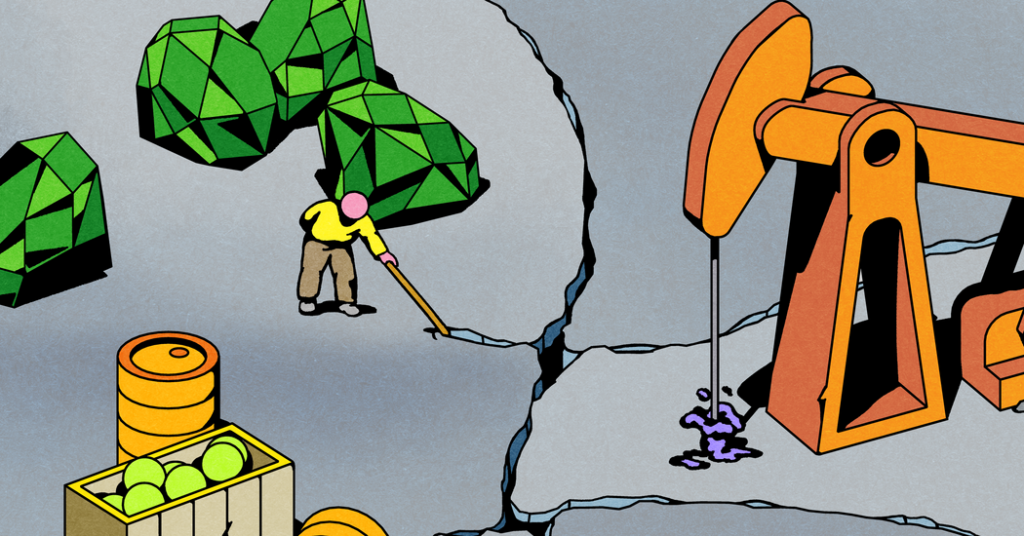
I do think the competition for, and control of, energy resources is central to global politics. A great deal of the geopolitical history of the 20th century can be explained in these terms, and I don’t think the 21st century is playing out any differently structurally, albeit the outcomes are thus far very different. It’s not possible to understand the kind of geopolitical power the United States is today without seeing how its shale boom transformed its energy position.
What did the U.S. shale boom do for U.S. global power?
The United States became rather more assertive in Europe from the point in the mid-2010s when U.S. shale gas companies could compete with Gazprom over European gas markets. It became much less willing to tolerate the German-Russian gas relationship, and it proved, at least under Trump, willing to put a lot of pressure on European states to purchase U.S. imports.
The consequence when coupled with Russia’s invasion of Ukraine is that most European countries are much more dependent on the United States for energy than they were a few years ago. That makes strategic autonomy for the European Union and individual European states rather harder than it was when President Emmanuel Macron of France was talking in 2019 about how this should be Europe’s aim.
You are working from the assumption that the world still demands oil resources for economic activity, right? Even as green energy sources are developing across and within countries — in China, within the United States with wind energy in places like Texas. The idea is that demand for oil remains strong, because when demand for electricity rises (as it is doing acutely with the artificial intelligence boom), the need for reliable energy sources also rises.
Yes. Under current policies across the world, the International Energy Agency forecasts oil consumption will still be rising in 2050. Electricity consumption has to increase both to achieve electrification and to power A.I. Even with electric vehicles that reduce oil consumption in the transportation sector, there is some increase in oil consumption on the manufacturing side, because petrochemicals are more important in E.V. cars than internal-combustion-engine cars.
It seems that reality about energy and Europe puts even more pressure on what was billed as a values-based arrangement — the basis, at least an aspirational basis, of the rules-based international order.
Carney offered a vision for a different arrangement of “middle powers.” So is there still a capacity for alliance building, or is it resource competition all the way?
There is space for middle powers to align. Historically, the European Union’s predecessors were created quite knowingly to try to end resource competition between the West European states. It’s no coincidence that the first European association project was the European Coal and Steel Community and that it ended the conflicts between France and Germany over coal that had been central to the territorial hostilities between the two states going back to the Franco-Prussian War.
The problem for Europe in comparison with Canada is that it is oil-poor and so has issues of foreign oil dependency that Canada does not. Whatever the energy issue, the difficulty for any middle power is that in different ways the United States and China dominate, so to get to where he has gone now, Carney has had to do a reversal from his position on China from last year and rebuild ties.
This raises the question of interdependence. You have previously noted that in 2025, President Trump seemed to be rattled by China’s embargo of its rare earths during a trade confrontation. The United States has become an oil exporter — but has a huge pile of debt; China is a manufacturing juggernaut — but depends on foreign oil to drive it; the European economies hold some U.S. debt — but they depend on foreign oil from either the United States or Russia. These vulnerabilities seem to keep a world of nations in a knotty state of tense interdependence. Does this ever settle into a more stable arrangement?
That’s a good question. I think it can. Germany and the Soviet Union/Russia were in a relatively uneventful state of interdependence through the last decade and a half of the Cold War and well into the post-Cold War era. Britain managed a long period of dependency on the Middle East, but it did involve it in a continuing set of geopolitical problems that at times were pretty serious, like the Suez Crisis of 1956.
Is there anything in particular that characterizes periods of peaceful resource interdependence from those involving more overt conflict?
Any situation in which there are multiple great powers that are large-scale energy importers and there is no dominant power able to restrain them can lead to terrible conflict. This is the story of Europe and Japan in the first half of the 20th century.
What we are in part seeing now is that the great power states with export capacity in at least one area — the United States in natural gas and China in rare earths — are willing to use resources as a geopolitical weapon. That is also destabilizing.
Let’s turn to the Western Hemisphere: You wrote in a 2024 article that the eyes of the world would soon turn there. You noted at the time a critical fact: China was South America’s largest trading partner. It took a couple of years, but suddenly (it seems) here we are.
What is the significance of that shift for the United States, China and geopolitics? Any idea who or what is driving them under President Trump and his advisers?
For the United States, the problem at its most simple is this: China’s commercial ascendancy in Latin America is a threat to the Monroe Doctrine, and the United States has not faced such a threat since the European oil companies were trying to operate there in the early 20th century.
This is then complicated by the particular fact of China’s economic presence in Mexico and Canada and the opportunities China has had through these two states’ trading relations with the United States to evade U.S. protectionist moves against China.
I think Trump has internalized the Monroe Doctrine. There are different people in the administration who think about the Western Hemisphere in different terms. I suspect, for instance, that Secretary of State Marco Rubio is thinking less about the resources of the Western Hemisphere than others are, but I suspect there is quite a widespread view in the administration that China needs where at all possible to be pushed out.
President Trump has been applying lots of pressure on the Federal Reserve to lower interest rates. The United States has a staggeringly large national debt. Of course, it is not the only country dealing with debt and deficit issues. How do you see these domestic budget pressures, particularly around debt, in the United States and elsewhere shaping global politics?
The debt issues are serious. In the United States the debt problem connects quite a few things that the Trump administration has tried to do, including imposing more defense costs on Europe. The spectacular failure of Elon Musk’s so-called Department of Government Efficiency shows just how hard dealing with debt by reducing expenditure is. In Europe, it’s another major problem for any attempt at strategic autonomy, particularly for France and Britain, two states where events over the past year or so have again shown how difficult it is to cut expenditure in other areas like the welfare budget or pensions. There was a sense earlier this year that Germany had made a big shift on debt, but that has not materialized as any bigger collective fiscal space for Europe to detach from the United States on security.
Is debt another potential geopolitical weapon?
What’s most significant here is the United States’ ability to provide dollar swaps — complex transactions where cash streams or financial assets are swapped to hedge exposure to risk — through the Fed. The threat that the United States under Trump would withhold dollar swaps — i.e., threaten not to provide them in a crisis — to make demands in other policy areas, including debt itself, was made explicit in Stephen Miran’s Mar-a-Lago Accord paper. We can also see that the Trump administration gave a credit line to President Javier Milei of Argentina during the elections there last autumn. These tactics can be a means by which the United States tries to both discipline and create allies.
What about holders of U.S. debt?
In principle, yes — and if we go back to 2008, then the Chinese and Japanese central banks selling the debt of Fannie Mae and Freddie Mac played an important part in the crash. But if the European states were to sell officially held U.S. debt, they would take substantial risks because withholding dollar swaps in a crisis would cause more damage, and that selling might precipitate such a crisis.
How do you see risk fitting into global politics? In the regulatory environment for financial markets and in terms of the U.S. president’s leadership, there seems to be far more appetite for taking on risk. What part does that play in thinking about global politics?
In one sense there is more risk-taking now because there are only high-risk options, especially geopolitically. That is what the geopolitical rupture creates. What is interesting about Trump as a political phenomenon is that he seems psychologically to thrive on risk-taking and aims to bring about change by the sheer capacity to disrupt, regardless of where the change lands.
Helen Thompson, a professor of political economy at Cambridge, is the author of, most recently, “Disorder: Hard Times in the 21st Century.” John Guida is a Times Opinion editor.
The Times is committed to publishing a diversity of letters to the editor. We’d like to hear what you think about this or any of our articles. Here are some tips. And here’s our email: [email protected].
Follow the New York Times Opinion section on Facebook, Instagram, TikTok, Bluesky, WhatsApp and Threads.
The post This Is Rewriting the International Order as Much as Trump appeared first on New York Times.