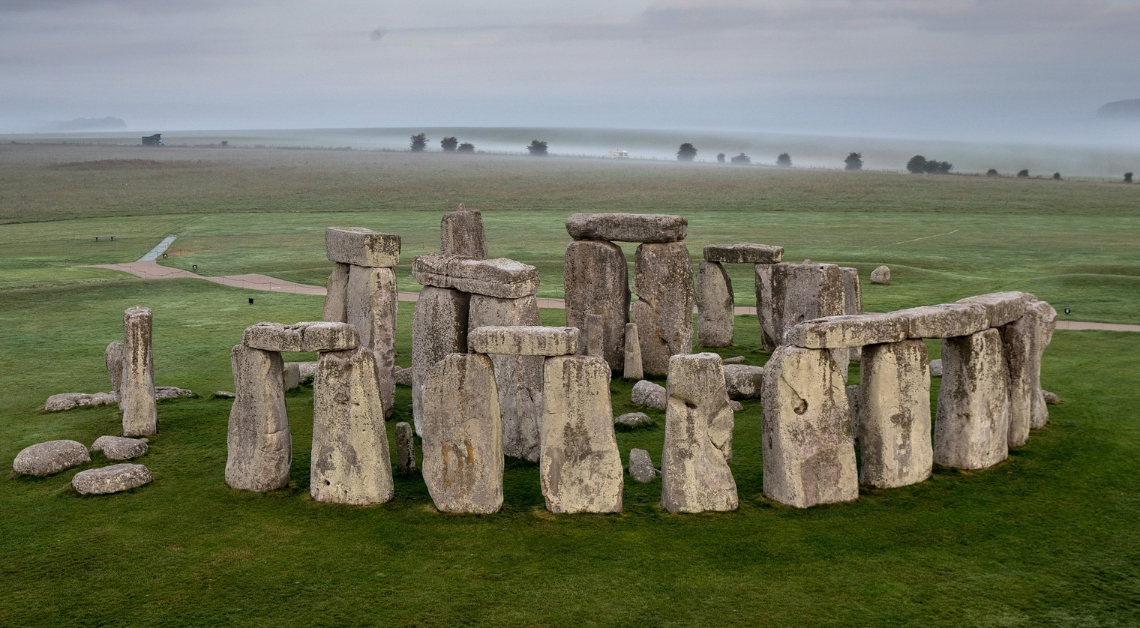
For as much as humanity has obsessively studied Stonehenge, we still don’t know much about it. Like who built it, or why, or how those massive stones ended up in England’s Salisbury Plain in the first place.
All we’ve got are theories. Well, a new study published in Communications Earth & Environment doesn’t add a new one to the list as much as it rules out one of the more popular long-standing theories: glaciers didn’t put them there.
If you weren’t aware, researchers have for years debated whether Stonehenge is bluestones, a.k.a. 2 to 5 ton rocks sourced from Wales, were dragged by humans across land and sea, or whether they were delivered by glaciers during the last Ice Age.
According to new research, glaciers never reached Salisbury Plain during the Pleistocene Epoch. Which, as I recently covered in an article about ancient gigantic kangaroos, ran from about 2.5 million years ago to roughly 11,700 years ago.
No glaciers means no frigid conveyor belt for the stones. That rules out the iceberg theory.
Stonehenge Stones Likely Moved by Humans, Not Glaciers
The research team, led by geologist Anthony Clarke of Curtin University, came to this conclusion by studying river sands near Stonehenge. If glaciers had passed through the area, they would have left behind distinctive mineral markers.
Clarke’s team analyzed tiny grains, including hundreds of zircon crystals, which can be dated and traced to their geological origins. The markers they were looking for weren’t there.
“If glaciers had carried rocks all the way from Scotland or Wales to Stonehenge, they would have left a clear mineral signature on the Salisbury Plain,” Clarke explained. The absence of that signature strongly suggests that humans moved them. This applies to all of Stonehenge’s massive components, including the bluestones.
Just how humans got them there is still a mystery. There are tons of theories out there. Maybe they were hauled over land on logs? Maybe, like Easter Island’s giant statues, they were painstakingly penguin-waddled across the landscape?
Who knows. We may never know. Fortunately, archaeology has a way of answering old questions with new tools, so maybe, in the distant future, some newfangled tech thing-a-ma-jig will be invented that easily answers that question.
Until then, we’ll keep visiting Stonehenge and fantasizing about the myriad ways these monoliths could’ve ended up where they are.
The post Researchers Finally Figured Out How Stonehenge Happened. Well, Maybe. appeared first on VICE.