BRUSSELS — In the latest display of major economies pursuing blockbuster free trade deals against the backdrop of President Donald Trump’s tariff threats, the European Union and India announced a sweeping trade accord on Tuesday.
The agreement, driven by a search for new partnerships to shield their markets from a volatile America, will deepen ties between the 27-nation E.U. — a trading power that is traditionally Washington’s closest partner — and India, among the world’s fastest-growing major economies.
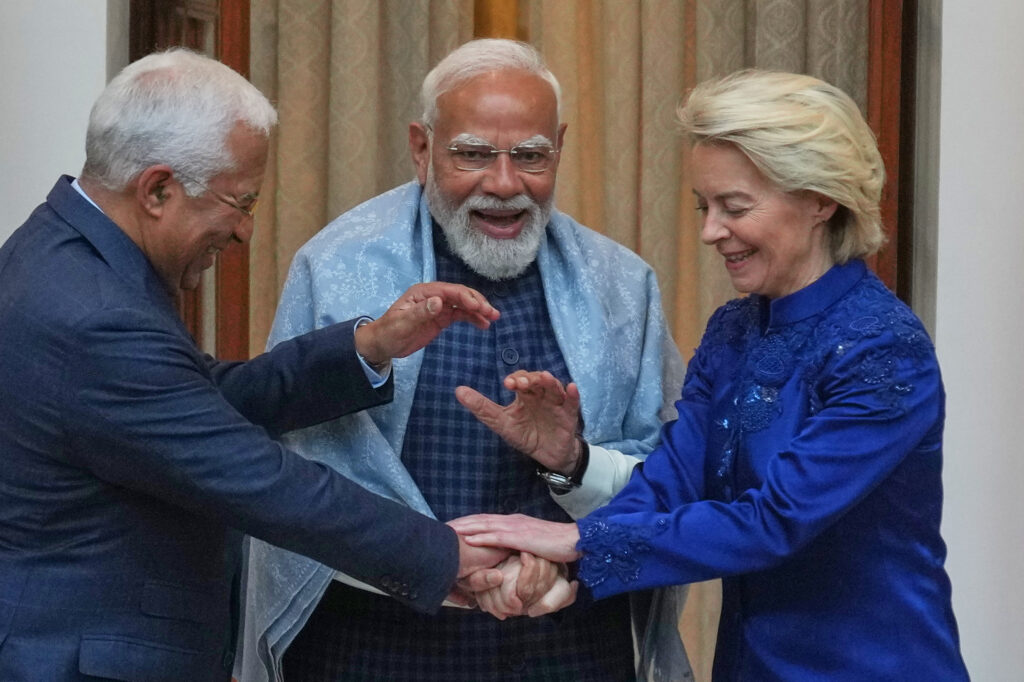
“We have concluded the mother of all deals,” European Commission President Ursula von der Leyen said. “We have created a free-trade zone of 2 billion people, with both sides set to benefit. This is only the beginning.”
E.U. and Indian officials said they concluded nearly two decades of negotiations after von der Leyen, the head of the E.U.’s executive branch, and European Council President António Costa, who presides over meetings of the E.U.’s 27 heads of state and government, traveled to New Delhi on Monday. They joined Indian Prime Minister Narendra Modi for a military parade on Republic Day, which celebrates the Indian constitution.
The agreement could double the total value of E.U. exports to India over the next six years, reducing Indian tariffs on European goods such as cars and pharmaceuticals, and European tariffs on Indian goods including chemicals and textiles, officials said. The agreement still requires broader legal and political approval in the E.U. and India.
As Trump upends U.S. alliances and global trade, Europe and India each found themselves staring down the barrel of the president’s tariff threats over the past year.
For European leaders, the Trump administration’s open disdain for the E.U. and looming shift from guaranteeing European security have spurred a push to “de-risk” from the United States — an approach the E.U. once reserved for its ties with China.
The giant deal trade deal between Europe and India reflects the ethos espoused by Canadian Prime Minister Mark Carney in a widely circulated speech at the World Economic Forum in Davos last week. Carney said that America’s smaller allies can no longer promote the pretense of a rules-based order to reap the benefits of being under the U.S. umbrella.
Carney, whose country has also been buffeted by U.S. tariffs and annexation threats, urged “middle powers” to chart their own course and come together where they have shared values or interests. Canada recently announced efforts to improve trade ties with China, only for Trump to react furiously and threaten 100 percent tariffs on Canadian goods if Ottawa pursues a free trade accord with Beijing. Carney said no such accord is envisioned.
Throughout Trump’s tariff blitz, European leaders have sought to convey that they can help maintain open global markets, with or without an increasingly protectionist United States.
The bloc has raced to ink trade deals or intensify negotiations around the world, including with Indonesia and South America. America’s rattled allies from Europe to Canada are closing ranks on trade, defense and other partnerships as Washington withdraws from coordination on climate, health and international aid.
After a whirlwind week of transatlantic tensions — in which Trump threatened and then suspended tariffs on European nations in his bid for Greenland — the E.U. has pushed for a win on the global stage, eyeing the long-elusive trade deal with India.
Europe is not alone in looking for new friends and hedging its bets. Indian and U.S. relations are at their lowest point in decades, strained by New Delhi’s decision to publicly reject Trump’s claim that he brokered a ceasefire between India and Pakistan in May.
India was among the first countries to begin negotiating a trade deal with the Trump administration after the president’s slew of tariffs on dozens of nations last year, but the two sides have not been able to clinch an agreement.
Washington has slapped some of the steepest tariff rates against India, pushing India to thaw tensions with China and double down on vows of strategic autonomy. India has signed trade agreements in the past year with Britain, New Zealand and Oman.
Modi on Tuesday described the deal with the E.U. as the largest free trade agreement in India’s history, which he said would help the country’s farmers, small industries and services sector reach the European market.
The deal comes as India’s economy continues to grow, but with sluggish manufacturing, weak consumption and inadequate job creation. For New Delhi, it represents a way to widen markets and attract investment in the hopes of reenergizing the domestic economy.
“This is not just a trade agreement,” Modi said. “This is a blueprint for a shared prosperity.”
E.U. officials said India, which has one of the most protected domestic car industries, would reduce or cut tariffs on more than 90 percent of European exported goods, and lower tariffs on up to 250,000 cars coming from the bloc.
European carmakers especially in Germany, hit by U.S. tariffs and tough Chinese competition, have welcomed the prospect of access to a new market. The deal also promises to boost trade in financial services, maritime transport and professional services.
While the two sides for years have laid the groundwork for expanding ties, some analysts said that the recent policies of the world’s mightier powers created impetus for the agreement.
“This would not have happened without the massive geopolitical churn unleashed by the US, China, Russia — in a time of need, both sides have moved beyond mere commitments and have become friends in deed,” wrote Constantino Xavier, a senior fellow at the Center for Social and Economic Progress, a policy institute based in New Delhi.
One of the most difficult chasms between India and the E.U. has been India’s long-standing ties with Russia. India has avoided condemning Russia’s 2022 invasion of Ukraine and its almost four-year war in the country.
“Europe has to grow out of the mindset that Europe’s problems are the world’s problems, but the world’s problems are not Europe’s problems,” Indian External Affairs Minister S. Jaishankar said in Slovakia in June 2022, months after Russia invaded Ukraine.
The stance sits uneasily with European leaders who have become Kyiv’s chief military backers and are in an intensifying confrontation with Russia. The E.U. has imposed many rounds of sanctions against the Kremlin including its oil and energy sector. In an attempt to hit Russian coffers harder, the bloc more recently has targeted entities in third countries, such as India and China, which have continued purchasing Russian oil throughout the war.
Recently, Trump slapped additional tariffs on India for its dependence on Russian crude oil, forcing the country to diversify. The country’s legacy military equipment remains heavily Russian-made.
The E.U. previously was one of the more vocal critics of human rights concerns in India, but has quieted as Europe and India frame themselves as democratic leaders and seek to deepen a strategic partnership. Indian voices have increasingly criticized the E.U.’s much-touted promise of upholding democratic values as hypocritical.
Unlike India, the E.U. signed a trade deal with Trump last year. The hope for stability collapsed, however, when Trump threatened fresh tariffs this month on eight European nations that rebuffed his bid for the U.S. to control Greenland, an autonomous territory of NATO ally Denmark. Trump has since reversed course, but that has done little to assuage E.U. concerns about the risk of dependency.
E.U. leaders signed a free-trade deal with the South American trading bloc Mercosur this month. The European Parliament has since referred the Mercosur deal to the E.U. Court of Justice amid objections from farmers, which could stall its implementation for many months and undermine the E.U.’s claims of a geopolitical victory. E.U. leaders have suggested provisional implementation of the Mercosur trade deal could move ahead regardless.
Mehrotra reported from New Delhi. Beatriz Ríos in Brussels contributed to this report.
The post Facing U.S. turmoil, Europe and India announce blockbuster trade deal appeared first on Washington Post.